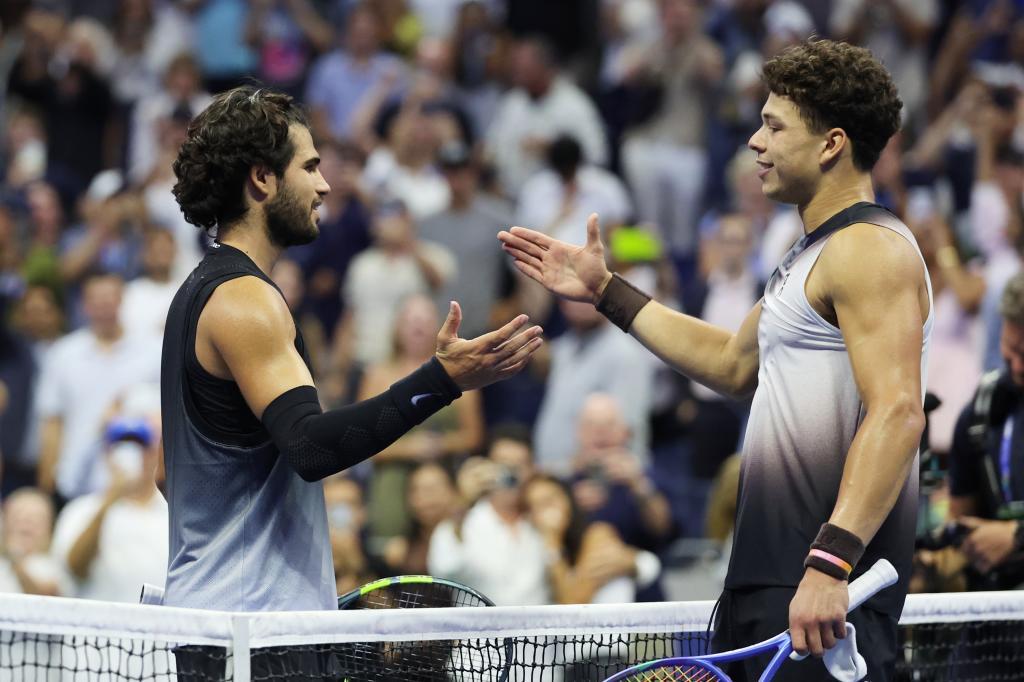
Until he could no longer. As he had done so many times, Carlos Alcaraz refused to lose. He fought against Ben Shelton, against his own anxiety, against fatigue, against vomiting, and against an insane schedule. But this time there was no miracle. He was eliminated in the quarterfinals of the US Open, in the super tie-break, by 6-7(5), 6-1, 6-3, 1-6, and 7-6(7).
At 3:37 in the morning in New York, a battle of four hours and 27 minutes of confidence and anguish, of fullness and vomiting, of all possible emotions, came to an end. A defeat to remember. After four months of inactivity, Alcaraz had made it there. Winning would have already been a miracle. Winning like this, in five sets, after that succession of blows, collapses, and resurrections, would be superhuman.
With a smile, he left Arthur Ashe court, aware of what he had just done. He will watch the match again and blame himself for that mistake and that other one, but he will surely also feel proud. It was him. The Alcaraz of the 2023 Wimbledon final against Novak Djokovic, the Alcaraz of the 2025 Roland Garros final against Jannik Sinner, the Alcaraz of this year's Australian Open semifinals against Alexander Zverev. He fought and fought until victory was no longer possible.
Too many things had happened and too much time had passed. Hours earlier, everything seemed simpler. Because until the first set was decided, just after the first hour, Alcaraz maintained control of the game and everything pointed to a quick outcome. In three sets, an easy thing. Shelton is the epitome of the American tennis player because his serve is dizzying - reaching 239 km/h - and his forehand punishes, but he struggles when rallies exceed five shots.
At the start, Alcaraz benefited from his lack of touch and control, trapped him on the backhand, moved him from side to side, and dominated him. If he resorted to the tie-break, it was due to an unnecessary break by Shelton, but it seemed like an accident. It was later revealed that it was not.
At the beginning of the second set, the match changed. "I can't afford to make mistakes, I can't, I can't," Alcaraz said to himself, and anxiety overcame him. A blackout. Shelton's pressure with the serve and some glaring errors - a missed easy shot, for example - started to twist his spirit, leading to one mistake after another, and for many minutes, he abandoned his game.
Already affected by certain physical problems, he lost strength, confidence in his forehand, and accuracy with the serve, eventually giving away two breaks with double faults. The match that seemed under control had completely slipped from his hands. And just as it disappeared, it returned.
In the early stages of the fourth set, he nailed an impossible volley, laughed at himself, and something changed. He regained composure, and with it, his tennis returned. Despite the fatigue - he even vomited during one of the breaks - his legs revived, and the forehand obeyed once again. Shelton also lost some speed on his serve. Alcaraz sensed it, pounced on him, and took the match to the fifth set.
At that point, well into the early morning, it was all about faith. "Accept the problems," his coach, Samu López, told him before facing the abyss. It was a survival exercise, playing with just enough strength and squeezing out every last drop of remaining energy. Alcaraz then showed his best serving and escaped defeat when he had to, saving three break points at 4-3.
But there was one last territory, the coin toss. The super tie-break. And there Shelton's serve became too powerful a weapon once again. Alcaraz fought until the last point, refused to give up the match prematurely, but this time he couldn't find a way out. The American closed the early morning. Alcaraz, four months after his last match, fell standing, smiling, proud. He held on until he could no longer.