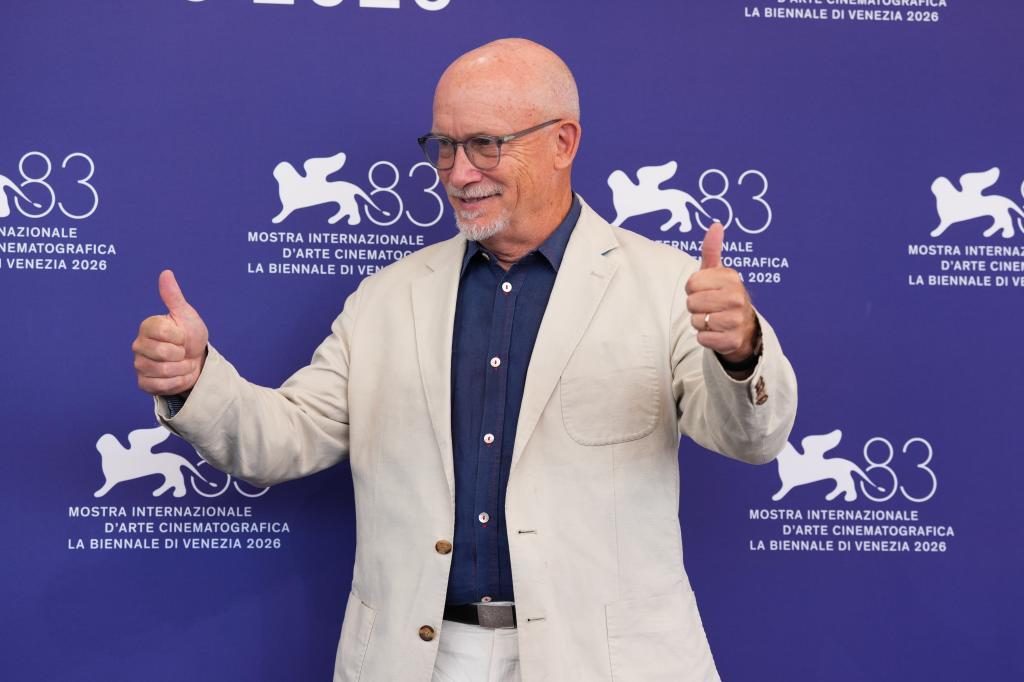
"The most surprising thing about this whole story is that it is not a new story. If you allow me, it is simply the same old wine in new wineskins." The statement is from the director of Musk, the documentary by Alex Gibney that exploded directly on Tuesday in Venice. The declaration, in its own way, perfectly accompanies the devastating course of a film that, during its three hours and 45 minutes, leaves no prisoners or wounded. When one ventures into what promises to be the film of one of the most well-known, influential, and, once everything is seen, "most dangerous to current democracy" men (comment by Gibney himself again), one expects to come across surprising revelations or hidden keys that help understand the character and nurture our most intimate and shared defenselessness. There are novelties, but the relevant aspect is the whole. What the director achieves is a panoramic view --essentially tragic without renouncing hilariously funny moments-- from which one can see, indeed, the world we tread.
In truth, there is no new news. The richest man in the world who was once an electric car entrepreneur then the man of the stars, progressive environmental hero before becoming an ultraconservative titan, later an Iron Man emulating figure, in between a Twitter destroyer and the Department of Governmental Efficiency (DOGE) in the United States, and along the way a father of an unclear number of children who has managed to blur his life with myth to offer himself for better or for worse, for the most devoted admiration or the most vehement hatred, as a kind of contemporary Nietzschean superman.
What Gibney does is organize much of what is known and give the appropriate meaning to much of what has been forgotten in a meticulous study not so much of the banality of evil but, quite the opposite, the evil of such a banal guy. Thus, it is revealed, perhaps most surprisingly of all, that the Tesla Autopilot driver assistance system from 2015 was responsible for at least 60 deaths that were duly silenced. Not far away, we learn that the way he dealt precisely with Tesla, with the removal of co-founder Martin Eberhard in 2003, closely resembles his first scandal as a magnate on his particular ego trip to the top of the world. And all this, while the film follows a completely ideology-free evolution from his flirtations with Obama, his subsequent enviable relationship with Joe Biden, to reaching the Oval Office with Trump.
"In truth, what has always been read as a revelation after feeling poisoned by the woke virus is much simpler to explain. On the one hand, he has always followed the money, essentially Government money. But on the other hand, his approach to the MAGA world was simply because his companies were facing a huge amount of federal investigations. Tesla was under criminal investigation. There were serious possibilities that if Kamala Harris won, he would have problems," Gibney comments. In the documentary, he is heard joking on Tucker Carlson's show about whether he would be allowed to see his children if he ends up in jail. And another fact: the first state agencies that disappeared when he took over DOGE were, conveniently, those that already had some complaints against his companies.
In a generic way, what the documentary does with an excessive and rigorous accumulation of data, archive images, and statements from former collaborators who dare to speak ("There is a terrible fear among all who have worked with him," comments Gibney) is to unveil a mechanism that repeats itself over and over. Selling a future project as if it were real, which, over time, would be revealed as unattainable or simply a lie. Like when he presented the battery change in his cars as a novelty as if they were simple household batteries. The battery in question weighed 450 kilos and there was no way to move it. "His great power is speaking confidently about each of his ideas and presenting them as facts. That is his genius, if such a thing can be called genius. He is not an inventor, he is an investor. His genius is inflating stocks," Gibney adds as a simple and direct summary of what his film teaches.
Another of the most striking (and even controversial) chapters has to do with his obsession with demographic decline and, hand in hand, multiple paternity. The film, which includes a revealing interview with his ex-wife Ashley St. Clair (who was at the film's presentation in Venice), details how Musk selected young women he deemed suitable for reproduction and impregnated them to then, after a confidentiality agreement, abandon them to their fate.
The film uses AI to create a fake Musk, but which, according to Musk's own dictate, seems more real than reality itself, more Musk than Musk himself. A digitally created character answers the questions generated, seemingly autonomously, by the film itself. He responds according to his own AI algorithm compiling all the character's statements over the years. It is not what one would call an orthodox system, but it is original and fun enough to once again demonstrate that the director of films about figures like Elizabeth Holmes, Lance Armstrong, or Mikhail Khodorkovsky remains the best surgeon (not just a notary) of the digital turbocapitalism that assists us.
"Musk's greatest skill is convincing his interlocutors that something is real and unreal at the same time," Gibney concludes. And he adds: "What is not unreal is that he is a proven threat to democracy."