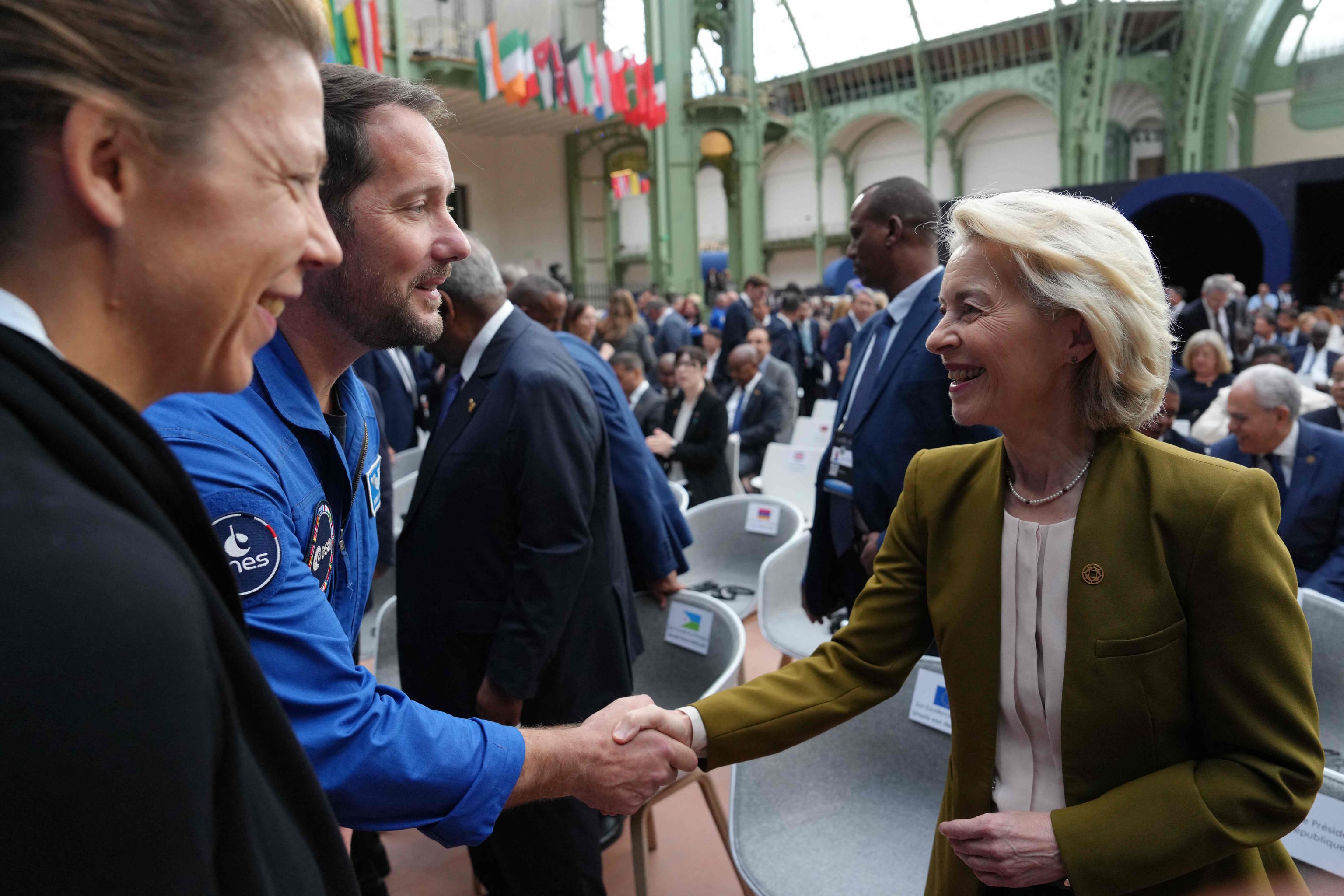
"Europe needs to do something big in space!" asserts Commander Thomas Pesquet, the European astronaut with the most accumulated time in orbit, stealing the spotlight from Emmanuel Macron at the recent Space Summit at the Grand Palais in Paris. At 48 years old, Pesquet announced his third mission to the International Space Station (ISS) next year, emphasizing that he will do it "on loan" and thanks to the Americans, aboard SpaceX's Dragon spacecraft, propelled by the Falcon 9 rocket (also from SpaceX) and on a mission sponsored by the private company Vast, based in Long Beach, California.
"Americans love NASA for achieving the unthinkable, which was putting a man on the Moon," recalls Pesquet in statements to El Mundo. "Europeans need to reach the Moon by our own means. We have to do something that captures the imagination and has a lasting effect. We also need to speak to people in their own language about how important space is for life on Earth. And we have to change the dynamics, as NASA did, no longer directly funding missions but turning to the private sector and asking, 'Who can do it better?'"
With feet on the ground, the United States invests between five and six times more than Europe in the space sector. In public money, the difference is 220 euros per citizen in the U.S., compared to 15 euros in the EU. Military programs account for 46% of public spending in space, compared to 25% in France, for example. The leading country in Europe has 546 private aerospace companies, compared to the 5,600 registered in the United States, a difference of one to ten.
The key to space still lies in Washington, explaining the pressures from the White House, which sent a clear message to American companies through the Office of Science and Technology Policy: their presence at Macron's space summit would be seen as endorsing European policies rejected by Donald Trump. SpaceX (Elon Musk) and Blue Origin (Jeff Bezos) complied and decided to withdraw, as did the startups Stoke Space and Starcloud. The American snub was joined by the absence of Chancellor Friedrich Merz, fueling speculation about internal rivalry between France and Germany in space and defense.
Paris advocates above all for "European priority," while Berlin calls for some independence and is more open to collaborating with American suppliers. The launch this week of the rocket from the German company Isar Aerospace from the Norwegian spaceport of Andøya (as an alternative to Kourou in French Guiana) also had its symbolic weight. Nevertheless, there was a strong German presence at the Grand Palais summit, which managed to bring together 90 countries and concluded with relative economic success (50 contracts valued at 22 billion euros).
The highlight was the presentation of the IRIS program (Infrastructure for Resilience, Interconnectivity, and Security), with which the European Space Agency (ESA) aims to follow the path set by Galileo and Copernicus, ESA's flagship programs. IRIS will consist of a "constellation" of 348 satellites (330 in low Earth orbit and 18 in medium Earth orbit) and will be fully operational between 2029 and 2030.
"In Europe, the value of space is underestimated, and the increasing impact it has on our daily lives," certifies the Austrian Josef Aschbacher from the ESA headquarters across the Seine River. "The U.S. President has proposed a thousand launches by 2030, Elon Musk has announced the creation of the largest spaceport in Louisiana... We are in the midst of the ignition of the second space age, and it is time to ask ourselves: What does all this mean for Europe? Where do we stand in this context? Are we well positioned, or do we need to change something?"
"Europe must take a leap forward in space," asserts the ESA Director-General, with an annual budget of 8.26 billion euros and branches in its 23 member countries, including Spain (where the headquarters of its scientific operations center, ESAC, is located). "We are well positioned in terms of quality, despite the fact that investments are much smaller than in the United States. In some fields, we are even leading, such as in Earth observation, thanks to the Copernicus program. But we must enhance launches, having overcome the crisis of being without our own launcher for a year until the Ariane 6 was ready. And we have to go further in the exploration chapter."
"Do we want to have our European manned missions, with our own production, management, and control chain?" is the question posed by Josef Aschbacher. "The issue is on the table of the Member States... The key for Europe is to have something to offer while boosting investments and increasing scale. The space summit has been a great opportunity to create that momentum and promote a long-term vision of Europe in a rapidly changing world." The ESA plays a central role in providing Europe with the capabilities, technology, and confidence needed to achieve its own ambitions.
"What Europe needs at this crucial moment for the space sector is a shared sense of ambition and direction," warns Hervé Derrey, CEO of Thales Alenia Space and spokesperson for GIFAS, the French aerospace industry association. In a statement also signed by the German association BDLI and the Italian AIAD, the private sector demands the recognition of space as "critical infrastructure," the introduction of "European preference," and the allocation of at least 60 billion euros to boost the sector through the European Competitiveness Fund.
"We are urging politicians to drive Europe's entry into the new space age," says Derrey, with an eye on the negotiation of the EU's multiannual financial framework in December. "We need a strong commitment to scale up the aerospace industry and be competitive in a key sector for the continent's strategic autonomy and increasing competitiveness."