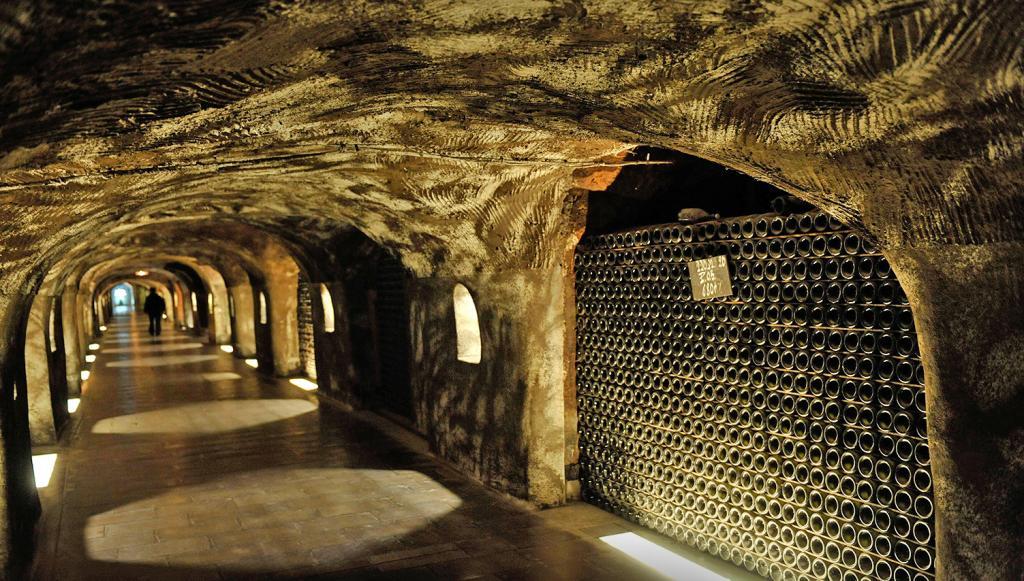
He was a great connaisseur of champagne and a lover of Moët & Chandon. Napoleon Bonaparte also visited the French maison in the city of Épernay on several occasions. Today, the dark tunnels and underground cellars where the French house founded in 1743 hides its effervescent power are named the Imperial Galleries in his honor. It is an astonishing labyrinth: 28 kilometers excavated by hand and filled with bottles where the world's best-selling champagne ferments, or in other words, the M of LVMH, the luxury conglomerate of Bernard Arnault.
To reach the Champagne capital (with Reims' permission), two and a half hours from Paris, you have to cross an endless horizon of vineyards. It's easy to forget that the only authentic champagne is cultivated and produced in this French region. Not only is the production unique, subject to rigorous rules, but also the beautiful and peaceful landscape that has been a UNESCO World Heritage Site since 2015. Amidst all the chardonnay, we find more than one iconic place that often appears in photos.
Loge Montaigu is one of them. This traditional vineyard house where farmers have rested and stored their tools for generations stands like a temple dedicated to Bacchus in the middle of Moët & Chandon's most historic plot. It is from here that the grapes come that will be used for the production of the cuvée Collection Impériale, the crème de la crème, as those who do not understand much would say, or a "multi-vintage blend of high oenology," as those who do.
A historic harvest
The one who knows the terroir best is Jeanne Carlier, the technical manager of viticulture at the house. "It is the combination of chardonnay and chalky soil that provides very mineral wines, with finesse and significant freshness," she reveals. But this has not been a normal year. On the contrary. "The 2026 harvest has broken all records," Carlier explained last week in the vineyard, detailing the climatic frenzy of the past months, including several episodes of frost, droughts, and four heatwaves —of which we all bear witness— that have put the vines in very difficult situations. "In warm years, between the flowering period and the harvest, we usually count an average of 85 days. This year it was 75." This means they had to start harvesting on August 14, "the earliest date in history for the house." In 12 days, thanks to a small army of 3,700 workers urgently called to duty, the entire harvest had been collected. Never before had the harvest finished in this corner of Champagne before the end of August.
From the Loge Montaigu, you can see two more emblems of the maison. One is the modern glass vinification center that receives the musts to analyze their quality. With its 1,400 hectares of vineyards and the grapes purchased from over 2,000 winegrowers, the house benefits from all the diversity of terroirs offered by the region. In this winery, this mosaic is organized to determine and group the musts with similar potential and, even more challenging, to discover how to maintain the Moët champagne style with each new harvest.
The other is the Château de Saran, one of the most exclusive private castles in France. Built in 1801 by Jean-Rémy Moët, grandson of the founder, this mansion among vineyards hosts the most renowned parties of the maison. It's not easy to be invited unless you are Roger Federer, Jay-Z, or Jessica Chastain... But there's no need to worry. Back in the center of Épernay, the former underground cellar has a wine bar for all those who want to toast. Cheers.