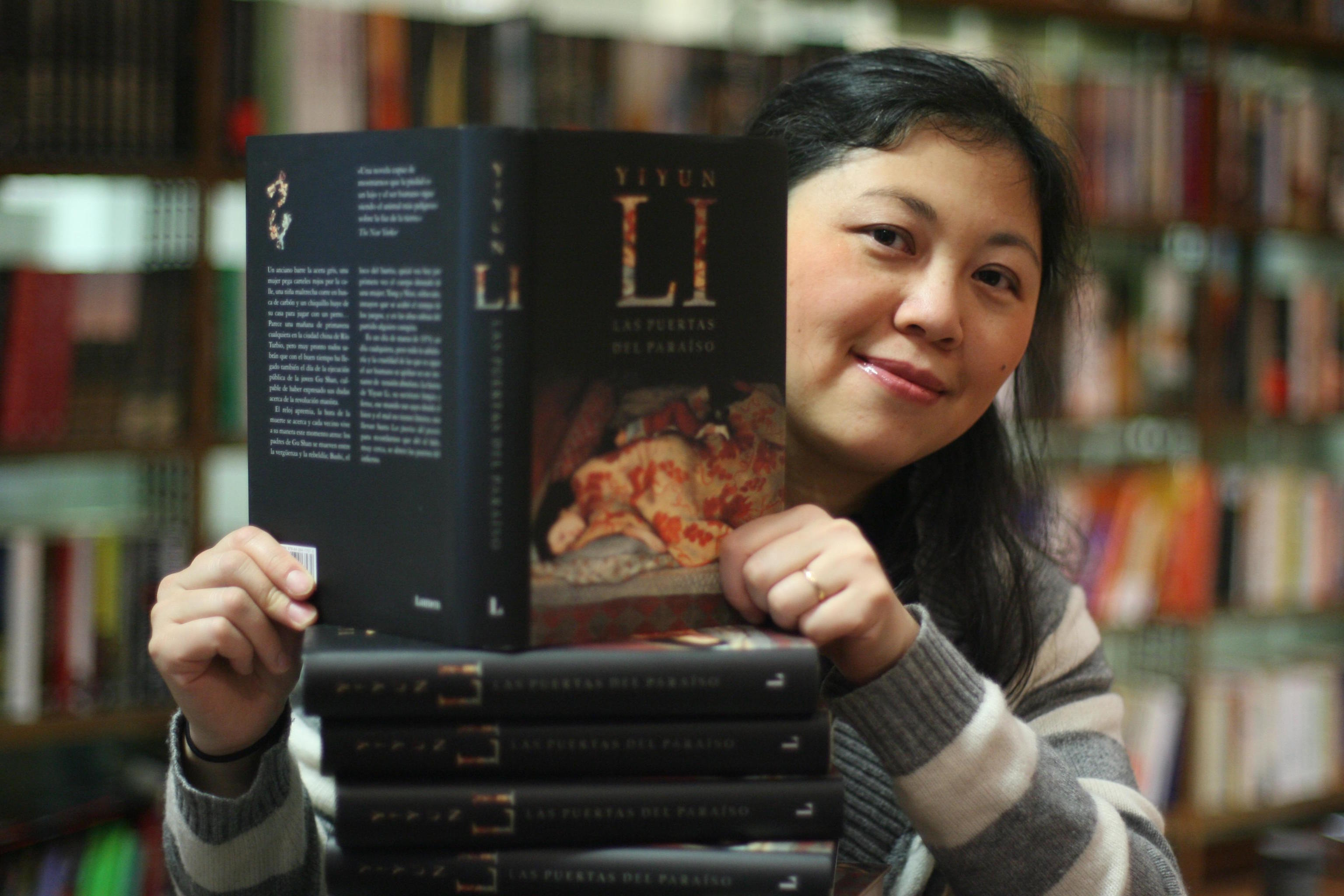
"Dear Mother". Two words found at random in an old English novel made her son's voice return to Yiyun Li. "It had been two months since Vincent's death [who committed suicide at 16 in 2017], who used to call me 'dear mother,' a somewhat old-fashioned expression, more typical of British English than American, when he wanted to get my attention," she recalls. Li was reading, and those two words did something that no deliberately summoned memory could have achieved. "Encountering that expression made Vincent's voice return to me," she explains.
She then wrote a text that began with "Mother dear" and that would end up becoming the first chapter of Beyond the Reasons, an impossible conversation between a mother and her deceased son, originally published in 2019 and has just arrived in Spain through Chai Editora. "Once I had that chapter, I knew what structure the work would adopt; I believe it was that structure that made writing the book possible," she explains.
It is a scene that contains much of the writer's literature: the chance of a word, memory activated through language, the need to approach someone who remains out of reach. In Beyond the Reasons, the mother does not investigate Nikolai's suicide or try to find an explanation that could close the story. She talks to him, remembers, argues, constructs a territory that is not a dream or a territory of gods or spirits, but "a world made of words and nothing but words".
For Li, that could also be a definition of literature: "It is precisely what attracts me to it, both reading it and writing it. Literature is a world made of words, but those words, when they are the right words, provide us with the texture of life, memory, time, and everything that we may overlook due to the hustle and bustle of daily life."
Perhaps that idea has something to do with the writer's scientific background. Born in Beijing in 1972, Li studied Cellular Biology at Peking University and arrived in the United States in 1996 to study Immunology in Iowa. There she began writing in English on her own and eventually abandoned the scientific career she had envisioned, but she does not believe she has abandoned that way of looking at the world. "My scientific background is essential to my writing. In a sense, I have never left behind my scientific mind; I have simply put it at the service of another type of exploration," she explains. Observing, distinguishing, distrusting premature conclusions: her literature seems to have changed its object without entirely abandoning the method.
The decisive moment when Li embraced literature actually came in a much less solemn way. "I had perhaps been in the United States for about a year when I entered a bookstore, opened a book, and found a scene starring three young women, roommates, shaving their legs in the bathroom while talking about makeup and men," she recalls. "It was a lively dialogue, but it seemed to me to have little content, it seemed to come straight out of Sex and the City." Her reaction was almost insolent: "I thought, 'I'm sure I could do better than that published author.' And then I knew I wanted to dedicate myself to writing," she says with a laugh.
English occupies a much more complex place in her career than just a simple tool; Li describes it as an experience of freedom. "Changing languages was like finally arriving at a place where all the decisions of my life could be made by me, instead of by others on my behalf," she shares. However, the word "identity" does not serve to explain that shift. "It is a word I have never used in my writing or in my thinking, always misused and overused."
In this sense, she never defines herself as a Chinese-American writer, even though that was for years one of the categories through which her work was read. "Those are labels that others put, I have never considered myself a Chinese-American writer, nor a female writer, nor any kind of writer that needs a descriptive word in front," she asserts. She does not feel like a foreigner, but not necessarily from her current home either; she prefers to occupy a position outside classifications. "I feel like an outsider, an exception, an outlier, that is the place I prefer to occupy. When one is in that position, one can observe without distractions."
In Spain, however, her editorial journey has been much more irregular. The Vagrants arrived at Lumen in 2006 and Kinder Than Solitude at Galaxia Gutenberg in 2013, but then her presence in bookstores began to fade. The commitment to her most recent work by Chai Editora, which has published Dear Friend, from My Life I Write to You in Your Life, Where Reasons End, and now, Beyond the Reasons, has coincided with a new critical attention that has attracted several thousand readers.
Also with her increased international recognition, as Where Reasons End has just won the Pulitzer Prize for Memoirs, after Wednesday's Child was a finalist for the Pulitzer Prize for Fiction in 2024. It was in February of that year when James, her second son, 19 years old, threw himself in front of a train in Princeton, where Li has been directing the Creative Writing Program since 2022. This new book stems from the deaths of her two sons, Vincent and James, but its theme is not solely about mourning. Li also addresses time, memory, facts, and the possibility of continuing to live when reality does not allow for correction. At this point, the second book establishes a movement opposite to that of Beyond the Reasons: if then time had to stop for the conversation to exist, now nature continues to grow, seasons pass, and the world moves forward.
"My relationship with time has been different with each of the two losses", explains the writer in a restrained yet natural tone. "When Vincent died, I felt that time had stopped, and the book was written in a space where time remained still, not moving forward. I suppose the second time I was less stunned by the impact, I observed more and could perceive in many other ways that time was moving forward and taking us along with it, as is its nature." The difference fits into a phrase of devastating precision: "The first time, my mind stopped in the same place as time; the second time, my mind simply did not refuse to move with it, everything flowed."
Labeled as cold, contrary to sentimentality or easy comfort, Li portrays in her novels a need to preserve something that conventional grief narratives tend to erase: the difference between those who have died. "Vincent and James were different, and each death left me in a different place. The threat of trivializing them does not come so much from my own pain as from how easily others can turn two lives into a single narrative. I loved them, and I still love them, but more important than loving them is understanding and respecting them, and that includes, more than anything else, understanding and respecting their choice to end their lives," asserts the writer, whose endeavor is "to keep them close instead of allowing them to become something generic and, ultimately, statistics."
Perhaps it is there where the deliberately unsentimental hardness of her prose is best understood, which does not seek to push away emotion but to avoid the language that turns it into a recognizable formula and, therefore, less true. "What is grief but a word, a shortcut, a simplification of something much larger than that word? Conventional language does not effectively express authentic feelings. Those words exhaust and irritate me," confesses the writer, recalling advice from her editor at The New Yorker, Cressida Leyshon. "She told me: 'Editing a text is like a medical intervention: as if the content of an essay or a story is under anesthesia while we choose the words.' I always remember her words when writing. If one chooses to protect oneself, one cannot dissect or approach the core of their traumas."
The same demand applies to her way of teaching. Li has been training writers at Princeton for years, but now she teaches more about reading than writing. "Teaching to read is teaching to pay attention, to distrust the initial glance, to go back over what seemed already understood. The core of my approach always consists of telling them: 'Look again; check if you are wrong or if you missed something the first time'." It is, fundamentally, the same principle that governs her books: not considering finished what may still contain something we have not seen.
Throughout her literary production, Li, as she explains, has pursued precise words without ever believing they can exist. There is an extraordinary attention in her writing to minimal differences, to what changes when a verb takes on a different tense, when a word slightly changes meaning, when looking ceases to be the same as seeing. But precision does not stem from confidence that language can explain everything, but from the awareness that there are things that resist any explanation. "The laws of Physics or botanical studies may benefit from explaining things, but minds, destinies, and human experiences are almost always inexplicable," she says. "Explaining means simplifying, and that is precisely what literature should resist. Literature is the place where the inexplicable finds its space."