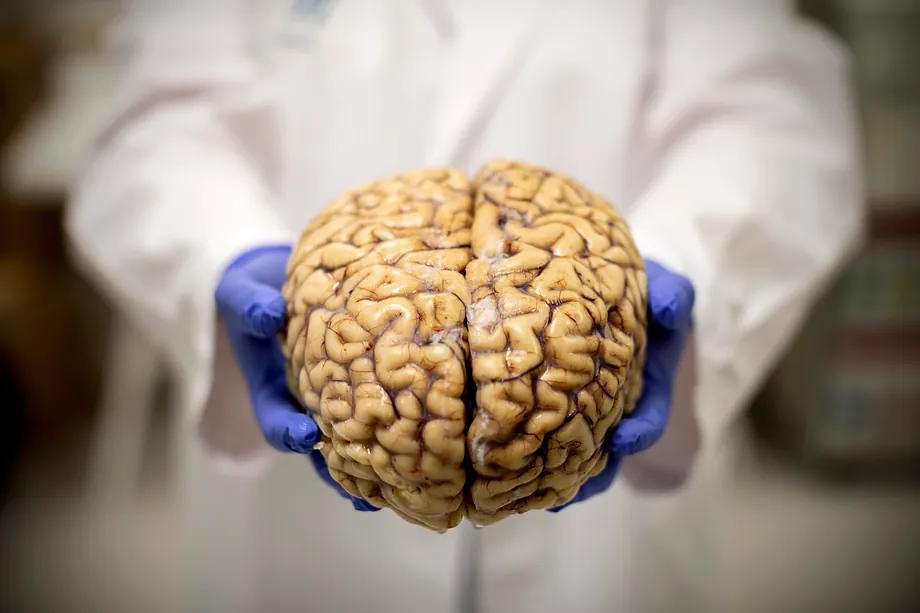
A controversial Alzheimer's surgery that emerged in China is a good example of a medical advancement where the cart is put before the horse, outside the scientific method: it was implemented first, and six years and thousands of patients later, clinical trials have begun in various countries, including Spain (at the Germans Trias i Pujol Hospital in Badalona).
A widely circulated video documents the recovery of an 84-year-old man who became, in September 2020, the first person in the world to undergo a deep cervical lymphatic-venous anastomosis (DCLVA) to treat Alzheimer's disease. Before the surgery, the patient was bedridden and unconscious. After the intervention, the images show a spectacular recovery: the man regains lucidity in a few days and eight months later walks confidently and sings.
The mastermind behind the miracle is plastic surgeon Qingping Xie, who published the procedure in a Chinese journal in 2022. The breakthrough came in 2023 when another surgeon, Wei Chen, from the Cleveland Clinic in Ohio (United States), showcased the video at conferences worldwide. Many patients began to request the operation in China.
Eventually, the authorities in the Asian country felt the need to intervene. On July 8, 2025, the National Health Commission of China formally banned the application of the technique, acknowledging that the procedure had progressed faster than the evidence supporting its effectiveness and safety, leading to Xie's arrest.
The most curious aspect of this story is that, while the inventor remains detained in China and his technique is banned in his own country, it continues to gain supporters worldwide.
Various medical centers in countries like the United States or Singapore believe there is a plausible biological basis behind the technique - which essentially involves draining the brain to clean it of abnormal protein buildup - and have initiated multicenter randomized and controlled clinical trials (with simulated procedures or placebos).
The starting point, as explained by neurologist David Pérez, a member of the Behavior and Dementia Study Group of the Spanish Society of Neurology (SEN), "is very mechanistic" and is based on one of the hypotheses of Alzheimer's disease - "which is not the only one," he points out -: the accumulation of beta-amyloid proteins and, secondarily, tau. Over the years, there is a reduction in the elimination capacity of these proteins, which is carried out by the glymphatic system. Coined in 2012, this term includes the g for glia because the brain does not have a classic lymphatic drainage; instead, it uses cerebrospinal fluid (CSF) as a cleaning medium, driven by glial cells (particularly astrocytes).
"It seems that there is evidence that this glymphatic system extends to the meninges and from there to the deep cervical lymphatic system," Pérez points out. The microsurgical procedure establishes a direct lymphatic-venous anastomosis pathway, reconstructs the lymphatic return pathway, improves the efficiency of cerebrospinal fluid and interstitial fluid drainage, promotes the excretion of beta-amyloid and tau proteins, and restores the altered meningeal lymphatic drainage function in Alzheimer's disease patients.
Spectacular but unconfirmed results
The goal is to alleviate the symptoms of the disease and delay its progression. Currently, there is no solid evidence that this is indeed the case. "The initial cases seemed spectacular," comments the neurologist from SEN. "Cerebral beta-amyloid was reduced, and some patients seemed to improve significantly." However, "subsequently ," he argues.
Earlier this year, the results of a series with over 100 patients were published. Pérez mentions the need to interpret them cautiously because, not being a clinical trial, they cannot be compared with any other therapeutic option. Furthermore, they are not particularly positive: "Patients continue to deteriorate; there is no evidence of stabilization or reversal of the disease." Additionally, in nearly a quarter of the patients, there is no follow-up, leading to the assumption that, probably, "the procedure did not go well, and that's why they did not return to the healthcare facility, as in China they have to pay for both the surgery and subsequent visits." This dropout rate contributes to "inflating the results of the group of patients who are doing well, those who return for follow-up visits."
The medical community, especially neurologists, do not rule out the possibility that this surgery may have some utility and, in fact, are pleased that clinical trials are finally being conducted. "It is possible that the cerebral glymphatic system and the deep cervical lymphatic system are connected, and by facilitating this connection, the elimination of abnormal proteins may be improved in some way," Pérez explains. The question is that from there to achieving an effective symptomatic treatment or going further and "reversing the neurodegenerative process" is a long way off.
The expert finds it "hard to believe" at a time when there are already "tools that eliminate beta-amyloid very effectively - such as new anti-amyloid therapies with antibodies - but the improvement achieved is modest."
What underlies this issue is the complexity of Alzheimer's disease, where the deposition of beta-amyloid and tau plays a significant role in its pathogenesis, but there are also other processes that may be equally relevant, such as neuroinflammation.