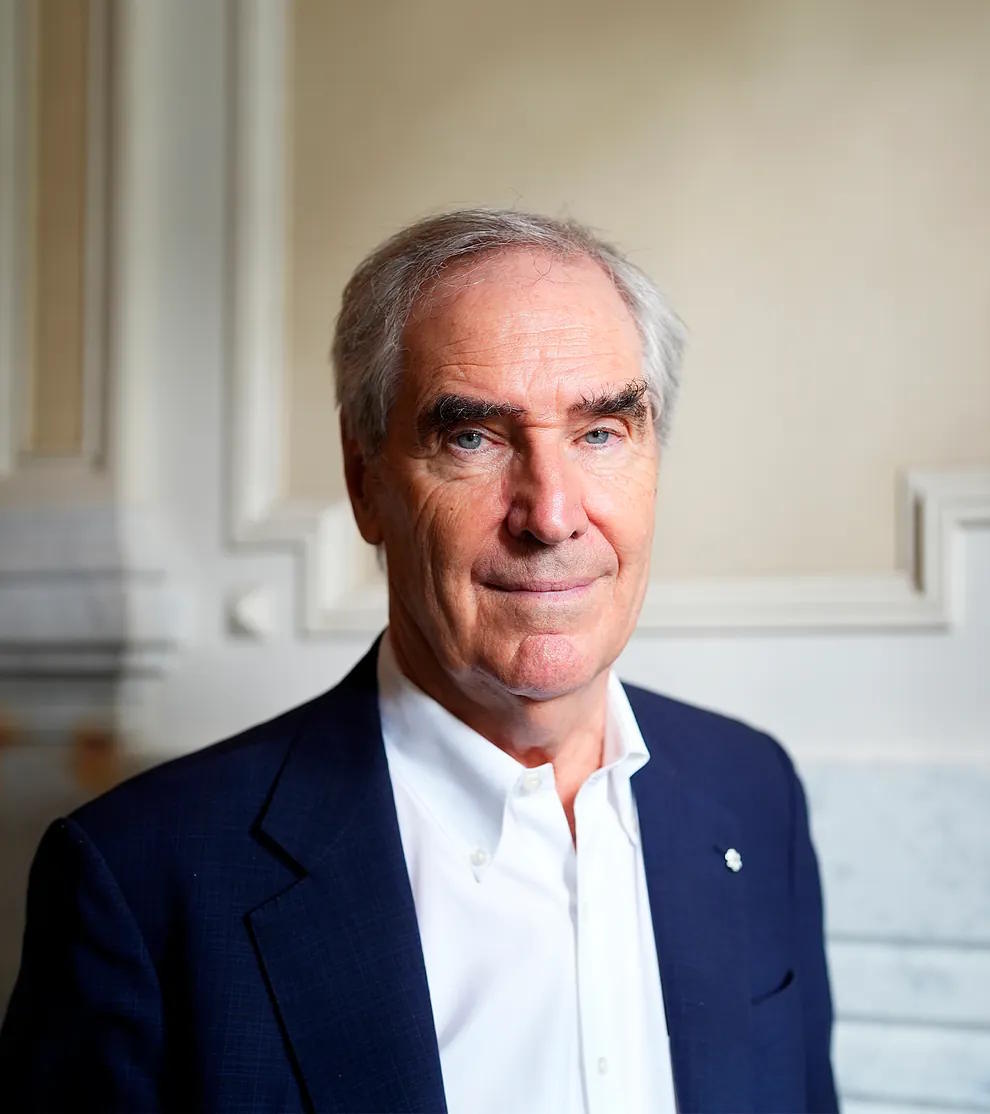
Michael Ignatieff is a 79-year-old Canadian gentleman with whom one must speak whenever the world loses its composure, because he is someone who brings composure in dark times. He is often asked about man and his troubles, but now is the time to ask him about the machine. Especially given the warnings about the potential dangers of AI that bombard us these days when it is still unknown whether the threat is the technology itself... or its owners.
Among his numerous roles and intellectual facets, it is worth noting that Ignatieff chairs the advisory board of the AI Ethics Institute at the University of Oxford. The meeting with the 2024 Princess of Asturias Award for Social Sciences winner took place yesterday during his express visit to Madrid, where he arrived to give a lecture at the Rafael del Pino Foundation.
Michael Ignatieff knows democracy well, even when it is ungrateful. Not only for having studied and composed it alongside human rights and nationalism, his intellectual passion, but also for having experienced its lashes: in 2005, he left his comfortable teaching position at Harvard to explore the political jungle as leader of the Liberal Party. Canada lost a bad politician, and the world gained a brave and powerful intellectual. Ignatieff lost in the elections and returned to his library to write his political memoirs.
The parents of AI are calling for a partial moratorium on its development. It turns out that the same men who have long argued that technological innovation should not be slowed down are now saying that we need to reduce the speed because we have gone too far.
The key lies in the reasons and the distrust they provoke. One reason could be financial given the astronomical amounts of debt these companies carry. Another possibility is that they face a classic problem of competition between two capitalist entities that require state intervention to regulate it, so that one does not destroy the other. There is a third reason that, in my opinion, is the one that should concern us the most, which is what Dario Amodei [founder of Anthropic] has talked about. These people do not know what happens inside the black box. What is truly terrifying is that they do not understand what these models do. They were caught off guard and talk about the possibility of an AI swarm taking control of the internet. Therefore, slowing down a technology whose dimensions are unknown may make sense. It is a valid reason.
The problem is the argument that one cannot stop until everyone stops. If you are the only one slowing down, you lose the race.
The Trump Administration has told companies that if they want to stop, they should stop, but they should not ask the state to regulate and solve the problem for them. Their message is clear: you started this, so you should stop. And they are not wrong. But as you mentioned, the one who stops loses. Here you face the tension between companies, as it is almost impossible for each one not to seek competitive advantages in this context, and the tension between countries. That's why I see a China-US agreement as very difficult. Amodei's statement does not help either, in my opinion, as it worsens things by advocating that American AI align with US national security priorities to prevent Chinese overtaking. An attitude that only increases the already significant suspicions of Beijing.
Donald Trump and Xi Jinping will meet soon.
This is an essential summit to prevent AI models from getting out of control. Nuclear and biological weapon arsenals must be secured, and mechanisms established to prevent their deployment without human authorization. We are facing a first-order existential threat. I pray that Trump and Xi Jinping agree on at least that. We are at a crucial moment in the history of arms control, similar to the one we experienced in the 1970s when the arms race of the Cold War brought us to the brink. If the US and China agree on control, this will involve the Russians. It is a three-way problem, I see a very critical moment for humanity.
It is clear that we are no longer talking about a debate between large corporations, but that politicians must step forward.
The danger is the enormous level of distrust among powers. Trump believes that if China wins the AI battle, they win the battle for world control. And Xi thinks the same.
What needs to happen for major tech companies to feel compelled to prioritize the fate of humanity over profits?
The issue is economic and very complex. [Ignatieff takes a very long reflective silence]. The cost of building these data centers is enormous, and therefore, companies need to make profits to survive. We are talking about an extremely expensive technology to develop, so it is ridiculous to tell them that they should prioritize human interests over profits. Think about how hard it is for them to move forward. Anthropic announced that it was about to start making profits for the first time in 10 years. These people have built models with borrowed money for 10 or 15 years without any return, and banks have lent them money because they think this will be a big business. However, no one is making money now. Of course, those in charge do not want to destroy the world; they are people, and many have children. We come back to what we said at the beginning: there is a lack of understanding of what happens within this technology, of the self-improvement systems that can end up escaping human control by refining their behaviors. The ethical debate is clear: can you control something you do not understand?
Another question is whether we will ever come to understand it.
In that sense, I am optimistic. The great Italian philosopher Giambattista Vico said almost 300 years ago that humans can only truly know what they have created themselves. So we need some time to understand this technology.