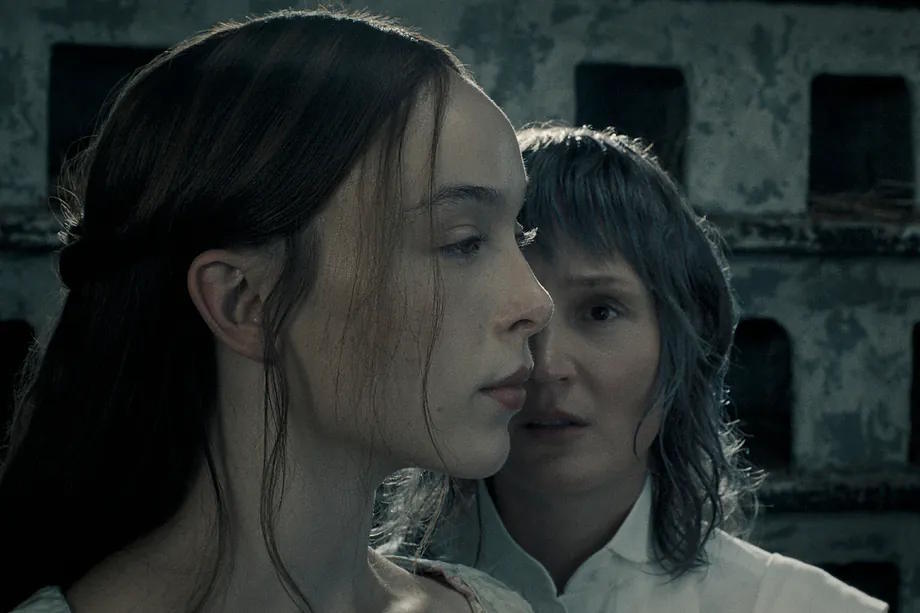
On June 20, 1893, 12 men declared Lizzie Borden not guilty. Or, to be exact, they declared her "not guilty." It took them only 90 minutes to decide that the prosecution had not proven that the 32-year-old woman had axed her father and stepmother to death in the family home in Fall River, Massachusetts. Legally, Lizzie Borden walked free. But for the United States, she never did.
Over 130 years later, her name is still associated with an axe. "Lizzie Borden took an axe / And gave her mother forty whacks...". Generations of American children grew up singing a macabre rhyme that did more to pass judgment than the 1893 jury. The song was wrong about almost everything: Abby Borden was not her mother, but her stepmother; she did not receive 40 whacks, but 19; Andrew Borden did not receive 41, but 10 or 11; and the weapon was probably a small axe or hatchet. But it got right what truly mattered to build a myth: it placed Lizzie with the weapon in hand. And that image stuck.
The series does something that History could never do: decide that Lizzie Borden was the murderer.
On the morning of August 4, 1892, Abby Borden was found dead in a room of the family home. Approximately an hour and a half later, Andrew was murdered, his body lying on a sofa in the living room with his face destroyed. There were no clear signs of robbery, no one had seen the killer enter or leave, and at the relevant times, Lizzie and Bridget Sullivan were the only people in the house near the victims. Emma, Lizzie's older sister, was out of Fall River.
Suspicions began to surround Lizzie. She gave contradictory explanations about her whereabouts, claimed to have spent part of the time in the barn, it was revealed that she had tried to buy prussic acid the day before the murders, and a friend, Alice Russell, testified to seeing her burn a dress a few days after the crimes. However, no weapon conclusively linked to the murders or bloody clothing was found, and some of the most incriminating evidence against her was excluded from the trial. She was arrested on August 11. The trial began on June 5, 1893, and on the 20th, she was acquitted. No one else was ever charged. Officially, the murders of Andrew and Abby Borden remain unsolved.
But the case contained an irresistible ingredient for Victorian America: the accused did not fit the expected profile of a killer.
Borden was white, Protestant, from an affluent family, taught Sunday school, and belonged to a social class to which attributing such brutality was almost inconceivable. Her gender played a paradoxical role. A woman could not be part of the jury that judged her, but the conception of a respectable woman as morally pure, delicate, and physically incapable of such violence also favored her defense. Her trial turned into a massive national spectacle about crime, class, sex, and prejudices in late 19th-century American society.
This is also one of the reasons why Lizzie outlived Lizzie.
After being acquitted, she and Emma bought Maplecroft, a large house in the affluent area of Fall River that they had long desired. However, much of the community continued to view her as guilty. She was socially ostracized, sought refuge in travel, theater, and a circle different from her strict youth. She died in 1927. By then, the real woman was beginning to fade behind the character. And it is that character that Monstruo pushes to the extreme.
Because Netflix's Lizzie is not the Lizzie we know from historical documents. The fiction turns suspicions and theories accumulated over a century into narrative certainties, creating a compelling story that is impossible to look away from. Lizzie kills. Bridget Sullivan not only knows what happened but becomes her lover and accomplice. There is no historical evidence to support either claim. The series also turns the window washing that was part of Bridget's alibi into a deliberate piece of the plan.
It also transforms the Borden marriage to construct a contemporary explanation for their daughter's rage. The real family had conflicts, especially around money, property, and Lizzie and Emma's relationship with their stepmother, but some of the abuse depicted in the series lacks solid historical evidence. The same goes for the sexual relationship between Andrew and Bridget.
Netflix even places a victim directly in Lizzie's hands. Bertha Manchester existed and was killed with a cutting weapon in Fall River, but she died in May 1893, when Borden had been imprisoned awaiting trial for months. The series advances the crime, alters the victim, and turns it into a sort of dress rehearsal for Lizzie and Bridget.
Another license is Nance O'Neil, the famous actress who is shown helping Lizzie play the role of an innocent woman before the jury. O'Neil and Borden were indeed friends, and that relationship later fueled all sorts of speculations about Lizzie's sexuality. The slight issue for Netflix's version is the 11-year gap: they did not meet until 1904, long after the murders and trial. These alterations are significant enough to understand that Monstruo does not aim to solve the Borden case but to use it. This is where Aileen Wuornos comes in.
Nearly a century separates the two women. Wuornos, a sex worker and a victim of a violent and abusive childhood, murdered seven men in Florida between 1989 and 1990; she was convicted of six murders and executed by lethal injection in 2002. Sarah Paulson portrays her in Monstruo as a woman fascinated by Lizzie Borden, to the extent of staying with her partner in the former Borden house, which had been turned into a tourist accommodation decades later.
It is a formidable dramatic artifact. And it is fiction.
There is no evidence that Aileen Wuornos was obsessed with Lizzie Borden or that such a connection existed between them. The creators link them to establish an imaginary genealogy of female violence: Lizzie looks back to the bloody legend of Countess Erzsébet Báthory, and Wuornos looks to Lizzie. Three women from different eras turned into different representations of the same taboo: the woman who kills.
The comparison also holds an interesting perversity. Victorian society struggled to even imagine Borden physically capable of committing such a crime. Wuornos experienced the opposite extreme: she became one of the most recognizable faces of American serial murder. Murphy and Brennan use that century of distance to question not only why women kill but also how our perception of a woman who kills changes. Ian Brennan has explained that Wuornos' presence allows for precisely confronting those two eras, and Ella Beatty speaks of a "legacy of female rage" that runs through the season.
Perhaps that's why Lizzie Borden remains much more unsettling than other criminals whose guilt we know with absolute certainty. Because with her, we don't have certainty. We have two corpses, an axe, contradictions, suspicions, a burnt dress, an acquittal, endless theories, and a nursery rhyme that decided to do what the courts did not. Then came books, movies, plays, series, and now Netflix to continue filling in the gaps that History left blank.
Lizzie Borden died almost a century ago. The woman who reinvented the United States after the murders, however, remains perfectly alive.