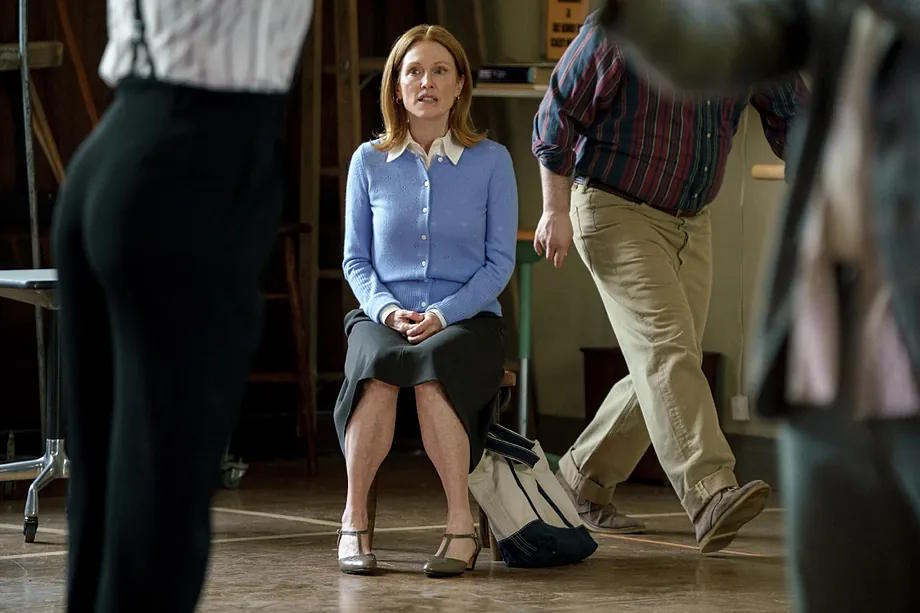
It is not entirely clear what leads us to stand in front of a mirror: whether it is the security, which is also vanity, of being oneself or the desire to escape the fear that being someone else would provoke. The story is well known. Narcissus looked at his image reflected on the water's surface and literally fell in love with himself. It was in this way or, rather the opposite, that what caused his end was the horror of seeing himself turned into another. His reflection confused him as a part, a simple element, of the world.
Let's say that on this mythological paradox moves The Debut, the new film, the third, by Jesse Eisenberg as a director. It is all nothing more than a mirror. It is theater within the cinema where the characters play other characters with the distant possibility of saving themselves from the ruin of the world they inhabit. They are in danger, of course, of condemning themselves forever punished for being someone different from who they truly are. And just as they do, the viewer is invited to reflect, to laugh, to cry a little, and to admire two actors like Julianne Moore and Paul Giamatti while they look at themselves in the mirror of a film in which a musical is also reflected. It seems labyrinthine and, indeed, it is exactly that: a delirious and brilliant labyrinth (and mirror worthy of Narcissus) directed with an unprecedented and even unheard-of ease by someone we only knew from two previous films as a director and didn't like so much.
The story is classic in its own way. A woman tired of her life, although it is hard for her to figure it out, decides one day to audition for a musical. Her chances of getting the role, a very small one, are few, almost nonexistent. But accidents and movies have their miraculous moments, and the woman, against any hint of talent, achieves what she intended. Suddenly, she goes from being a housewife ignored by her family to an actress (first very bad and then we'll see) loved with a certain condescension, but loved in the end, by the members of the theater group.
With this start and the phenomenal talent of Julianne Moore escorted by a Paul Giamatti at her level (but, was there ever a better pair?), Eisenberg achieves a delight that recalls with the same lack of shame Opening Night by John Cassavetes, as well as Bullets Over Broadway by Woody Allen. Few pleasures in cinema, and no challenge as delicate for a seasoned performer, as seeing an excellent actress play a bad actress. We have seen it with Lana Turner in Imitation of Life by Douglas Sirk, and not long ago with Penélope Cruz in Broken Embraces by Pedro Almodóvar. What Moore does is even more complicated, fun, and insane. She shows step by step the process from the absolute disaster to glory. And all this observed through the mirror of a script so intelligent, agile, and lucid that there is no choice but to surrender. Mirror by mirror, in this reflection, we all fit. Consider it one of the films of the year.
Hans Petter Moland (2nd), the screenwriter, producer, and actor Gard B. Eidsvold (r), and the actors, Asta Kamma August (2nd from the left), and Herbert Nordrum (l) on Wednesday at the presentation of Growth of the Soil.EFE
Growth of the Soil: From Genesis to Apocalypse in two and a half millennia of captivating and subjugating hours (****)
Alongside him, on a day as enlightening as it is full, the veteran and somewhat erratic Norwegian director Hans Petter Moland presented what could well be considered his best film. Based on Knut Hamsun's novel Growth of the Soil, it tells the story of a couple determined to do something as basic as living despite everything. Beyond the forest limit, first him and then her, they settle from the absolute nothingness. Against the cold, the wind, the snow, and time itself passing, with patience and much effort, they first build a cabin, then a house, and later a stable. They plow the fields, harvest, manage to get by, and have three children, who in truth, are four. But that's another story. They live free, alone, and happy. Until, with the passing of years and seasons, the outside world makes its presence felt. And everything starts over.
The director turns the screen into the stage of a drama --actually, a biblical western-- almost silent, in which the narration advances at the strenuous pace, as Hesiod would say, of the labors and days. Growth of the Soil progresses solely focused on the feeling of exhaustion, suffering, the image's ability to hurt, smell, or even bite. The mechanism of actions matters, the warmth of sex in the snow, the sweat of failure, the ability of cinema to literally build a world from the absolute void to the most tremendous of debacles. The result, aside from the slight pomposities with which the film pays homage to itself, is undoubtedly chilling and captivating. We talked above about mirrors and what Hans Petter Moland's film reflects is an entire universe where, once again, we all fit.