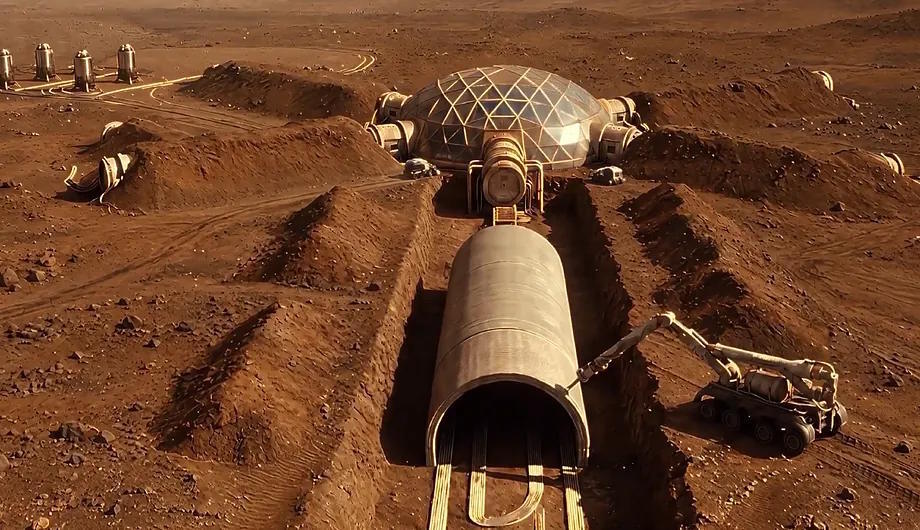
Some see it as a waste of time and money that distracts us from Earthly problems, while others view it as the next inevitable great step for humanity. However, efforts to achieve the colonization of Mars in the future, a planet extremely hostile to life as we know it on Earth, are already underway. After all, it is the only world in the Solar System that humans could set foot on. For decades, scientists and engineers from space agencies and private companies have been working to design systems that protect astronauts on such a long and hazardous space journey and sustain life once they arrive there.
The technology company Pioneer Labs has just announced a breakthrough to achieve this goal. As stated by the company's director and founder, Erika Alden DeBenedictis, in two years they have designed a genetically modified microbe to survive in that hostile world and assist humans in settling there. In fact, she described it as "a safe and useful first step towards terraforming," which is the theoretical process of modifying a planet's conditions to enable human life. The microbe in question would consume only nutrients found on the red planet, which it would transform into construction materials. The discovery has been made public through a press release and three preprinted studies in the biology repository bioRxiv, which have not yet been reviewed by other scientists, as is customary for such advancements.
"Today, Pioneer Labs announces the first microorganism we have created for Mars. sPL.001 is a genetically modified bacterium that will use nutrients from Martian soil, processed water, and air to build the first city on Mars. We have also demonstrated that it is safe to send it to Mars. And, most importantly, this microorganism eliminates a key risk on the path to terraforming: it confirms that terrestrial life can grow directly using the nutrients already present in Martian soil, a crucial step towards achieving the goal of greening the planet," Alden argues in the aforementioned press release, defining herself as "a scientist who solves big problems using evolution."
The underlying idea in this and other projects to ensure human survival on Mars is that the red planet has a large amount of resourcesin situ that, with the right technologies, could be transformed and utilized by robots and humans. This would allow for fewer materials to be transported from Earth and for Martian resources to be used to produce what is needed there. For example, there are estimated large amounts of water, but only in the form of ice. If it can be extracted and melted, it could have numerous uses for humans. One tool to achieve this could be simulating Martian chemistry using living organisms.
According to Alden, Mars has become "a dump for toxic waste." It has abundant raw materials and nutrients necessary for life, but they are mixed in the soil with toxic substances like perchlorates and salts, which would hinder the growth of most living beings. "There are many proposals to grow plants on Mars, and all involve some form of soil recovery or decontamination: removing toxic substances by washing the soil, transporting additional nutrients from Earth to fertilize it, or completely giving up outdoor cultivation and resorting to hydroponics. If terraforming requires manually cleaning and fertilizing the soil, robot by robot, on a planet with a land area roughly equal to Earth's, the process would be unfeasibly expensive and take too long," she states. And one of the great advantages of their genetically modified bacterium, she emphasizes, is that "it does not require additional fertilizers or pretreatment of materials to remove toxins."
This is not a bacterium created from scratch, but a modification of a microorganism already living on Earth. The directed evolution mentioned by the Pioneer Labs team involves subjecting a bacterium to certain processes so that it can develop a specific desired characteristic. The idea is not to take it to Mars to live outside the planet freely, but it has been designed to remain inside a bioreactor, with controlled temperature, pressure, water, and feeding. If it were to escape into the Martian environment, according to the experiments presented, it would die quickly, mainly due to the absence of liquid water and extreme environmental conditions: "Even a total and catastrophic leak from a large-scale industrial bioreactor on Mars would still be several hundred times below the planetary protection threshold. These organisms would be very dead very quickly if they were to escape outside on Mars," assures the founder of Pioneer Labs.
According to Felipe Gómez, a Mars specialist at the Center for Astrobiology (CAB/CSIC-INTA), affiliated with NASA, Pioneer Labs' announcement "is a step further in a field that is in full development and to which many people are contributing": it is called ISRU (an acronym in English for 'in situ resource utilization'), which, as its name indicates, involves collecting, processing, and using materials found on other celestial bodies, such as the Moon, Mars, or asteroids, instead of transporting them from Earth.
As he explains in a phone interview, in their laboratory, they have conducted similar tests to those presented by Pioneer Labs with bacteria that help prepare manned missions to Mars within habitability studies: "In our case, we have used non-genetically modified or directly evolved microorganisms as Pioneer Labs did. We have published several studies in which we have used cyanobacteria isolated from extreme environments, for example from the Rio Tinto (Huelva). We have exposed them to a Martian regolith simulant, which is toxic, very abrasive, and highly oxidizing, to see if they could survive and if we could get them to grow to perform processes that we know these cyanobacteria naturally do," he points out.
Cyanobacteria are microorganisms capable of photosynthesis. And as Gómez points out, "they are very good at producing oxygen and biomass, and there are some algae that can be consumed, so these resources could be used by astronauts going to Mars. Additionally, they can also carry out processes to clean contaminants, degrade organic products, human waste, and more. That is why their use is currently very popular among researchers dedicated to habitability issues," he states.
At NASA, he reviews, there is a great interest in developing this field, and in addition to work with bacteria, experiments are already underway on Mars, such as MOXIE aboard the Perseverance rover, which is being used to produce oxygen. "What we are clear about is that when a mission with humans is carried out, they will not be able to take 500 kilos of lettuce and 800 kilos of potatoes. We have to develop techniques to use resources in situ," Gómez summarizes.
Therefore, from his point of view, the bacterium modified by Pioneer Labs "is relatively novel and not particularly striking." On the other hand, he receives the announcement with caution because they have presented their finding without undergoing the peer review process, carried out by scientists unrelated to that study. Gómez is not in favor of this type of pre-publication in scientific repositories: "It could happen that when it goes through reviewers, they start to find certain problems and it takes several years to publish it in a scientific journal. Therefore, we must acknowledge the Pioneer Labs team for offering scientific studies, but pending that review, we must receive them with caution," he argues.
Bioengineering to build a city
Scientists believe that 4 billion years ago Mars resembled Earth today, so they believe it could have harbored life. Currently, its surface does not allow for development due to extreme cold, radiation, very low atmospheric pressure, or toxic regolith chemistry.
Searching for traces of past life is the main goal of missions sent to Mars. Therefore, Gómez emphasizes, "in all these processes being carried out with terrestrial bacteria, genetically modified or not, the utmost caution must be taken. We are very clear that we cannot inoculate bacteria that could jeopardize future studies to find out if Mars has ever had life. Therefore, space agencies conduct thorough checks to ensure that any technique used must be confined to prevent biological contamination of the red planet.