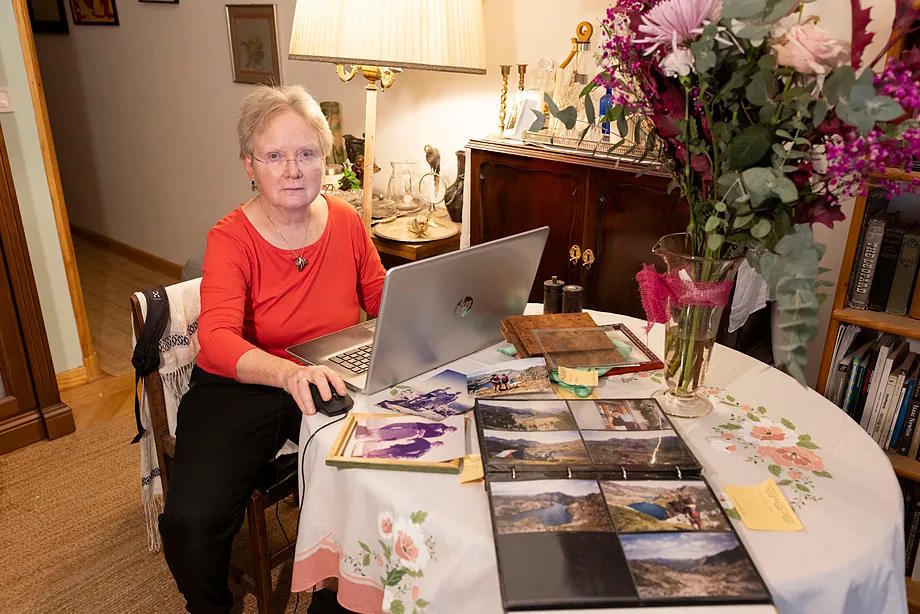
For years, the Americans Elizabeth Baile Lewis and Alice Ferrero Rattotti shared a small ritual every December. First, they would compare a Christmas lottery ticket together. Then, with a bottle of good wine as the third guest, they would imagine how they would spend the money if they were to win big.
"Year after year we said the same thing," recalls Elizabeth. "That we would dedicate a considerable part to ensuring a financially stable old age, that a small part would be for a joyful indulgence, preferably shared with others, and that finally there would be a substantial amount that we would give to a charitable cause, to an entity dedicated to the well-being of people."
The prize never came, but Alice wanted that desire to share to become a reality. And that's why, after her death in August 2025, she left part of her inheritance to the Biomedical Research Foundation of the San Carlos Clinical Hospital in Madrid. A total of 140,000 euros that will be allocated to Alzheimer's research, the disease she suffered from and was treated for at the Madrid center.
"Alice firmly believed in the moral obligation to share good fortune, to give back part of what she received as a sign of gratitude. This is her way of helping to bring about a day when both her illness and other equally devastating ones have more manageable outcomes," says Elizabeth, her eyes shining as she remembers. Along with her friend Caroline Bintcliffe, she accompanied and cared for Alice during the 10 years she suffered from the disease. They were her family here.
Both arrived in Spain in 1974 to study Hispanic literature, although they did not meet until a few years later, when both had already decided to settle permanently in Madrid.
It's not easy to condense the essence of someone with whom you have shared 40 years of friendship. It's very difficult to synthesize their uniqueness, their qualities, their nature... Elizabeth and Caroline, however, manage to portray their friend's soul with just a few sentences.
"Alice had a wonderful balance between the very rational and logical and the very intuitive and spiritual," summarizes Elizabeth.
"She was pragmatic, determined, executive, but also devoted to Saint Anthony of Padua, for his feast day. She explored meditation, always seeking a greater understanding of the inner world and its connectivity with the external world. And she believed in karma," they reminisce.
In '76, Alice graduated in Geology in the United States, with a specialization in Hispanic literature. With the degree in hand, she didn't hesitate to return to Madrid to reunite with her Spanish boyfriend and start a new life here.
Years later, that relationship ended, but Alice already knew then that she wanted to spend the rest of her life in Spain. "And she never regretted that decision". In Madrid, she graduated in Law and worked for years as a lawyer, although the last years of her career were spent linked to Carlos III University.
"Disciplined and with a great organizational capacity," Alice "firmly believed in social causes, in public education and health systems" and greatly enjoyed simple things, like walking. "She had enormous resilience", recalls Elizabeth, a companion on many routes.
It was precisely on a walk, walking the 100 km that separate Madrid from Segovia, where Elizabeth realized that something was happening to Alice. "As always, she was ahead of me because she had great capacity and agility. And I noticed that she was leaning to the right, that she was walking more and more inclined. I thought her walking sticks had become misaligned and that, due to fatigue, she wasn't realizing it. But over time, we saw that those were the first signs of the disease." Then, unstoppable, the forgetfulness, organizational problems, neglect, and the loss of her "wonderful handwriting" began to appear. At that time, Alice had not yet turned 60.
The American never uttered the word Alzheimer, but from the beginning, she prepared for the decline. Elizabeth learned years later, when her friend handed her her medical history and a notarized power of attorney to make her responsible for her care, which she had signed at the time of diagnosis.
Unfortunately, the progression of the disease was relentless. Alice, "a wonderful cook who liked to experiment and prepare elaborate dishes," remembers Caroline, could barely hold the cutlery at the end of her days.
"There came a time when her connection to reality was very scarce. She connected mainly when she got angry, which almost made us happy because you could see it in her eyes. We always reminded her that we knew she was still there, that her brain was betraying her body but that she was still there and we knew it."
She was a very beloved person, they recall. In the streets of Chamberí, where she lived, everyone greeted her at the market, in the usual bars... "All those people were also very attentive to her. The neighborhood was a small town for Alice," they reminisce.
The 140,000 euros that the American has bequeathed to research will allow the creation of a specific project - something like the Alice project - that will delve into the knowledge of neurodegenerative diseases that, like in Alice's case, have an early onset, says Jordi Matías-Guiu, the neurologist who treated her and a researcher at the Madrid center.
"We greatly value and appreciate that people like Alice want to show their gratitude to the public sector by supporting research," notes César Gómez Derch, manager of the San Carlos Clinical Hospital.
What Alice would want, confirm Elizabeth and Caroline, "is for her donation to contribute to improving the quality of life of the more than 800,000 people in Spain who suffer from Alzheimer's and also to the family members and caregivers who take care of them," they say, moved. "Hopefully, that will be the case."