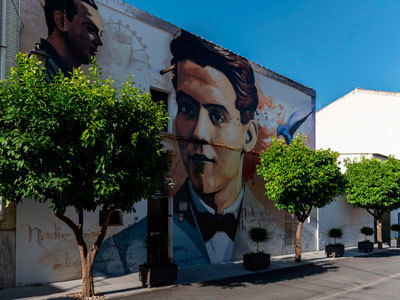
To understand Federico García Lorca, one must first set foot on the land where he was born, Granada. But also in Madrid where he triumphed and Catalonia where he forged his friendship with Dalí. The poet left his mark wherever he went, and today the interest in his figure is experiencing an exceptional moment. The Black Ball, the film by Javier Calvo and Javier Ambrossi, Los Javis, gathered more than 610,000 viewers in its first weekend in theaters, and searches about the writer on Google have increased in the last week by 3,000% in Spain and 250% worldwide compared to the same period in 2025.
Added to this is the commemoration this year of the 90th anniversary of his assassination in the same place where he was born, Granada. And specifically, the Víznar ravine. For all these reasons, and for those who want to follow that trail, the largest platform of free tours, GuruWalk, has compiled the best experiences that allow approaching the life and work of the poet throughout Spain. Some are entirely dedicated to his figure, while in others, he appears as an essential stop on the route.
Fuente Vaqueros and Valderrubio, the Origin of Everything
The starting point cannot be any other. About twenty kilometers from Granada capital, the Vega preserves the landscapes of his childhood. The playwright was born in Fuente Vaqueros in 1898, in the house that is now his birthplace museum, open to the general public. Around 1906, Federico and his family moved to Valderrubio, then called Asquerosa, where they lived until 1909, although they continued to maintain their home as a summer retreat. There they settled in number 20 Church Street, a traditional two-story labor house very close to that of Frasquita Alba, now an iconic neighbor who inspired the poet's popular work The House of Bernarda Alba. The two houses where Federico grew up, Frasquita Alba's house, Vaqueros, Valderrubio, and the surrounding villages, can be visited today.
Now we focus on his city, Granada. There he spent the decisive years of his education. He studied at the university, frequented the literary gatherings of the city, and even published Impressions and Landscapes, his first book there. Therefore, there are dozens of routes entirely dedicated to the poet that even include recited works with stops at emblematic corners. From Plaza Nueva to the Federico García Lorca Center, which preserves original manuscripts, photographs, and audiovisual material about his work, passing through the current Hotel Reina Cristina, the former home of the Rosales family where the poet took refuge during the outbreak of the Civil War. One must also visit the Plaza de los Aljibes, where in June 1922, Lorca and Manuel de Falla celebrated the Deep Song Contest, a cultural event that has gone down in history and with which the artists aimed to rescue the purest versions of flamenco.
Víznar and Alfacar, a Place of Memory
Less than 10 kilometers from Granada, between Víznar and Alfacar, lies the Fuente Grande, which the Arabs called Ainadamar, the spring of tears. It was precisely there that Lorca was assassinated in August 1936, so today the park bearing his name in Alfacar is a space of remembrance and tribute. The route that links Lorca to the Spanish Civil War passes through the area, stopping at the Víznar ravine where his body was thrown and one of the locations of the recently released film The Black Ball.
In 1916, a young Lorca traveled with his university colleagues through Andalusia and Castile. In Baeza, he met Antonio Machado, who taught French at the city's institute. Those trips shaped Impressions and Landscapes, his first book. In the Jaén town, you must visit the Casino de Artesanos, where the encounter between the two Andalusians took place, as well as the Santa María square. Declared a World Heritage Site by UNESCO, the city was also the filming location for other popular movies such as Alatriste, La Conjura de El Escorial, and Lope Enamorado.
Madrid, the Capital that Saw Him Shine
Lorca arrived in Madrid in 1919, and the capital was the springboard for his career. He settled in the Residencia de Estudiantes, where he befriended Luis Buñuel and later Salvador Dalí. His first premiere, The Butterfly's Evil Spell, did not convince the audience at the Teatro Eslava in 1920, but the city eventually surrendered to his talent. In 1928, he published Gypsy Ballads, the work that made him the most read poet of his generation. Four years later, he began touring the towns of Spain with La Barraca, the university theater company that brought the classics to the squares. There he met Rafael Rodríguez Rapún, the company's secretary, whose story also appears in The Black Ball. The big successes came shortly after: Blood Wedding, at the Beatriz Theater in 1933, and Yerma, at the Teatro Español in 1934. Today, in the heart of the Barrio de las Letras, his statue in Santa Ana square gazes directly at the Teatro Español.
Barcelona and Figueras: Dalí's Catalonia
The friendship between Lorca and Dalí left its mark in Catalonia. The poet spent time with the painter's family on the Costa Brava and dedicated his poem Ode to Salvador Dalí to him. In Figueras, the Catalonia Toy Museum preserves the toys of Anna Maria and Salvador that fascinated Lorca. In Barcelona, his work resonates live. The Barcelona Guitar Trio performs pieces by the poet alongside compositions by Falla and Paco de Lucía at the modernist Palau de la Música and at the La Perla del Born flamenco venue.