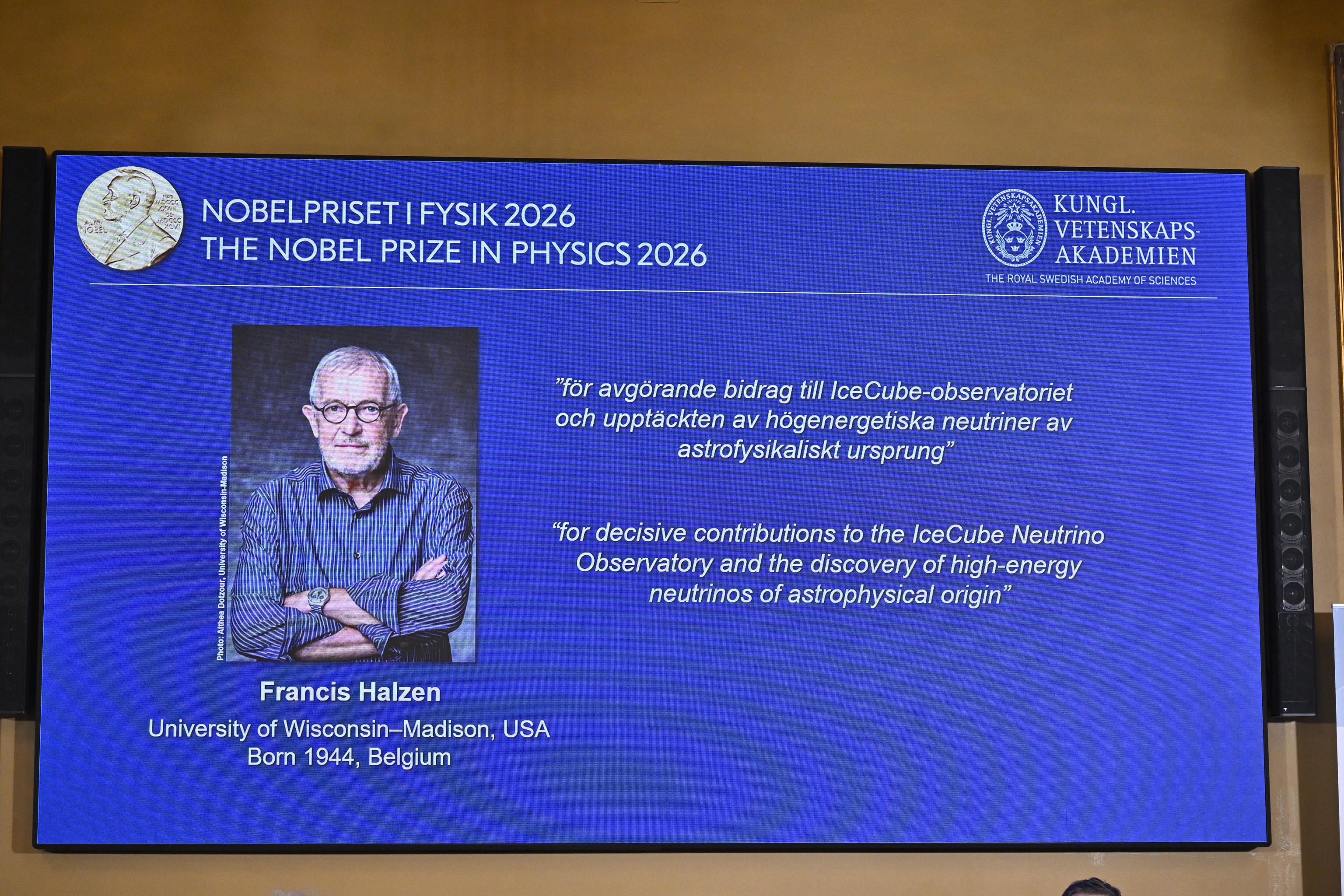
Francis Halzen has won this Tuesday the Nobel Prize in Physics for his experiments at the IceCube Neutrino Observatory in Antarctica, which have allowed the astrophysical origin of high-energy neutrinos to be discovered. These particles are often known as ghost particles.
Cosmic neutrinos with extremely high energies are very rare, so a huge volume of ice is needed to observe a number of collisions that allow them to be studied. With this purpose, the IceCube Neutrino Observatory was born, covering an entire cubic kilometer and completed in 2011. Researchers soon discovered the first high-energy neutrinos and, a few years later, were able to publish their discovery of neutrinos that must originate very far outside our solar system. The search for the sources of neutrinos in the universe could begin in earnest.
Halzen is the director of the Institute for Elementary Particle Physics Research at the University of Wisconsin-Madison, holding the Hilldale Chair and the Gregory Breit Distinguished Chair.
Last year, the Nobel Prize in Physics was awarded to John Clarke, Michel H. Devoret, and John M. Martinis for their research on the strange behavior of subatomic particles, known as quantum tunneling, which made possible the ultra-sensitive measurements made by magnetic resonance machines (MRI) and laid the groundwork for developing more advanced mobile phones and faster computers.
On Monday, the Nobel Prize in Physiology or Medicine was announced, shared this year by Karl Deisseroth, Peter Hegemann, and Georg Nagel (Weingarten, Germany, 1953) for their discoveries in optogenetics, an area that "has opened a new era in Neuroscience."
The total amount of the prize amounts to 12 million Swedish kronor (about 1.2 million dollars). The Chemistry award will be announced on Wednesday, Literature on Thursday, and the Nobel Peace Prize on Friday. The Sveriges Riksbank Prize in Economic Sciences in Memory of Alfred Nobel will be announced on Monday.