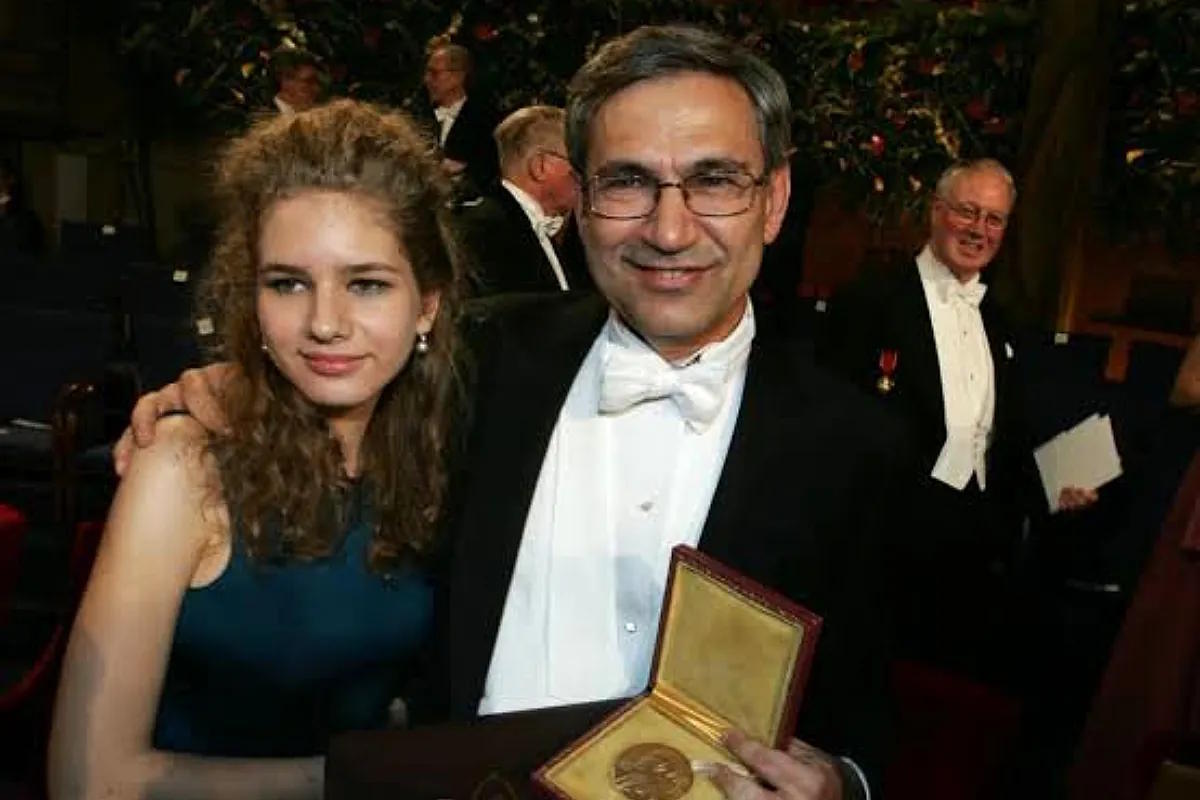
At 74, Orhan Pamuk (Istanbul, 1952) still carries notebooks wherever he goes. Many notebooks. He shows them to the camera during the video call, opens one at random, and there are pages full of notes, drawings, phrases, details, ideas still taking shape. One of them contains notes for a novel he has not yet started to write. The Turkish Nobel laureate, an award that will turn 20 in a few days, talks about them as if showing the blueprints of a house that does not yet exist: "I don't believe in bursts of inspiration, a writer develops the idea of a novel for years". For him, it does not come when the author sits down to write it but much earlier, during that time of accumulation when the 10,000 sheets that will one day form the entire tree are gathered.
Pamuk gestures a lot, laughs, makes constant jokes, and when a question particularly interests him, he gets excited to the point of momentarily losing track of the answer. He is about to retire from Columbia University, where he has taught writing for two decades, and says he now wants to dedicate all his time to writing. In his conversation, literature, politics, museums, painting, memory, happiness, and above all, that unique way of looking at the world from an intermediate place appear: between East and West, between words and images, between tradition and modernity.
20 years have passed since that 2006 Nobel Prize that made him a global literary figure and, at the same time, a too public personality in Turkey. He recalls that moment with humor and also with the awareness of everything that came after: the controversies, the threats, the bodyguards, the political questions he did not seek but ended up being part of his life. However, when asked what literature means to him today, after more than half a century of writing, his answer is surprisingly simple. He picks up one of his notebooks again: "If I go anywhere and forget one of these, I am not myself. It is part of my essence, of who I am". Writing, he says, is still for him "observing, noting, imagining, and continuing to narrate".
He has said many times that the novel is a way of thinking, but also that the novelist must be able to get lost in what he is writing. At what point in the process of a novel does he stop knowing exactly what he is looking for and start trusting that the novel itself will reveal it to him?
A writer develops the idea of a novel over many years. People sometimes think that one sits down and starts writing, and that in two years a novel is finished, but it is not like that, the novel develops in the mind over many years. I always have notebooks about the content, the details, the scenes. Here, for example, I have the notebooks of a novel that I have not yet started. I take notes on everything: someone kissing someone, someone holding a hand, a landscape, the Sea of Marmara that I see from my window, the trees in this garden... There are apple trees, pear trees, fig trees. What do they remind me of? I want to talk about all these things, but I need something to connect them. A novel is like a tree with ten thousand leaves. You take notes on those ten thousand leaves and then you need to find the trunk, the main story, the branches that connect them. A novel is a huge organization. You have to think a lot and then start by showing one leaf, then another branch, and so build the whole. I think of it a bit like a film producer who thinks about what will produce a certain effect in the viewer's mind. And the great secret of the pleasure of writing a novel lies precisely in working tenaciously on something whose meaning you still do not have completely clear.
In The Naive and the Sentimental Novelist (2010), you spoke about that "secret center" towards which every novel gravitates, although the writer does not always know what it is when he starts. After so many books, do you still think that each novel has a center to discover?
Yes, but that center is not a clear idea that you have before starting, it is something abstract. In a sense, it is an illusion, but it is also a humble method, because I am not a theorist, I am a storyteller. When we write a novel, we have many ideas, but a good novelist does not know exactly what he is writing that novel for until he starts writing it. The joy of writing consists in searching for that meaning while you write. And it is something that also happens when you read. I teach writing at Columbia University and one of the things I try to explain is the difference between the writer's intention and the text's intention. The writer may have a specific intention, but the text may end up saying things that the writer did not know he was saying. That is one of the wonders of literature and perhaps the most wonderful part of being a novelist, discovering the meaning while writing.
There is a very interesting paradox in your idea of the novelist, the more aware he is that a novel is an artifact, the more he needs to believe in it as if it were reality. Do you think that writing consists of learning to hold these two contradictory beliefs?
In my novels, I make it clear that I know it is a novel. Sometimes I appear myself, like Alfred Hitchcock in his films; I make references, I refer to myself. Thirty years ago, I did not consider myself postmodern, and today I would not exactly say that I am, but it's okay, I am reconciled with the idea, as postmodernism opened the way for me to combine things that previously seemed difficult to combine. I admired Joyce, Faulkner, Woolf, Dostoevsky, but I also had behind me all the Ottoman, Turkish, and Persian tradition, mysticism, ancient texts... How could I combine them? The techniques of collage, Dadaism, surrealism, helped me do it. And what I would tell young people is that whatever they tell you that you cannot combine, you should focus precisely on that. That is a formula for originality, combining things that apparently should not be together. Although it takes character and self-confidence, of course, but that is the joy of inventing something.
As a child, you wanted to be a painter and ended up being a kind of "visual novelist." Do you think all your literature was born out of the frustration of not being able to paint?
I don't know if frustration, but I left the brush for the pencil naturally. I even taught a class for years where I explain my theory. The class was called Verbs and Images and explored how we think with words and how we think with images. Sometimes we think with words and sometimes with images. If you are very hungry, you do not want an image of a hamburger, you want a real hamburger. When we think about religious things or abstract concepts, we often think more with words. But, as you say, I consider myself a visual novelist. When I describe a scene, it first appears in my mind as an image, and a good part of my work is to turn that mental image into words. Someone kisses a girl, someone jumps, someone fights with swords, someone works in a melancholic industry... I turn that image into verbs. The reader reads the verbs and reconstructs in his imagination the image I had in mind. That is what happens when we read a novel.You always say that literature is ultimately an attempt to understand someone. But to deeply understand a character also means to understand their reasons, even when they do something morally terrible. Where does the novelist's empathy end for you and his judgment begin?This topic I like a lot because, in the end, writing novels is about inventing and defining characters. When we identify with a character, we begin to understand him, and the more we understand a character, the more problematic it can be for the writer because perhaps the character does something that we consider bad. In Snow (2002), for example, I wanted to write about the rise of political Islam in Turkey, and for years I talked to upper-class, secular, and Westernized people, but also to religious people. I did not think like them and politically I did not want them to come to power, but I also wanted to show that they were human beings. A novel does not say, "This character is right." It says, "Try to understand why he does this." Understanding does not mean excusing cruelty or terror. Tolstoy had a very simple rule: if you have a character who seems too good, add a bit of evil to him; if he seems too bad, add some goodness. That is one of the great joys of the novel. Confusing the character's mind with the writer's ideas is a mistake. The writer must be able to identify with very different characters and see a situation from different points of view.
In much of your work, you have addressed the modernization of Turkey, which you do not simply see as a conflict between East and West, but as an intimate, familiar, even sentimental experience. Over the years, have you stopped thinking of that tension as a political problem to see it more as a human condition, as the desire to change without ceasing to be who you are?
As I say, a writer does not have a single line of thought, but many ideas throughout his life. I am Turkish, so I am between the West and the rest of the world, and I like to take advantage of that position because the issue of modernization is not simply a conflict between East and West. In non-Western countries, there has been for two or three centuries an enormous desire to belong to modernity, to globalization, to be considered modern, civilized, rich, and intelligent. But then comes the guilt: "Am I betraying my own culture?" And that does not only happen to nationalists or religious people, it also happens to you as an ordinary citizen. One day you embrace modernization and the next day you get angry with yourself for having done so. I have also gone through that. That is why I look back at the Ottoman past, at the Sufi texts, at the Turkish tradition, and try to somehow mix them with modern and postmodern Western novel techniques. That tension is part of my life and my literature.
For years, you have rejected being defined simply as a political writer, although politics has entered your novels time and time again. Do you think a novel can be more political when it stops talking about politics and focuses on understanding how a person lives, desires, fears, or deceives?
Yes, that's true. In reality, I didn't want to be a political writer. The generation before mine, with writers as brilliant as Yasar Kemal, that current of the "educated peasants," was made up of very political writers who admired Gorki and Steinbeck. But I, coming from an upper-middle-class neighborhood, all my bourgeois friends were more Maoist than anyone, so I was always skeptical about ultra-leftism. So I decided no politics, I wanted to be Thomas Mann, Rousseau, Tolstoy... But when I started to become famous, in Turkey and abroad, they started asking me political questions. And if you say you don't want to talk about politics, they immediately call you a coward, and I didn't want to seem like a coward. Then came the problems, a trial, death threats, bodyguards for many years. I didn't become a political person because I was a young Marxist; I was more of a young reader of Marx whom Turkey's situation and being one of the few famous people available led to expressing political opinions.
And also a trial for "insulting and weakening the Turkish identity." Do you regret anything from all that after experiencing persecution and the whole process?
No, never, I would do it again, I still do. It's not that I don't care about politics. I admit my criticisms of Erdogan, past and present. For a while, I also wanted Turkey to join the European Union and participated in that discussion with a lot of energy, especially when my books were becoming popular in Europe and internationally. But that didn't work out, and then I lost interest in politics. Now I criticize Erdogan's government to defend my dignity. The current political situation is so bad that you can end up in jail, and one must be careful, but it's something that must be denounced.
As you say, your fame allows you to say things that other people may not be able to say. Have you ever felt that the public writer was interfering with the writer you needed to be in order to write?
At certain times, it was necessary to be public in order to write. It's an eternal problem, no writer before me solved it. As I said, my fame led me to give many interviews on Turkish and international political issues, which made me a politically known person. Do I complain about it? Partly, because once you enter that target, it may seem like you are afraid or can't bear the consequences if you are attacked, mistreated, and end up in court. I lived with three bodyguards, then two, then one, for many years. But if you start thinking too much about the consequences, you may end up giving up, and that's not dignified. It's cowardly, and no one would respect that. In the end, my criterion to earn the respect of my readers is based on telling the truth, which requires a certain amount of courage. My friends told me, "You must speak because you can say things that no one else can say." They are right, so I say them. But it's true they are much more enthusiastic about that idea than I am.
For Tolstoy, one of your great masters, literature was a means of exploring the reasons for happiness. Is it possible that, after so many years writing about sadness, loss, obsession, and melancholy, the true theme of your novels has always been happiness?
Well... yes, it is. I think the deepest and most significant literary question a novel can answer is, "what are the values of life? How do we judge a life?" Most of the time, the great novelists give direct or indirect answers to that. If you read Tolstoy, it's about happiness. Anna Karenina or War and Peace may talk about history, but they also talk about happiness and how to find it in that society. Dostoevsky doesn't explicitly talk about happiness, but all his characters, more agitated than Tolstoy's, long to be happy. It's about passion, ideas, change, evolution, being, identity... Every writer is preoccupied with something specific, according to their time, but behind all those ideas lurks the pursuit of happiness. In the end, we all seek happiness, even if we are not very clear about it. We say, "Let me tell you a story." Yes, the story is there, it serves to connect the themes we want to talk about. But ultimately, we want to talk about our experiences and relate them to happiness, to a broader view of life. And no, I don't have a clear view of that broader life when I start a novel. The joy of writing lies precisely in searching for that meaning while writing.
In your Nobel speech, you said that there came a moment when the city of Istanbul you had built in your books seemed more real to you than the city you lived in. Is that still the case?
Of course! A city preserves not only the days, objects, and events but also the language, the things we use, the things we think, and the things we take seriously. After a while, you discover that a city is a city of concerns. I have been living in Istanbul for 74 years. When you live such a long life in a city, everything is filled with layers of meaning. In that sense, it behaves like a museum, preserving our memory. You can be walking in a city, feeling very sad, see a fountain, and drink water. The next time you see that fountain, you will remember what you experienced there. That object, that architectural detail, that fountain, acts as an index that refers to your memory. Istanbul went from about 2.5 million inhabitants in 1952 to about 16 million today, and I have seen that change in just one lifetime. I tell myself that I have a unique experience that no one else possesses. And I am also a writer, so I can tell whatever I want about the city, and anyone can read it. The curious thing is that internationally I am known as the writer of Istanbul, but when I published my first books in Turkey, no one called me that, but rather they called me a bourgeois novelist, and for me, Istanbul was simply the place where I lived.
The Museum of Innocence, that real building based on his eponymous novel which opened in 2012, takes to an extreme an idea present in many of his novels, the conviction that something seemingly insignificant can contain an entire life. Why can an ashtray, a ticket, a photograph, or a dress preserve memory? The museum is a combination of conceptual art and literature. As we were talking, I wanted to be a painter until I was 22 and failed, but when I succeeded as a writer, I thought: why can't I find a way to combine my desire for art with literature? The solution was to create a museum with objects from the everyday life of a man deeply in love and publish a catalog whose entries were arranged in such a way that the text could be read as a novel. That's how I found the story: a man falls in love with a woman, his love is not completely reciprocated, and he starts collecting everything she touches, everything that reminds him of her and their relationship. And those objects are everyday objects from Istanbul: movie tickets, buses, trains, street food... fifty years of urban life. I wrote the novel thinking about the museum and built the museum thinking about the novel.
There is something almost revolutionary about placing a humble thing in a showcase and asking the visitor to look at it as if it were a work of art. Is that also what a novel does, telling us that an ordinary life deserves to be looked at with the same attention as an extraordinary life?
Of course, good novels show ordinary things and show them in a way, through composition, collage, structure, that we begin to see the extraordinary nature of our lives. They show boring things in a way that makes them interesting and, at the same time, make our lives seem interesting. Museums are similar to novels because they preserve our everyday life, how we talk, how we eat, what clothes we wear. Although it is true that museums have changed today, they are no longer just repositories where old things are kept. In the last twenty years, they have also become places that reflect the identity of the people around them and those who created them. Now the big debates about what to exhibit, what to include, and what to exclude are also debates about our identity, that's why many of the big political debates that used to make headlines in newspapers now take place in museums. And I think that's great.
This introduces an interesting political dimension to your idea of the museum. You have also experienced firsthand the discussion about who tells a story, from where, and with what tradition. Are you interested in the museum precisely because it allows looking at the same object from different perspectives?
Yes, I am interested in being in the midst of those perspectives. In The Museum of Innocence, Kemal steals objects from Füsun's house because he is obsessed with her. And, at the same time, when you think about museums built by colonialists, you discover that there is also a history of stolen objects, of things that were taken from one place to another and then exhibited as heritage. As a resident of a country that was an empire and also a colony, I like, again, being able to look at things from both sides. I don't want the museum to have a single interpretation, and I believe that all these postcolonial debates are very enriching and interesting.
This year marks twenty years since you received the Nobel Prize. How do you remember all that today and what does it mean to you, two decades later, to have received that recognition?
I remember it with happiness, of course. Although I must say that, in a way, the Nobel was not a surprise to me. Let me explain: for years, since I was in my forties, Turkish newspapers wrote things like, "Pamuk didn't receive it" or "Will he finally receive it tomorrow?". The most serious thing was that those who did this were my political enemies, the same ones who said that I was a sellout, that I criticized the government to win the Nobel, that I was destroying our country, and that I didn't even get the prize. And so it went on for a long time. I never responded, never talked about it, not even at home with my wife. We hated it because everything was organized to damage my image. When I finally received it, my joke was: "Well, thank you. Now no one will ask me again if I will win the Nobel." But, of course, they kept asking me about the award, of course. It's like a curse, but a blessed curse.
To which writers or literatures would you like to pass on that 'curse'?
Of course, I won't give names. Well, one. Javier Marías was a great writer whom I respected a lot. I read *A Heart So White* twice, it was wonderful, and I would have liked him to receive the Nobel. I even mentioned his name to the jury because we had the right to propose names. Now that he has passed away, I am very sorry. As for the present, I don't feel qualified to give ideas to the Swedish Academy, but I believe that Asian literature, Chinese and Japanese, should be more thoroughly valued in the West.
After more than fifty years of writing novels, of the Nobel, of building your own museum, and having reflected so many times on what a novel is, what mystery of literature do you still not understand? What are you still expecting from it? What can literature still do that nothing else can?
First of all, literature is very democratic in the sense that anyone can capture their imagination with a pencil and paper. That hasn't changed and never will. In my youth, humanity cared a lot about novels, the best ones were on a pedestal. And today that world has shattered. I'm not afraid, but I still can't see the shape of this new world, and that worries me a bit. However, humanity continues to read. Maybe not on paper, maybe reading shorter and shorter fragments, but I don't want to generalize. We always say that no one reads long novels, but there are writers who write them, and humanity reads them. So I have learned to be optimistic. Perhaps the current saturation of images is changing some things, but I don't think culture and literature are in danger. As for me, literature today is no longer a job, but the pure pleasure of writing is the most important thing in my life. If I go somewhere and forget one of these notebooks - he picks up a random notebook, full of scribbles and notes - then I am not myself. I don't know, I just enjoy the process as I did over fifty years ago. And I hope that never leaves me.