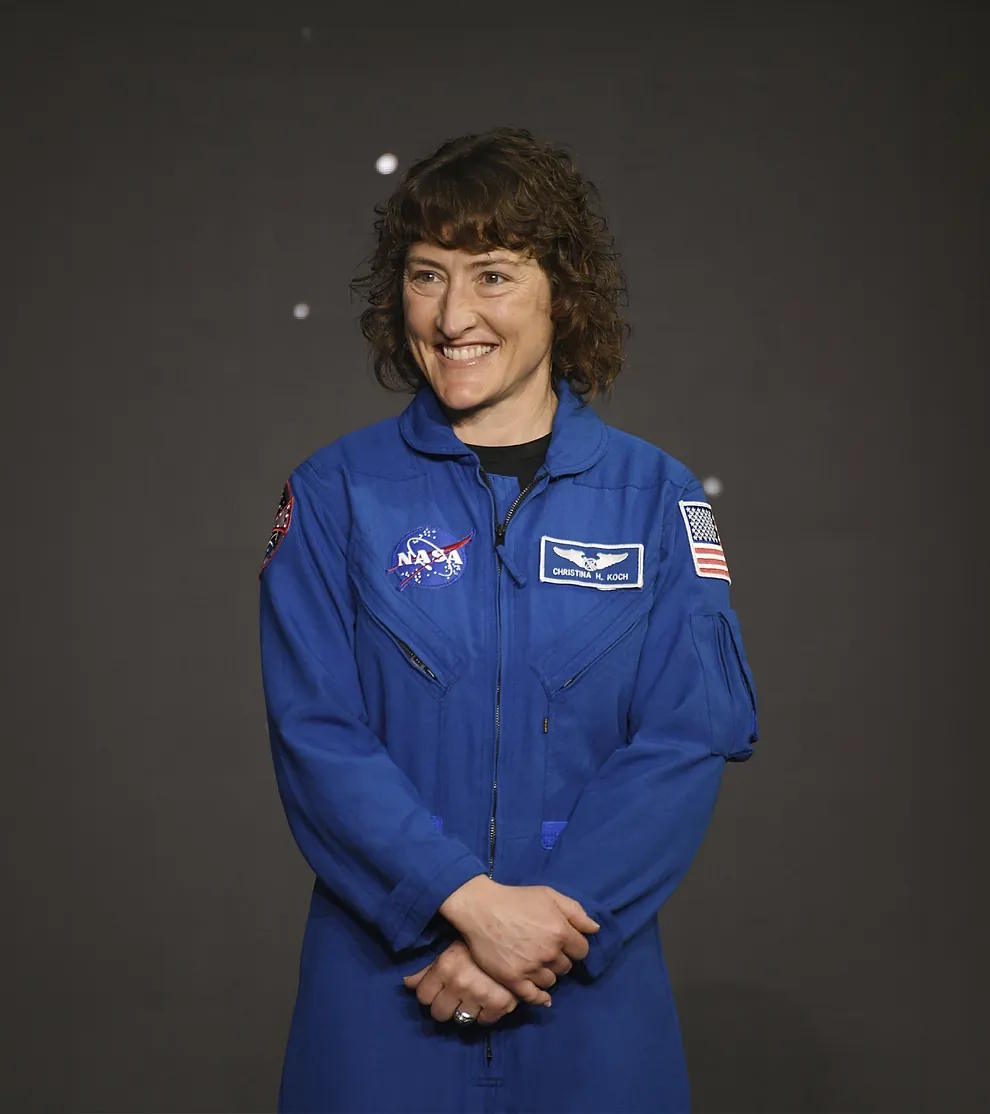
Before making history by being part of the Artemis 2 mission and becoming the first woman to fly over the Moon, the astronaut, engineer, physicist, and polar explorer Christina Koch (Grand Rapids, Michigan, USA, 47 years old) was already one of the people who had spent the most time in space: 328 consecutive days between 2019 and 2020.
However, it was during those nine days in April when she and her colleagues Reid Wiseman, Victor Glover, and Jeremy Hansen became the humans who have traveled farthest from Earth and the first to see with their own eyes some areas of the far side of our satellite, that she captivated the world. She dubbed herself a "space plumber" after fixing the toilet on board the Orion spacecraft, took historic photographs, and moved millions of people with her descriptions of the Moon and her reflections on our place in the universe.
Her lunar mission was the culmination of a quarter-century career: before joining the astronaut corps in 2013, she developed instruments for space missions at NASA's Goddard Space Flight Center and Johns Hopkins University, undertook several long-duration stays in Antarctica and the Arctic, and worked at the US National Oceanic and Atmospheric Administration (NOAA).
Her colleagues Wiseman and Glover have just retired as active astronauts, so Koch is the only NASA crew member from Artemis 2 still in the lunar program. The goal is to land on the moon in 2028, with Artemis 4. But before we know who will be chosen to walk on the Moon, NASA must carry out another complex test mission: Artemis 3, scheduled for mid-next year.
On October 23, Koch will receive the Princess of Asturias Award for Concord in Oviedo: "I am very excited to go to Spain and be part of these incredible awards that I have held in very high esteem since I learned that the International Space Station (ISS) received the award many years ago, as well as for the incredible achievements they seek to recognize worldwide," she said during a video call from Houston.
It has been half a year since returning to Earth after circling the Moon with Artemis 2. In the previous mission, almost 11 months were spent on the ISS, while this time it was only nine days, but in a smaller spacecraft. Have you fully recovered physically, or do you still feel any effects from being in space?
I believe that for a mission of such short duration, I have fully recovered. After my longer mission, it took me about six months to fully recover cardiovascular capacity levels and such. But this time, it has been quite quick, fortunately.
The impact of Artemis 2 was significant, even though they did not land on the Moon. Millions of people worldwide followed what was happening on the Orion spacecraft. Were you and your colleagues aware of the impact it was having here on Earth?
It's interesting that you ask because we were not fully aware at the time. It wasn't until towards the end when we started to realize, especially through our families, the impact it was having. Our conversations with the ground teams and the control center were very operation-focused. We didn't necessarily discuss the public aspects of the mission, but our families were very involved. When we had video calls - I had two during the mission - or received emails from our relatives, we began to understand that it was resonating. Perhaps our dreams had come true: that this would reach all of humanity. It was an incredible feeling. When my husband told me about it in a video call, I started to cry and said, "This is everything we've always wanted."
Memories tend to evolve over time. Half a year later, how would you describe to our readers what the Moon is like and what you felt during those minutes when you could gaze at it with your own eyes while surrounded by it?
Yes, you are right. Sometimes it's hard to recall that feeling. But on September 30, I was fortunate to meet with our scientific teams and review some of the observations I made. I listened to some of my recordings, combined with the photographs I took at that moment, creating beautiful mosaics of the Moon. And that transported me back to that incredible moment. What an extraordinary sight it was to look out the window and see a completely unknown place that you knew was part of our universe; our closest neighbor, the Moon, but on its far side, the one we never see! And it reminded me of what I felt the first time I saw the far side: that my perspective would never be the same. Because the far side of the Moon was as if it didn't need us to exist. In a way, it was a demonstration of how vast and beautiful the universe is. And sometimes we are not there to witness it. That incredible thought - that the Earth and all we see is not all that exists - was very profound. Looking at the Moon from above and seeing valleys, shadows, craters, and mountain ranges made me feel like I could be down there exploring, climbing, hiking. It was beautiful and a great honor to see what we saw.
NASA is now preparing for the next manned mission of its lunar program, Artemis 3, which will orbit the Earth to practice the approach and docking of the Orion spacecraft with the landing modules being developed by SpaceX [Starship HLS] and Blue Origin [Blue Moon]. It seems like a very ambitious mission, and they only have a year to prepare for it. Additionally, the modules are not yet ready, although a few days ago, the Starship reached Earth's orbit for the first time. Do you think they will be able to launch the mission in 2027?
Yes, Artemis 3 is very ambitious. And I believe what will make the mission possible is having the landing modules ready for it. I have a lot of confidence in the teams. They are extremely creative. We are willing to change course to ensure that this mission can be everything it can be within the timeframe it needs to be carried out. It's amazing to see how they shifted focus from Artemis 2 to Artemis 3. They are moving fast, and the fact that it is an ambitious mission is also motivating.
As you know, there was some controversy regarding the absence of any women in the Artemis 3 crew. For example, when I interviewed European Space Agency astronaut Luca Parmitano [one of the chosen ones], he was surprised that we asked him about this issue because he considered it a very diverse crew, and diversity is not just about gender. What is your opinion on the absence of women in this important mission?
I completely agree with Luca. And I think that was also the case in our mission, Artemis 2. Diversity is not just about people's appearance but how they approach problems, their backgrounds, their skills, and what they bring. Many people see me as the only woman in Artemis 2, but more importantly, I was the engineer, the only one who was not a test pilot. And often, that was the crucial factor in being able to address problems from different angles and achieve more success. So, he hit the nail on the head. The worst-case scenario would be if the crew had been selected to be the best they could be, and someone said, "They don't look the way I think they should, and we need to change something." I am very glad that we live in a world where we do not necessarily choose a crew simply based on how it will look on a poster.
The jury of the Princess of Asturias Award highlights that your career "is an inspiration for future generations, especially for women, and a symbol of humanity's ability to overcome challenges through hard work, collaboration, and empathy." How do you face the responsibility of being a role model? Do you sometimes feel pressure or get tired of journalists highlighting that you are a woman when you achieve a milestone, like when in 2019 you conducted the first all-female spacewalk with Jessica Meir?
Thank you for asking me this. I think, in my case, as I don't really consider these achievements as individual, I don't necessarily feel individual pressure. What I feel is gratitude for being part of something so significant, for being part of a long series of decisions made to ensure that all people who have a dream and are willing to work hard and contribute their talent are welcome at the table. That is what deserves to be celebrated collectively. I hope that each of our achievements inspires all kinds of people equally: men, women, boys, girls, students... anyone who aspires to make a dream come true. You mentioned collaboration and empathy. We named our Orion spacecraft Integrity. It is an honor to be part of this, and I believe my individual responsibility is to continue living according to the values that have connected me with people, which I consider very important.
The U.S. aims to return to the Moon in 2028 with Artemis 4. China plans to send a manned mission by 2030, so if Artemis 4 continues to be delayed, China could land on the Moon before the U.S., although they have not provided details on their progress. To what extent do you have information on how the Chinese lunar mission is progressing? Are you concerned that they may land on the Moon before the U.S.?
Well, in the U.S., there is a law that prevents us from collaborating with the Chinese space agency, so I know very little. I will say that I am excited about anyone willing to explore. And I focus on our missions, on how we want to be leaders for all of humanity based on the Artemis Accords, which establish a peaceful and shared way of exploring space. If we think about our goals, our way of life and leading, contributing to those goals, and our sense of urgency to contribute to them... for me, it's not a race. It's about the benefits out there that we can seize. And the fact that many people, countries, and leaders see those benefits, to me, is more reason to pursue them faster and seek them collaboratively.
You have spent a lot of time relatively isolated, on your space missions and during your long stays in Antarctica and the Arctic. Would you be willing to travel to Mars?
Personally, I want to see the next generation exploring Mars. If you ask me if I would go, the answer is yes, one hundred percent. If NASA were to do a mission there, I were still an active astronaut, and they wanted me to contribute in that way, of course, I would. I have full confidence in that mission to Mars, and it will be incredibly important to be part of it. But I am pretty sure that, in my case, I will not be on it.
Spanish astronaut Pablo Álvarez from the European Space Agency (ESA) has been training with you in Houston, preparing for a mission to the ISS. How would you describe his potential as an astronaut?
It's wonderful to have the opportunity to train with ESA astronauts. What I see the most is enthusiasm, the desire to be part of the team, a positive attitude, work capacity, and a breath of fresh air. The energy and diversity they have brought to our office are wonderful. It is an honor for us to pass the baton to them and see all that they can contribute. I flew to space with Luca Parmitano and David Saint-Jacques, and it was extraordinary to see the reaction they caused in their home countries and how they were received as heroes.
By the way, where is Rise, the mascot plush of Artemis 2? I have it, at my house. I ask you about another curiosity: whose was the jar of Nutella that we saw flying through the Orion spacecraft?
[Laughs]. It didn't belong to anyone in particular; it was just part of our food kit. In fact, it wasn't me who asked for it. We didn't request individual items like that. Peanut butter or Nutella is part of our supplies; NASA sent all those good things.