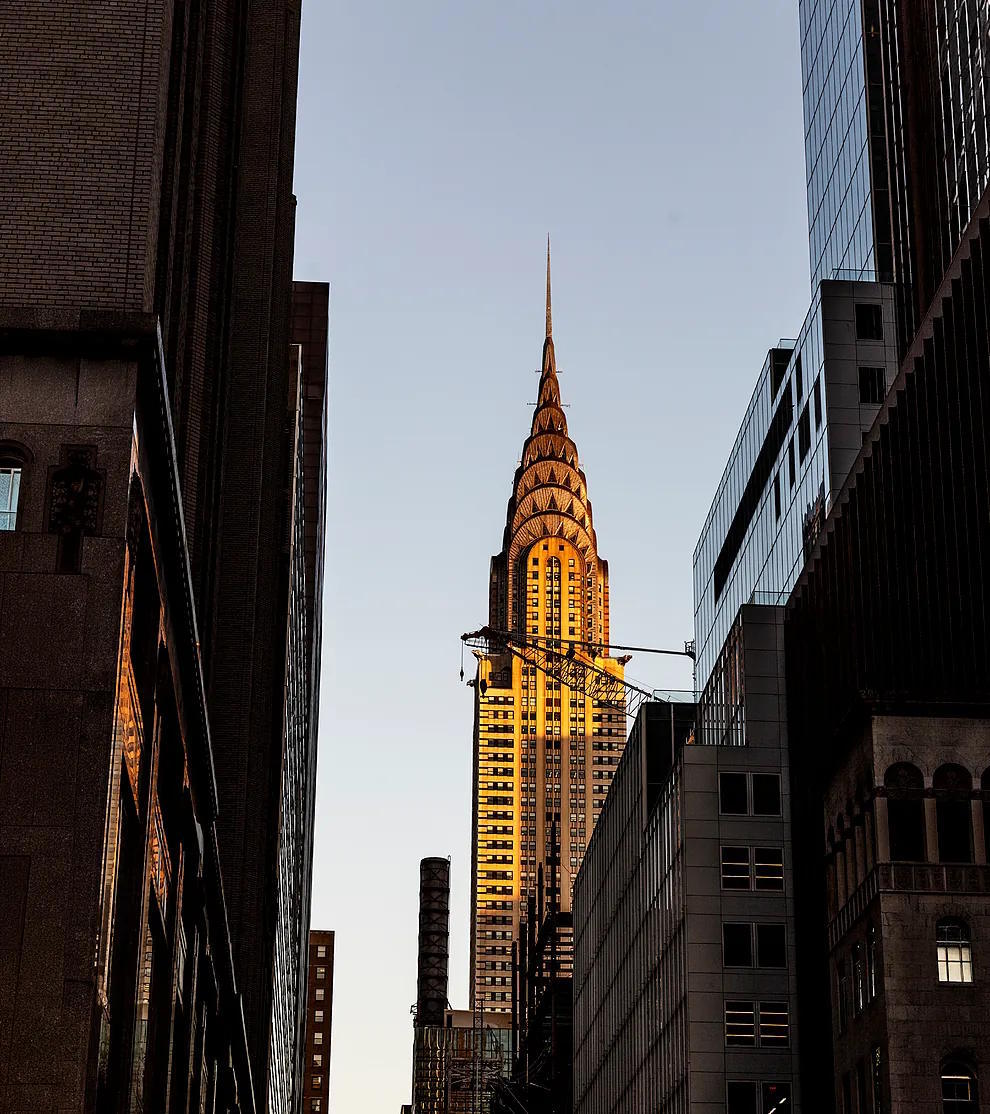
In the late 1920s, everything seemed possible. The Anglo-Saxons use the expression The sky is the limit to say that in the land of opportunities, the American dream, anything is within reach for those with ideas, will, and faith, as fortune always favors the bold. But in the case of Manhattan's skyline, the expression, 100 years ago, was literal. Only the stars were the limit.
In 1930, architect William Van Alen erected a tower for the billionaire Walter P. Chrysler, king of automobiles, that aspired to be the tallest building in the world. The original idea had come from William H. Reynolds, who was behind the famous Connie Island amusement park. But Chrysler took over the project and enriched it with his dreams. According to legend, Van Alen secretly assembled a steel spire inside the building's shaft and hoisted it almost at once to surpass the 1,046 feet (about 319 meters), achieving the feat and dethroning the Bank of Manhattan building.
In reality, it held the record for less than a year, as the Empire State Building surpassed it in 1931, but it had already left an indelible mark on the collective imagination, with its concentric stainless steel arches, eagle-shaped gargoyles, and motifs inspired by the car hubcaps of the brand. The building became the emblem of art deco, of the automobile and engine era, of man's dominance over nature. A symbol of exuberance and modernity, of hope and power in the midst of the Great Depression, making Manhattan's silhouette recognizable worldwide then and now. It became part of popular culture, appearing in Kurt Vonnegut's novels, superhero movies, Annie Leibovitz's photographs, the credits of Sex and the City, and in part of the lyrics of musicals like Annie. Or in the legendary mural by Edward Trumbull that survives in the lobby.
If the rise was spectacular, immediate, the fall, on the other hand, was slow and painful. The post-war world, after the destruction of World War II, the Holocaust, the trenches, turned into glass and steel, seeking light. The building's history is marked by rivalry and ambition. Also somewhat cursed. The height record lasted shortly, the architect never fully received his fees and ended up estranged from Chrysler. In 1978, the building was declared a historic landmark in New York, but by then the facilities that once dazzled the world had become obsolete and in need of investment and maintenance that never arrived.
21st-century companies have shunned a building with an extraordinary location but too old, with poor mobile coverage, elevators constantly breaking down, leaks, and serious pest and plumbing issues. It also has small windows, little natural light, a hostile layout for the era of open offices and large transparent spaces, and cannot compete with the incredible facilities of its more modern rivals in the area, which now charge three to four times more per square meter. The Chrysler Building has the fame, the charisma, the aura, but that is not enough in 2026.
The property has an additional peculiarity: the land on which it stands has belonged to Cooper Union, a small private university, since 1902, which does not sell it but leases it for very long terms and uses the income to provide scholarships to its students. After Walter Chrysler's death in 1940, the building passed into the hands of his family, who sold it in 1953 to real estate developer William Zeckendorf. In 1957, it was acquired by investors Sol Goldman and Alex DiLorenzo. In 1979, Jack Kent Cooke bought it, and in the late 1990s, it was taken over by Tishman Speyer, a real estate giant.
In 2008, the sovereign wealth fund Abu Dhabi Investment Council acquired 90% of the property by paying over 800 million dollars. However, just a decade later, in 2019, the building was repurchased by the real estate company RFR, owned by investor Aby Rosen, along with the Austrian group Signa, for just 150 million. A price that reflects the state of the property, the cost of the necessary renovation... and also highlights the Manhattan real estate bubble. In 2018, ground rent was close to eight million dollars, but it suddenly rose above 30 and could reach 40 million next year.
During these years, the glory has faded, and in a city full of extraordinary constructions, half of the offices are vacant. At least until now. This month, Tishman Speyer and its partners have finally closed a deal to reassume the land lease for 150 years with the intention of restoring the building and modernizing the services, paying around 235 million, plus the renegotiated lower rent. They have promised a complete renovation. Not only the offices, elevators, or the lobby, but also the facade and the iconic crown, taking advantage of the high demand for offices in Manhattan this year, driven by AI-related companies and Wall Street firms. And by regulatory limitations on new construction in the area.
"We are going to modernize the entire building's infrastructure, whether by completely renovating the elevators or polishing the stainless steel at the top to make it shine. Because this is a building that every New Yorker feels is their own. Because when you see it on the horizon, it's your building," said the company's representative to The New York Times. Plans include converting the 61st floor, where the gargoyles are, into a social club with a restaurant and terrace open to all building tenants. They will also add a gym and recreational spaces, enhancing the appeal of a property located just a few minutes' walk from Grand Central Station. A luxury and huge attraction for those living in the outskirts who have to commute every morning.