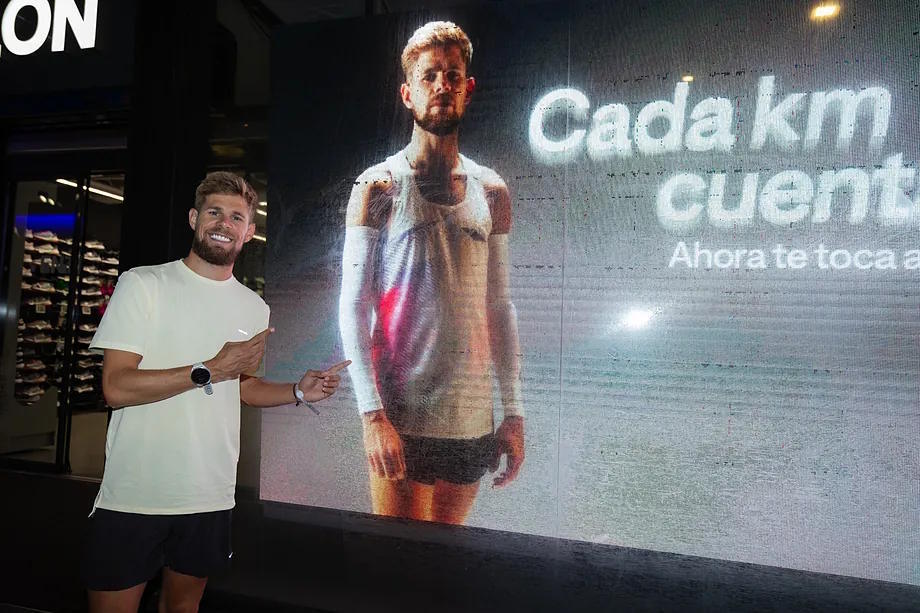
42 years had passed since an athlete born in Europe (Italian Alberto Cova in Helsinki 1983) was crowned world champion in the 10,000 meters. The feat of Jimmy Gressier (Boulogne sur mer, France, 1997) in the last World Championships in Tokyo was one of those that leave a lasting mark. The impact translated into fame and a lucrative contract with Decathlon, the brand with which he shares geographical origins and for which he did not hesitate to leave Nike. Visiting Madrid, the Frenchman, who holds the European record for five kilometers on the road and won bronze at the European Championships in Birmingham this summer with a viral sprint, reflects in EL MUNDO on his origins - having to choose between athletics and football, where he also excelled - and explains his upcoming challenges.
Question. Does that race in Tokyo, that sprint where you won the world gold, still cross your mind a lot?
Answer. I remember it very well because it is the best moment of my life. I am very proud of what I achieved in Tokyo. It's incredible emotions, the most beautiful thing I have ever experienced. It took me time to come back down to earth. I will carry that title with me for the rest of my life, but now I must prepare for what's next. Because I became world champion on September 14, 2025, but today everything starts from scratch. That was a golden finish to my career and proved it was worth leaving football to dedicate myself to athletics. I am very proud of what I did, but now I want even more.
Q. That day you beat the impressive Yomif Kejelcha, who in August broke the world record for the half marathon (56:51) and previously ran a marathon in under two hours...
A. What he achieved was incredible. It would be a dream to do something similar one day. As Kilian Mbappé says, you have to be stubborn to win. He applies it to football, and I apply it to athletics. I believe Kejelcha will run even faster. For me, he is one of the best in the world. I beat him last year in the World Championships final, and I don't think it's something I can repeat often in the future: he is stronger than me. He ran 1:59 in the marathon but is not a world champion. And I am (joking).
Q. How do you imagine your life would have been if you had continued in football?
A. I don't think I would have reached playing in the Champions League, which is my equivalent level in athletics. In football, maybe I could have played in Ligue 2 (French second division). Therefore, I don't think I would have been as well-known or achieved as many great things.
Q. When you won the gold, Zidane sent you a dedicated Real Madrid shirt.
A. Yes, but I would have preferred him to send me the French national team shirt. Still, it's a great memory because Zidane is my all-time favorite player. And it's a great honor for me to have his shirt at home now.
Gressier, during a training session in Madrid.Decathlon
Q. Many of your childhood friends now work in the factories in industrial Boulogne sur mer (Northern France). Where would you be if it weren't for athletics?
A. I think I would have managed to move forward because I am a person with great ambitions. Someone who dreams a lot. I could have succeeded in another profession, but I would never have worked in construction or in a factory for someone else, like some of my friends do. No, I see life on a grand scale.
Q. You have an interesting relationship with Decathlon from when you were a child...
A. Yes. When I started practicing athletics, my parents didn't have enough money to buy me shoes. I took some from my grandmother's storage. Decathlon shoes, size 38. I already wore size 41. And I won a race. They gave me a gift card, and with it, I could buy new shoes in my size. And then I started winning a bit more easily, of course. When Decathlon made me the offer to join them, I knew right away it was something obvious: we had a particular history together. And I trusted them. And even though the shoes from two years ago are not the same as now. I left Nike, and I am very happy to work with Kiprun. The goal is to produce the best shoes on the market. We still have a lot to do, but we are already close to the Top 5.
A. I have many good memories and a lot of affection from that time. If I could press a button and go back to my childhood, I would, because when you are a child, you live without worries. You don't imagine there could be problems, differences between people, or between countries. You don't think about politics. When you are little, you only think about one thing: having fun. That's why I prefer a thousand times the life I had as a child to the one I have now, although —and I know I have a wonderful life compared to others—, if I look back, I prefer the life I had in my childhood.
Q. You are one of the most versatile athletes in the world, but what do you prefer: cross country, road, or track?
A. I prefer to win. I compete where I can win, where I feel good, but if I have to choose between the three, I would say the road. I prefer the road.
A. Because it's easier. On the track, the kilometers feel long because they are 400-meter sections, whereas on the road, we go by kilometers and not by meters like on the track or in cross country. And cross country is tough: even when the course is straightforward, it's tough all the time, all the time, all the time...
Q. Your future seems destined for the marathon. Will it be at the Los Angeles Games?
A. No, it will be after 2028. For Los Angeles, I focus solely on the 5000 meters and the 10 kilometers; then I will definitively move on to the marathon for eight years and, later on, I will dedicate myself to trail running. But first, eight years of marathons —let's say, from 31 to 38 or 39 years old— and then I will move on to something else.
Q. Who has been your biggest inspiration?
A. It used to be Julien Wanders, and now it's Jacob Ingebrigtsen.
A. Yes, he is my rival, but also someone who inspires me a lot. I believe my main rival is myself. I observe a lot, follow athletes closely, and know many Spanish runners because I love watching competitions on TV. I practically know all the runners in the world and know their times by heart.
Q. How do you prepare for the future after professional sports?
A. Practically all the money I earn through athletics, I invest in acquiring assets, specifically in real estate; this way, I secure my future. I am also a person with entrepreneurial interests. I have already thought about creating my own nutrition brand, and someday, I would also like to launch my own clothing brand. I have many ideas in mind.