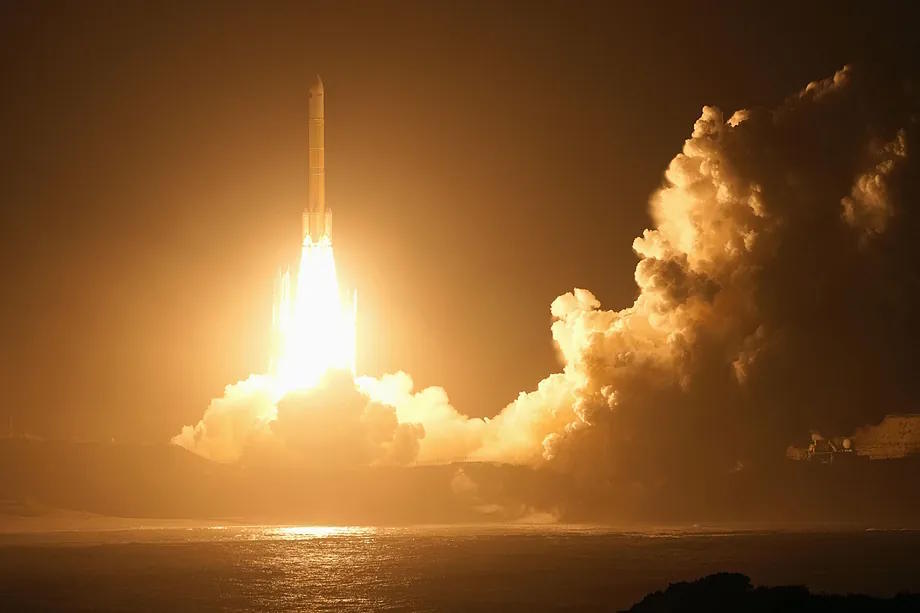
Well into the early morning, while much of Japan slept, a gigantic column of fire illuminated the sky over the island of Tanegashima, at the southern end of the archipelago. The H3 rocket took off amidst a cloud of smoke and a thunderous noise that heralded the beginning of one of the most ambitious space journeys in the history of the Asian country. Its destination was not the Moon or Mars, but a small and enigmatic world that orbits the red planet. It is called Phobos, and scientists have been trying to figure out where it came from for decades.
Just over an hour after the launch, the control room of the Japan Aerospace Exploration Agency (JAXA) celebrated the first victory. The Martian Moons eXploration (MMX) probe had separated correctly from the rocket and began its long interplanetary journey. If all goes as planned, it will reach the vicinity of Mars in August 2027, study its two moons for three years, and return to Earth in 2031 with an extraordinarily valuable cargo: at least ten grams of extraterrestrial dust and rock.
Phobos, the larger of Mars' two moons, is an irregular rock of just 22 kilometers in average diameter, covered with craters and grooves that give it the appearance of a battered potato. It orbits about 6,000 kilometers from the surface of Mars and completes three orbits around the planet each day. Its name comes from Greek mythology: Phobos was the personification of fear, the son of Ares, the god of war. Its celestial sister, Deimos, is named after terror.
The big question astronomers ask is how they got there. One hypothesis suggests that both moons are ancient asteroids captured by Martian gravity. The other posits that they were born from debris ejected into space after a giant celestial body collided with Mars billions of years ago.
If they were asteroids, experts point out, they would preserve information about the primitive materials with which the solar system was formed. If they emerged from a collision, they could contain fragments of Mars' own geological history.
"Despite their potential importance, the Martian moons have never been fully investigated," explained Yasuhiro Kawakatsu, director of the MMX project, in statements reported by the international press. The Japanese scientist describes them as some of the most significant mountains in the solar system that are still waiting to be climbed.
The operation will be an extraordinary technological challenge. The five-ton spacecraft must adapt to Phobos' orbit before approaching a surface that is practically unknown. The gravity of this moon is approximately one-thousandth of Earth's: any overly abrupt maneuver could cause the instruments to bounce.
To reduce risks, Japan is collaborating with the United States and several European agencies. France and Germany have developed a small four-wheeled vehicle named Idefix, like the dog in the Asterix comics. This rover will survey the terrain and study its characteristics before the main spacecraft attempts to land to collect samples using devices capable of drilling and vacuuming material.
The mission will also observe Deimos, although it will not land on it. Subsequently, the capsule with the samples will begin the return journey, with a planned landing in Australia.
For Kawakatsu, the project represents much more than a scientific expedition. At JAXA's official presentation, the researcher highlights that "the analysis of Phobos will help understand how the Martian environment evolved and what was the origin of water and organic materials present on rocky planets." It will also help develop technologies necessary for future human exploration.
Japan is well-versed in the delicate art of collecting samples from distant worlds. Their Hayabusa and Hayabusa2 missions successfully brought material from the asteroids Itokawa and Ryugu back to Earth. Those successes made JAXA an international reference and demonstrated that a country with a much smaller space budget than the United States could compete in robotic exploration.
But Japan has not had the same luck with Mars. The Japanese probe Nozomi, launched in 1998, never managed to enter Martian orbit after experiencing technical problems. And the H3 rocket itself, a central piece of Japan's new space ambitions, began its trajectory with a resounding failure in 2023.
Japan's new space adventure also has a geopolitical dimension. Space is once again becoming a stage where major powers compete for influence, scientific prestige, and strategic technologies. For decades, the United States and Russia dominated planetary exploration. Now China is disrupting that balance with a program advancing at an extraordinary pace.
In 2021, Beijing successfully landed its Zhurong rover on the surface of Mars, becoming the second country, after the United States, to operate a mobile explorer on the red planet. Their next big bet is Tianwen-3, a mission set to launch around 2028 and return in 2031 with at least 500 grams of material extracted directly from the Martian soil.
While Japan aims to bring samples from a Martian moon, China aspires to become the first country to retrieve material directly from the planet's surface.