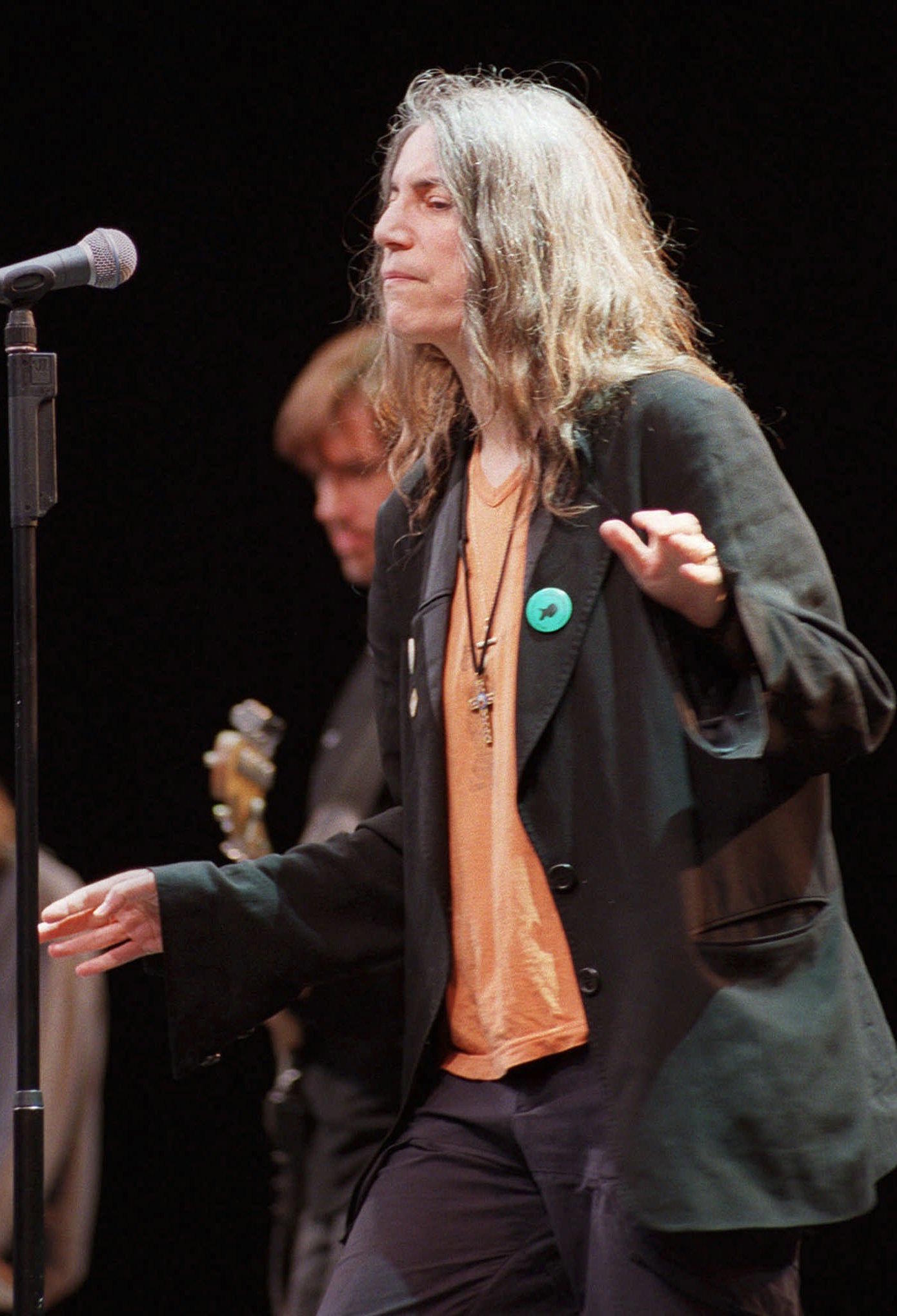
"When I was young, I was greatly influenced by the work of Lorca and Rimbaud. Both introduced me to the political and mystical world through their wonderful language. They helped me become a poet." Patti Smith and Spanish culture, a symbiosis that has reached the Reconquista hotel in Oviedo. The singer and activist has cited the poet from Granada as one of the great influences in her career. And she has done the same with Miguel de Cervantes, Roberto Bolaño, Pablo Picasso... "Picasso led me to become an artist at the age of 12, when I saw his work, he showed me different ways of looking. I already had that idea, but I couldn't articulate it until I saw Picasso's work and cubism."
All of them linked to our country, all of them crossing through the music and writing of the American. Patti Smith has been awarded this year with the Princess of Asturias Award for the Arts and on Tuesday she appeared before the press to thank it. "Spain has produced a lot of beauty and has also suffered many tragedies that it has been able to show through its artists [...]. There are so many things that catch my attention about Spain," said the singer who was one of the first awardees to arrive in Asturias last Sunday and one with the busiest schedule.
On Monday, she already had a meeting with students from the Bernaldo de Quirós Institute in Mieres, in the mining basins, and on Tuesday and Wednesday she will give two concerts, at the Jovellanos Theater and at the Palacio de Deportes in Gijón -the second was going to be held at the Fábrica de Armas in Oviedo, but the location was changed due to weather forecasts and its capacity was increased by 2,000 people due to high demand-. These two performances will serve to commemorate the 50th anniversary of the first time the godmother of punk brought her music to Spain.
"We were young and we wanted to bring rock and roll to Spain after the Franco dictatorship. We didn't have the perfect equipment, but everything turned out perfectly because we had a sense of change," Smith said, quoting Gay Mercader, the historic Catalan music promoter who brought her to Spain in 1966, the same year as the Rolling Stones. "It fills me with emotion [to give these concerts], but I am also saddened by the turbulent times we are living in. I always have young people in my thoughts, the young people who will come to the concert, what can we do for them," she said.
The singer, a recognized activist, also wanted to address the political issues shaking this world and, above all, her country, the United States. "I am not a nationalist, I am not a Republican or a Democrat, I am global, but I am ashamed of the corrupt government of my country. It is difficult to talk about it because we have a deplorable leader. I have nothing good to say about my president," she began. And she continued: "These are difficult times where art is not enough. We can always do something, use our voice, write songs, do what Picasso did by showing the suffering of the people. We can influence in many ways, but only if we are united. Voting is much more important today for change than responding artistically. It sounds strange coming from an artist, but we need numbers, to be united," she emphasized.
The jury already highlighted in its ruling last April that Patti Smith "has captured the rebellion of the individual in society in pulsating songs, some of which are already icons of popular music of our time". "As a writer, she has conveyed a poetic vision of life committed to offering a message of hope against injustices," the jury's ruling stated in reference to someone who, in addition to her musical facet, stands out for being a transgressive poet and a female reference in the New York counter-culture of the 70s.