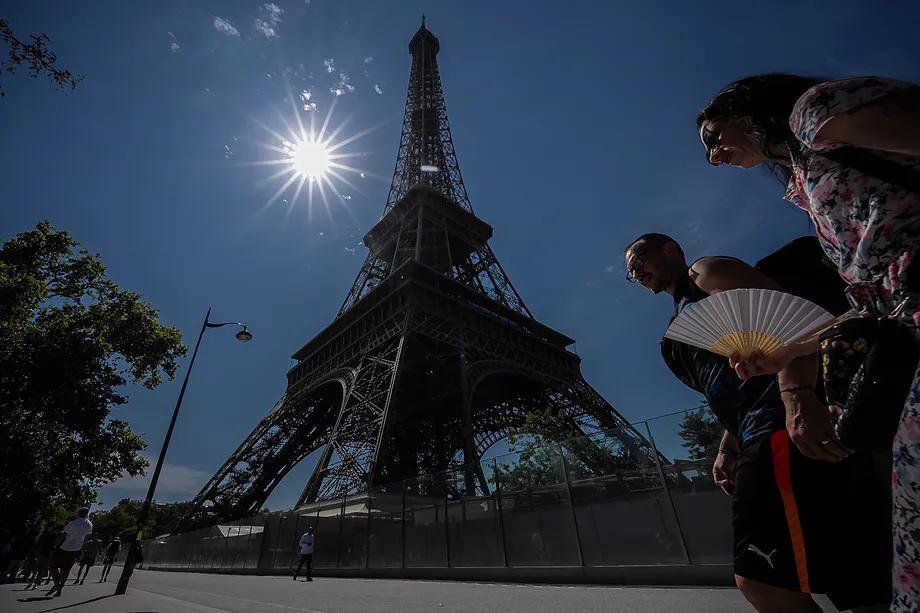
The recent memories of the past summer bring curious scenes: half of Europe cooling off in fountains and seeking shade, rivers and aquifers drying up, high temperatures in cities where the use of air conditioning or curtains is not common... The high temperatures of the various summer heatwaves set an unpleasant record: 50,391 estimated deaths in 2026, surpassing previous record summers of the 21st century like 2022 (29,480 deaths), 2003 (28,462 deaths), and 2025 (24,572 deaths).
According to experts who conducted the analysis published in Nature Health, "this is a wake-up call." "These figures demonstrate that our summers, increasingly hot and extreme, are having an increasingly serious impact on public health. Behind these statistics are real people who have lost their lives and real families who mourn them," laments Clair Barnes, a researcher specializing in extreme weather events and climate change at the Imperial College London.
The average temperatures for this time of year were 7.3°C above normal, as reported in the study. The season as a whole was unusually warm in Western and Southern Europe (anomalies of 2.9°C and 2.6°C, respectively). Therefore, researchers do not hesitate to point out that "climate change is responsible for an increasingly larger proportion of deaths," stated Garyfallos Konstantinoudis, assistant professor at the Grantham Institute of the Imperial College London. At the beginning of this century, it was estimated to be responsible for around 40%, but in 2026, this figure has increased to represent approximately two-thirds of heat-related deaths.
The significant increase in mortality in the summer of 2026 compared to what happened in 2003 or 2022 is explained by the combination of exceptional weather patterns, physiological factors during the heatwave, and urban vulnerability conditions. While in 2003, the most severe impact followed a southwest to northeast corridor in Europe (from Portugal to Germany through France), in 2022 and 2026, the highest mortality burden was markedly concentrated in cities in continental southern Europe.
Firstly, meteorological episodes stand out. While in the summer of 2003, mortality was mainly concentrated in a specific and extreme heatwave in early August, in 2026, there was a continuous and prolonged succession of heatwaves from late May to late August. In Southern European cities, dangerously high temperatures persisted uninterrupted from mid-June.
This weather pattern is compounded by the increased human-induced warming. "Europe warmed approximately 2.5°C above pre-industrial levels in 2026," noted Malcolm Mistry, assistant professor specializing in climate modeling and geospatial analysis at the London School of Hygiene & Tropical Medicine, during the briefing. 65% of the deaths recorded in the summer of 2026 were attributable to anthropogenic climate change, a proportion higher than the 56% estimated for 2022.
A third key factor was the early onset of heatwaves and the lack of population acclimatization. The peak with the highest number of deaths (almost a third of the total) occurred between June 17 and July 1. As it occurred early in the season, the population had not had enough time to physiologically acclimatize to the extreme heat. Looking ahead, experts point out that the speed at which extreme temperatures are increasing due to fossil fuel emissions is exceeding the capacity of urban infrastructure and public health services to adapt.
Lastly, the combination of tropical nights and high humidity also played a role. The June heatwave was characterized by a combination of very high relative humidity and unusually high nighttime temperatures, preventing the body from thermally resting at night and increasing cardiovascular stress.
The combination of factors had an impact on the health of the most vulnerable age groups: children and the elderly. "Mortality predominantly affected the elderly, accumulating 22,502 deaths in the 85 years and older group (almost 45% of the total 50,391 deaths)," stated Andrew Hartle, Anesthesiology professor at the Imperial College London and specialist in intensive care medicine at the Imperial College Healthcare NHS Trust.
Impact in our country: 6,824 deaths
In our country, 5,227 of the estimated 6,824 heat-related deaths between June and August in the 90 cities analyzed in the study can be attributed to climate change. This accounts for 77% of the total, with Barcelona being the second European city with the highest number of additional deaths (1,587), surpassed only by Milan (1,627).
However, if the climate had not warmed due to the burning of fossil fuels, there would have been around 1,587 fewer deaths, meaning that climate change is behind 88% of the deaths in the case of Barcelona.
In Madrid, the sixth European city with the highest mortality, this phenomenon caused 967 avoidable deaths (91%). The study estimates that around 1,067 people died due to extreme temperatures. In Valencia, it was responsible for 262 of the estimated 355 deaths (74%).
In Andalusia, it caused 84 of the 111 estimated deaths in Malaga (77%), similar figures to those of Seville, with 77 of the 109 (73%) or Granada, with 71 of the 98 deaths (72%) attributable to the heat. A lesser impact was seen in Zaragoza, with 169 of the total 264 (65%).
In our country, the reasons can also be found in the meteorology. The team coordinating MoMo at the National Center of Epidemiology (CNE-ISCIII) points out that this impact occurred "in an exceptional climatic context, characterized by four heatwaves identified by the State Meteorological Agency (AEMET), in addition to an additional heatwave in early September, persistent drought, large forest fires, and an intense marine heatwave in the Western Mediterranean." The researchers at ISCIII also note that, according to AEMET, it has been the warmest summer in recent history.
The elderly were once again the most affected: 97% of the estimated heat-related deaths occurred in people aged 65 and older, with 62% in those over 85. 60% were women. Additionally, the impact was not uniform across the entire territory, with the highest rates of heat-attributable mortality observed in the northern and northeastern regions of the peninsula.