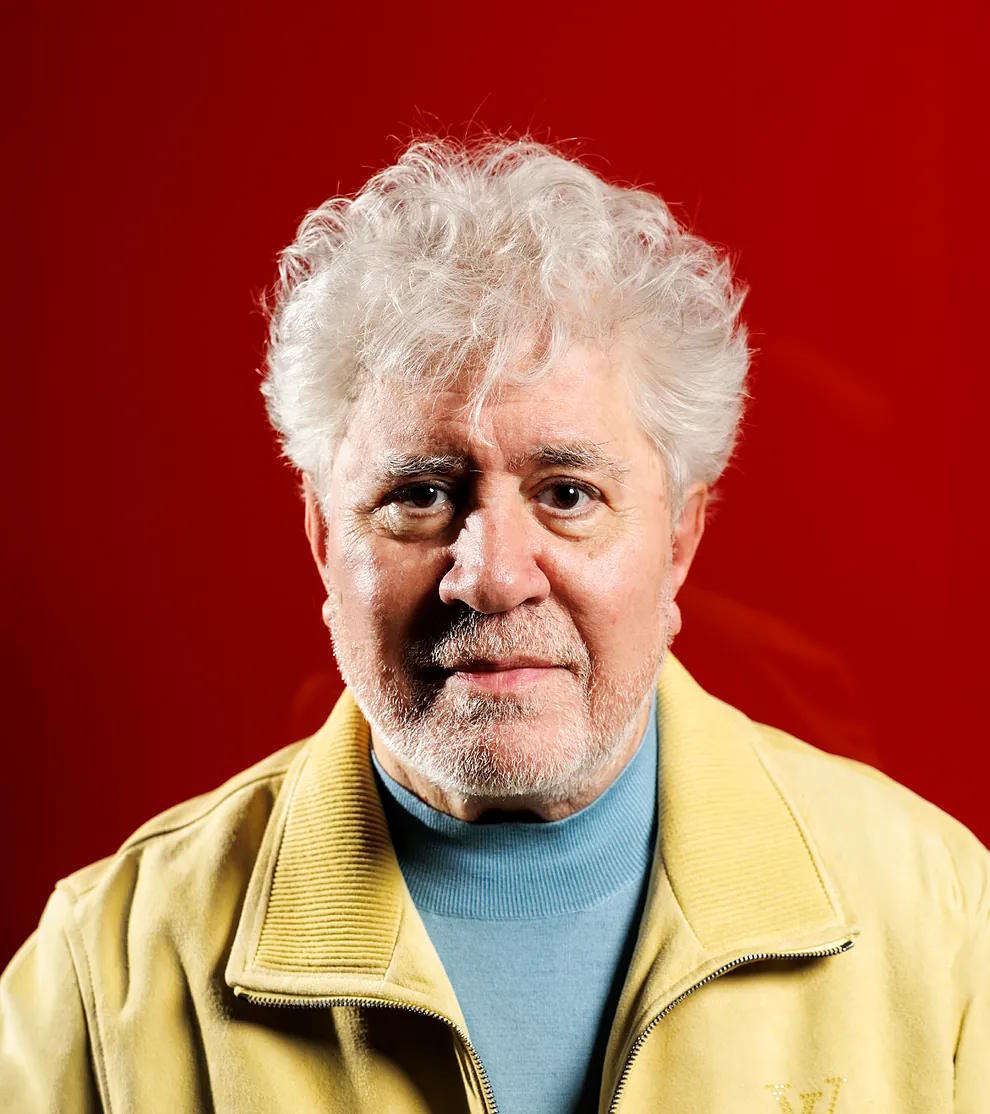
It was only a matter of time before—after the early madness of Fire in the Gut, his chronicles of Patty Diphusa, and his short story collection The Last Dream—the filmmaker would debut as a novelist. And he did so, true to himself, like no one ever has. The Man Who Only Wrote on Airplanes (Reservoir Books) is more nivola, as Unamuno would say, than a novel. It is the story of a writer wounded by anxiety and the insatiable pleasure of reading; a writer who turns his craft and himself into the very material of fiction; a writer who, as the title suggests, can only write in the stratosphere, that dry and barely dense place where reality loses its footing, weight, and meaning. Back on solid ground, in his office at the production company El Deseo, Almodóvar sits down, pulls out a stack of carefully drafted pages ("These are reflections to keep me from getting lost in interviews," he says) and takes a sip of the coffee just brought to him.
What comes first, writer or filmmaker?
I have always had the vocation to write. In fact, I have always written. I have been doing it since my mother gave me an Olivetti typewriter and a typing book when I was 10 years old to learn. I could never have imagined that, thanks to this gift, I would end up writing every day of my life. But I believe I am a better director than a writer.
Do you write differently when planning a movie or when, as now, it's about a book?
I start writing when I read. And I almost always read lying down. Ideas come to me while reading, and like the character in the novel, I rush to jot them down wherever I can, in the margins of the books themselves, if necessary. But above all, I love my desk, which is where I feel most comfortable. What happens is that when I am in the genesis of a story and I realize that the story is within me, I can write anywhere. I do it when I'm in the car or, as the book says, on airplanes. I wish I could, like the protagonist, write for ten hours straight. I settle for those first three hours right after takeoff. It's the moment when, for whatever reason, I achieve the most concentration. Many of the ideas for my films have emerged at that precise moment.
In the prologue of the book, you insist on distancing yourself from Flavio Guijarro, your protagonist, but as the reading progresses, it seems that there are many things that coincide; too many, even.
One is not exactly the person one believes to be. It's not that you mask yourself in literature, but it is true that you always become an element of fiction. We are imbued with our lives no matter what we do. Whether you write autofiction or not, you always take yourself as a reference.
Does literature explain life, so to speak, or is it part of life? In other words, what relationship does Almodóvar have with what he reads? I have the spirit of a thief. Once I read something, that experience belongs to me because it has indeed had an effect on me. And since it belongs to me, I can do whatever I want with it. It's true that, as I am already of a certain age and have a sensible brother, if I think of using something I've read for my own stories, I take the precaution of asking for rights. But to be honest, many of the rights to my works have been bought, but I would give them away freely. Once I have done something, I don't care what happens next. That's why I say I have the spirit of a thief. Because I am clear that you are never the first or the only one in anything. I have no sense of ownership and I continuously distort what passes through me and what I read. It's only fair, in return, that I be distorted too. I don't often look at myself. Although I write autofictions from time to time and am very self-aware, I am not narcissistic at all and can go weeks without looking in the mirror. I do shower daily, of course.
In your novel, you become the author of a fanfiction of Blade Runner...
I am fascinated by this phenomenon. It's people who cannot stand that their favorite story ends and feel the need to continue it beyond the author because, as readers, it is theirs too. The first time I stumbled upon this was with a story from Star Trek. The author had made one of the characters pregnant and continued the story on their own. It's very popular in the United States. Not so much here. Perhaps the closest thing was the phenomenon of fanzines in the 80s. I am fascinated, I said, because of what it represents as a declaration of love for the original and for fiction itself.
Where does inspiration end and plagiarism begin?
It seems like plagiarism but it isn't, because the author continues to bring the story to life on their own. My protagonist cannot stand that Blade Runner ends. It's as if fictions never end, and that's wonderful. The idea is that fiction is alive as long as someone picks up the torch and continues with it. I identify with this way of creating in common. Right now—I don't mind confessing—I am working on a fanfiction about the Menendez brothers' crime [referring to the series Monstruos: La historia de Lyle y Erik Menendez]. It doesn't resemble what Ryan Murphy created at all, I'm not going to turn it into a movie or anything, but I enjoy creating my own version of the murder. What I'm producing is very intense. I also write a bit against boredom and without seeking a specific destination like a book, a series, or a movie.
You mention that what you're producing is very intense, and I think of the pedophilic novel that appears as a secret in one of the stories created by your protagonist. Perhaps the question sounds a bit pious, but should there be any kind of limit, moral or otherwise, for creation?
No, there can't be limits. Any creator will tell you that the very idea of a limit goes against the very essence of creation. But it is true that literature can harm someone, and that must be taken into account. And avoided. If you have an idea that moves or excites you, which generally comes from the people closest to you, you cannot do anything to ignore it. Moreover, in my case, I have always been inspired by pain. And that wonderful drive towards creation is non-negotiable. When it happens, you don't pay attention to anything; you don't think about your friend, your boyfriend, your mother, or your brother. You only think about the idea. In summary, as a creator, I must have no limits.
Despite this, I think of Consent, by Vanessa Springora. The creation of the pedophile Gabriel Matzneff ruined the author's life...
Yes. And there's also the case of Lewis Carroll or Nabokov with Lolita, which, although it is fiction and serves as a denunciation, much of what he makes his protagonist say, and how he says it, leads one to think that it goes through the writer himself. But writing from the depths of darkness is extremely important, even if it may be illegal and based on a crime. I appreciate that literature that comes from those places and, I admit, terrifies me. There are photos, for example, of Robert Mapplethorpe that paralyze me, but I appreciate that someone, from the depths of the purest and hardest sadomasochism, illustrates that unknown and inaccessible territory for most. Otherwise, beauty would not exist. I don't know if I like that kind of people exist, but I like their work. And I carry that even into the ideological territory. I cannot disagree more with Louis-Ferdinand Céline on everything, but that cannot disqualify the value of his writing.
"I am getting younger, smaller, and I have less and less time." It's one of the quotes you use to portray the anxiety from which you say you write.
The book is an example of what it is to write constantly anxious. Anxiety drives you, spurs you to go faster. But, on the other hand, it devours and consumes you. After premiering the last film, I had a brutal spike of anxiety. I had no choice but to seek help from a neurologist who applied magnetic neuromodulation. I had never seen myself so bad. I love the drive when you start writing; the problem is that there's nothing to warn you that you might be overdoing it. And you're in danger.
Are you worried about aging, are you worried about the passage of time?
Time has become the great enemy. The relationship of time with cinema is the relationship of death with life. Every day I wake up, I don't feel like I'm facing another day, but rather living one day less. I must confess that after the pandemic, I felt a terrible rush. Since then, I have worked more than ever in my life. In fact, I currently have three active projects... I am very active. And that resembles anxiety.
Not long ago, you spoke of a science fiction project; isn't it related to the continuation of Blade Runner that appears in the book?
No, I had to leave that one behind. And it was very painful for me because it was very developed.
In the fanfiction of Blade Runner, there is talk, among other things, of synthetic culture vs. human culture...
I'm glad this topic has come up because when I wrote this, nothing was known about artificial intelligence. Or it wasn't as popular as it is now. I have the impression that we are at a moment in history where it is necessary to protect culture in a sanctuary. In the story, I imagine the paradox that it is the replicants who are fascinated by films like Brief Encounter by David Lean, because for them, human passions are science fiction. Something like marriage seems as fascinating to them as it is dystopian. In other words, if things continue this way, it will be the machines that end up protecting human creation more than humans themselves.
Do you think culture is experiencing a period of harassment? And I'm not just talking about AI, which is also a factor, but about the law passed in Castilla León that proposes to reinstate censorship by withdrawing funding from films that indoctrinate or simply have political content.
But what films are those? I understand that it is in the nature of everything we do to be political because it is influenced by its environment. Even a musical comedy is political. I think of my own cinema, for example. Parallel Mothers had a clear political message, but Pepi, Luci, Bom and Other Girls from the Bunch did too. It had a political message that was to advocate for the absolute freedom of the characters. Trying to impose censorship again, as some want, is absurd. Censors are always too clumsy, and things happen like them being handed the script of The Executioner and getting fooled.
Are you scared of the new era of censors that is coming?
We are in the midst of an Apocalypse. Or at least in a pre-apocalyptic period. In addition to the current problems and what is coming on November 29, we must add issues like AI that place us in a perfect storm. I am horrified and I believe we should be horrified. We cannot get used to feeling fear. I do not get used to it. On the other hand, I see the youth of the world taking to the streets, and I can't help but agree with them. The future belongs to them, and right now, they have no future. So yes, I am very afraid of what is happening, but at the same time, I am not willing to throw in the towel. We must not give up or get used to horror. We must be indignant every day. I refuse to stop being indignant. The only limit to indignation is that your blood pressure rises.
And what do the polls say about the youth's shift to the right?
Well, not all of them. The truth is that it makes me very happy. What is happening in Puerta del Sol refutes the idea that young people are right-wing and that 25% of them prefer Franco's dictatorship. That's not true. Not all of them, far from it. The best are in Sol. I want to participate more and help them. I only went once and brought food because I thought it would be good for them. What they say (well, Ayuso says) about the businesses in the area suffering is not true. When I went, they were all full.
How do you see the phenomenon The Black Ball, of which you are a minority producer, and that the directors, Javier Calvo and Javier Ambrossi, consider themselves heirs to your cinema? I've heard them say that I am their first teacher, and I appreciate that very much. I hope it serves them well. What is happening with The Black Ball is something unusual and historic. The closest thing that has happened to me was with Talk to Her. But it was very early. It was the second time a script that wasn't in English was awarded. The revolution that came with the protest against the "too white Oscars" that internationalized the Academy had not yet happened. Now everyone can vote in all categories. It is undoubtedly their moment.