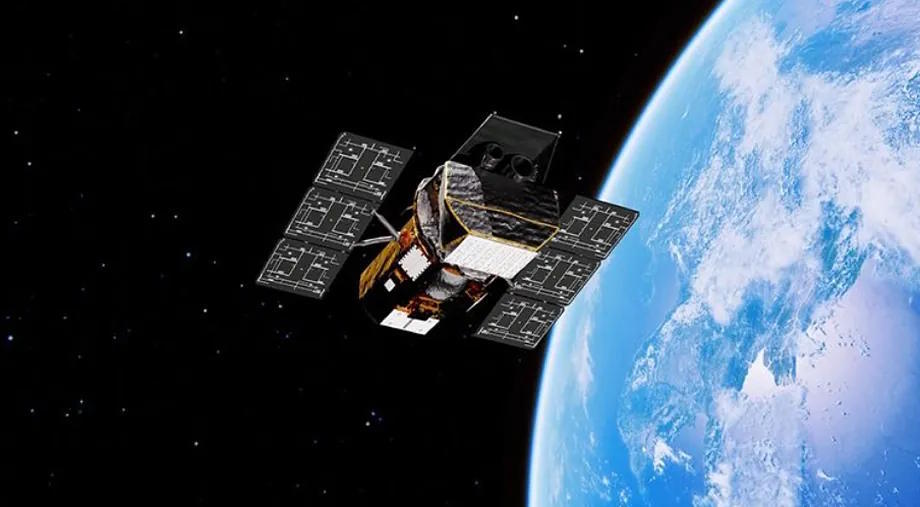
Nearly 22 years after its launch, NASA's Neil Gehrels Swift Observatory is about to return to Earth. However, it will do so as space junk and with some concern because the re-entry into the Earth's atmosphere will be uncontrolled. According to NASA, most of this observatory, which weighs approximately 1,450 kilograms, is expected to disintegrate, but some components will survive the atmospheric re-entry.
The U.S. space agency does not know where those fragments might fall, as it stated in a release that the possible landing zones for the surviving fragments may vary from one hemisphere to another and will depend on the exact moment of re-entry.
In September 2025, NASA initiated a technological rescue mission to try to raise the observatory. To do this, it commissioned Katalyst Space to build a spacecraft capable of reaching Swift, capturing it, and elevating it, but the company failed in its mission and abandoned the attempt last August. Since then, Swift, which does not have its own propulsion system on board, has been gradually approaching its end while orbiting Earth at a speed of approximately 27,000 kilometers per hour.
According to forecasts from the U.S. Space Force made on Monday, the observatory will enter the Earth's atmosphere this Wednesday, November 4, at 9:30 AM Spanish mainland time, with an uncertainty margin of 11 hours.
Due to Swift's low orbital inclination, the areas where the surviving fragments could fall are limited to the equatorial region, within a band between 20.6 degrees south latitude and 20.6 degrees north latitude.
The probability of someone on Earth being harmed is very low but not zero, as its possible trajectory includes populated areas in South America, Africa, and Asia. U.S. authorities have estimated the probability of someone being harmed at approximately 1 in 2,100. Therefore, the space agency and the U.S. Space Force will continue to monitor the re-entry and update their forecasts.
According to Reuters, the Aerospace Corporation, a nonprofit research entity dedicated to national security, calculated a re-entry window at 11:19 AM (in the Peninsula), with an uncertainty margin of about two hours.
On the other hand, astrophysicist Jonathan McDowell, honorary professor at the Space Research Center at Durham University, noted that according to data reviewed by the U.S. Space Force, re-entry is most likely to occur around 1:45 AM.
NASA's Swift, composed of three telescopes, was launched on November 20, 2004, to explore the most powerful explosions in the universe, known as gamma-ray bursts. At that time, it was a pioneering mission for observing the cosmos across multiple wavelengths, in which NASA invested $500 million.
Originally, it was designed for a primary mission of only two years. However, over more than two decades of scientific operations, it became a multifunctional tool for exploring the universe. It observed a wide variety of wavelengths of light, could quickly orient itself toward short-duration phenomena, and sent alerts to other observatories to coordinate subsequent observations.
As NASA highlights, "Swift has expanded our knowledge of a wide variety of cosmic objects and phenomena: from active galaxies powered by supermassive black holes and stars experiencing X-ray flares to supernova explosions, comets, and asteroids from our own solar system."
Thus, it has observed more than 2,000 gamma-ray bursts. It has studied over 1,400 supernova explosions, witnessed stars being torn apart by black holes, monitored active galaxies, conducted an X-ray survey of the entire sky, and studied asteroids and comets, among other activities. The data obtained by Swift have contributed to the publication of nearly 7,000 scientific articles.
Its name is a tribute to the first principal investigator of this mission, Neil Gehrels. When the scientist passed away in 2019, NASA decided to rename the mission in his honor and add his name to Swift.