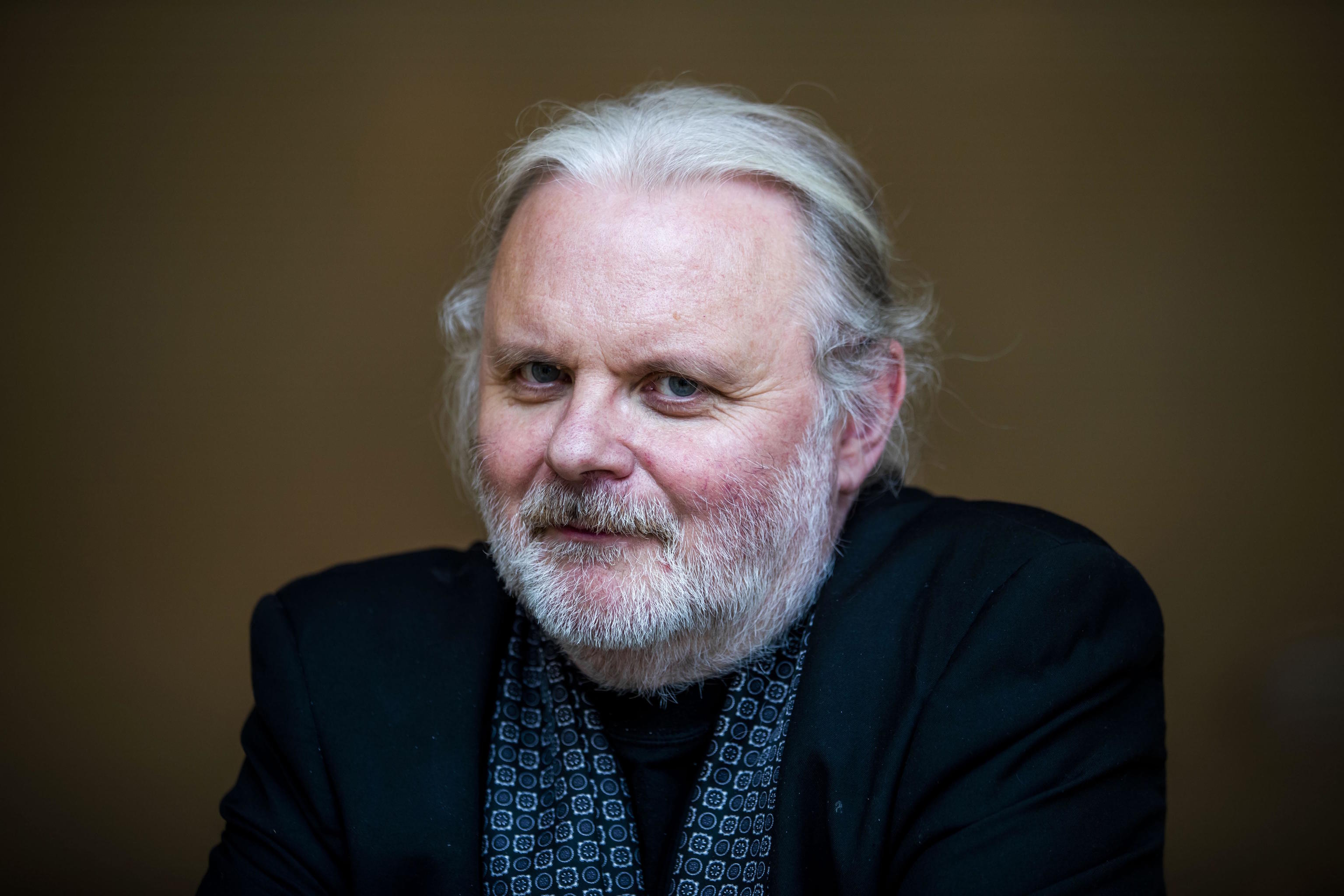
"How's everything going? Are you hungry? I'm going to eat a Rekesmørbrød - a typical Norwegian shrimp toast - and I'll snack while we talk," announces a cheerful Jon Fosse (Haugesund, 1959) in the luxurious Biblioteksbaren of the Hotel Bristol in Oslo, a grand hall filled with leather sofas to sink into, heavy carpets, and shelves full of ancient books that have been the favorite meeting place of politicians, writers, musicians, and journalists in the Norwegian capital for over a century.
We attended our appointment with the Nobel Prize in Literature 2023 to chat about Hotel Vaim (Random House), the second part of his trilogy dedicated to this imaginary place, a reflection of the towns and fjords of western Norway where the author grew up, in which he explores love, loss and memory, loneliness, unease, and the mystical to reveal through a ghostly atmosphere the profound complexity of human relationships and existential spirituality.
In Hotel Vaim, the world shifts to an establishment where things seem to have stopped obeying ordinary laws. The Guest, always unnamed, remains there without us knowing quite why, objects appear and disappear, relationships become tangled, and the boundary between the real and the imagined becomes increasingly porous. There is something nightmarish, but also a disconcerting comedy in this man who seems unable to govern his own life. Fosse clarifies, however, that he did not start from any thesis about the human condition.
"After writing Septology [his major novel], which was a very demanding work, I wanted to do something quieter, something I enjoyed and that didn't force me to aspire to more. I started writing while waiting for my daughter to finish her French classes. I would sit there with my notebooks and write by hand, with various colors, just for fun. And this universe appeared." What began as an exercise in freedom turned into another way to explore his obsessions. "I really enjoyed writing these novels. It wasn't a burden. For me, that's not a weakness but another way of telling a story."
The hotel is, indeed, a place of passage where one settles without fully belonging. Fosse compares it to an airport, that intermediate space that places us in a city without truly living in it, waiting for a destination that may be indefinitely delayed: "Perhaps all hotels are a kind of purgatory. You're there, you can sleep, but you're not really anywhere." The image extends to much of his work, populated by characters who seem suspended between life and death, the past and the present, what happened and what could have happened.
In Hotel Vaim, moreover, the Guest gradually submits to rules that no one has explained to him. Freedom, for Fosse, is never a property one can take for granted. His characters do not always know what they desire, nor are they able to oppose their desires when they recognize them. "We spend most of our time obeying unwritten rules, simply to behave in a more or less decent manner. We can break them, of course, but we have to be willing to face the consequences. And we almost always act unconsciously," he reflects.
The strangeness of this universe should not be confused with an exercise in solemn darkness. One of the surprises it holds is its humor, which does not lighten the unease but makes it even stranger. A fishing tackle that appears and disappears, an encounter that shouldn't happen, a character who seems always on the verge of understanding something but never quite does: comedy arises without the writer seeking it. "When I started writing, my novels were absolutely dark, destructive, almost nihilistic. Then, something changed. My work remained tragic, but a comedic side also emerged. Since then, much of what I've written is in an intermediate point: it's neither tragedy nor comedy, but both at the same time. Like life."
"Art is the opposite of war. While politics divides the world into two camps, literature, which is ambiguous, can say two opposing things."
Fosse carefully distinguishes between being humorous and being comedic. The former aims to make people laugh, but in the latter case, laughter happens without anyone calling for it. "When I write, my only concern is to do what the work needs; I don't try to be funny. Sometimes things just turn out to be comedic. And that can be as serious as the tragic." In this border zone, two of his great masters reappear, Samuel Beckett and Franz Kafka, although he grants greater admiration to the latter. "Kafka is perhaps the writer I admire most. When I was young, I was very interested in Beckett, and I still am, but over the years I've seen more clearly the enormous influence Kafka had on him. We often talk about Joyce and Beckett, but if you delve into them, you always find the echo of Kafka."
The affinity becomes especially visible in Hotel Vaim. Fosse acknowledges that his own writing does not resemble that of either of them too much, but he does find in this novel something of the disconcerting logic of the author of The Trial: "Kafka was a very comedic writer. There is a prejudice that he is not, but just read him carefully. His stories are both tragic and comedic, like Beckett's and, in many ways, like mine." In that logic, a man can be arrested one morning without having committed any crime and accept, despite everything, that the world works that way. The explanation does not come because there may be nothing to explain. "The absurd is not an anomaly that the writer must correct, but one of the forms that human experience takes," he emphasizes, insisting: "The paradox is fundamental in my writing. Things can be one and the other at the same time, without one possibility negating the other."
This conviction links his literature with faith, a relationship that has increasingly gained centrality in his work. Fosse does not present himself as someone who has resolved religious questions, but as someone who has learned to coexist with them. "Being Christian means accepting a paradox. The Trinity, for example, is one and three at the same time. From a scientific point of view, that seems impossible, but literature and religion can contain those contradictions. You have to accept the mystery. If you believe you can explain everything, you cannot believe that way."
As he recounted many times, his path to faith was not linear. As a young man, he tried to be a Marxist and an atheist, but there was something in his own writing experience that he could not explain from a materialistic perspective. "When I wrote, I wondered where it came from: the voices, the characters, the settings... I couldn't understand it," he recalls. "My mind began to open to the invisible and then to the idea of God. I felt something very close and, at the same time, very distant. I can say that I believe in God, but I cannot say what God is. I know He is there, close to me, even though I cannot explain how." Fosse's faith does not resemble a definitive answer but rather a way of keeping an open conversation.
That is why, he recalls, he was so surprised by the reception of Septology, the extensive novel featuring a painter named Asle, a Catholic devoted to reflection on existence, creation, and the possibility of grace. In Norwegian society, he remembers, "the word God had been almost unutterable in the literary realm for a long time. I was convinced that people would not like that religious dimension, I thought the book would face great rejection, but the opposite happened, in Norway and many other countries. I realized that I had misunderstood something important: our contemporary society needs to ask those questions. It was a very strange and also very surprising experience."
This need does not imply, however, that the Church should regain the power it once had. From his Norwegian perspective, the institution has lost much of its authority and, precisely for that reason, can play another role. Fosse maintains a close relationship with the Quakers, whose spiritual tradition does without priests and sacraments, and sees in liturgy a possible counterpoint to contemporary noise. "In Northern Europe, people hardly care about the Church. It was perfectly reasonable to criticize it before because it had too much power, but today I'm not sure that is the problem. In Norway, a church can be a place of silence, a space that opposes the demand that everything be subjected to money, capitalism, and commercial interests."
Silence is not for him an absence but a form of attention. It is at the center of his theatrical writing, where words seem to be drawn on a blank space, and also in Asle's experience, who seeks in it the possibility of hearing God. "We live in a world where everything is noise. People want noise and more noise, perhaps to calm themselves, to stop thinking. I believe that we need, in literature and in general, to give more space to silence. It is not about withdrawing from reality but about stopping the obligation to express it at every moment," he asserts.
However, cautiously, we ask him to comment on the wave of protests shaking Europe. Fosse, subtly, again distrusts labels: "I am not a political writer; I don't know if that exists, I am just a writer. You can interpret my literature from the left or the right, however you want. But I hope to be a good writer because then perhaps I can contribute something valuable to the world. My way of supporting the protests of young people is to show them through my books that another possible world exists." Fosse does not see this position as a renunciation of responsibility but as another way of exercising it. "A good book can have political implications without becoming a manifesto or offering answers to the problems of the present. As Wittgenstein said, ethics and aesthetics are the same," he quotes.
"Literature and art are the opposite of war," he continues. "In a war, one side says one thing and the other says the opposite. In politics, something similar happens. Literature, on the other hand, can say both things at once. It does not simplify the world but returns it to the ambiguity that it truly has." Again, ambiguity, a core idea in the work and life of the Nobel laureate. "Good literature does not eliminate contradiction to make the reader feel secure; it preserves it, even when it is uncomfortable." In times when so many leaders promise to restore certainties, the writer advocates precisely the opposite.
The author recalls an observation from the American critic Harold Bloom: "He said that good literature does not teach us how to live but how to die, and I think that is a very accurate idea. Literature teaches us something about uncertainty, which is both the most certain and the most indeterminate aspect of our existence. Death is inevitable, even though we cannot comprehend it. Good literature maintains that ambiguity; it does not try to resolve it." Fosse does not seek to make his novels enigmatic; he simply does not believe that reality can be reduced to a single explanation without losing something essential along the way.
This uncertainty also extends to the reader. The Norwegian asserts that he never thinks of himself while writing. "If I did, I would be afraid and wouldn't be able to write. I would think that what I am doing is going to be published and available for anyone to read. It's a terrifying idea," he admits with a laugh. However, his writing is anything but accidental: "When you write, you are addressing something. I compare it to a prayer; it is not directed at a specific person but to God." Thus, the work arises from a singular experience but does not remain confined to it. "A good artist manages to transform the most idiosyncratic aspects of themselves into something universal. My favorite painter for years has been Mark Rothko; his work is completely unique and, at the same time, can reach anyone."
Art, therefore, is not limited to representing a prior reality; it can create one that did not exist before. The world of Hotel Vaim may not be real in a literal sense, but for its readers, it acquires its own consistency; it is a place to return to and recognize something of their own experience. From that belief arises Fosse's skepticism toward artificial intelligence. For him, a machine can produce correct texts, even incorporate errors to simulate a human voice, but it can never replace the origin of a work of art. "Generating text is not the same as creating literature. In literature, emotion is fundamental, and so is understanding through emotions. In theater and poetry, we understand that way, not through a concept, as in philosophy. A machine can produce emotions, but if you discover that what moved you came from it, you might feel that someone has betrayed you."
The issue is not reduced to formal perfection or the ability to imitate a style. "Art has to do with the most intimate aspects of being human, and a machine does not possess and will never have that spiritual dimension," he emphasizes. "Fundamental creation must come from a person. After that, you can copy a work, reproduce it, but that is not the same as creating it." He adds something that brings the conversation back to silence: "Writing is also a pleasure, the pleasure of discovering things while you write. If you take the writer out of the text, at least for me, it ceases to be a living experience. It is something physical, like playing an instrument. You write with your hands, not just with your head."
The Nobel Prize has turned Fosse into a public figure on a much larger scale than that playwright who for years saw his works performed throughout Europe and eventually stepped away from theater to return to the novel. Today he recalls the surprise of discovering that suddenly there were a hundred productions of his works in Germany or that his name circulated in stages he never would have imagined, like China and Japan. However, he acknowledges that the 2023 award represented a transformation on another scale. "For me, it was a blessing, of course. Every writer dreams of publishing a work that completes what they have done," he asserts. "But something like that also has a bit of a curse because it imposes the struggle to make your life resemble as much as possible the one you had before. You need to continue being the person you were to remain the writer you were and hope to continue being."
Recognition can become a public identity that has little to do with creation. "When you are a marginal writer, you are a subject, someone who is outside the system. When you receive the Nobel, you become an object, a national icon. That exposure, that fame is something completely opposite to my identity and my way of creating."
There is something of that paradox in the fame that now accompanies Fosse himself. The writer who seeks silence and solitude has become a public presence impossible to ignore. However, as with almost everything, he does not seem particularly concerned about offering a conclusion. "There are people who need to be completely sure of something and others who are not afraid to ask questions and live with uncertainty. The difference is important; dogmatism and the radical search for answers are harmful to society. I do not believe in a God that can be defined without flaws, and I also do not believe that literature should tell us what to think. The human experience is so complex and wonderful that it is much better to live in doubt," he concludes.
And in that doubt made of questions, the seed of one of the most fertile literatures of the present, we leave you until our next almost annual meeting.