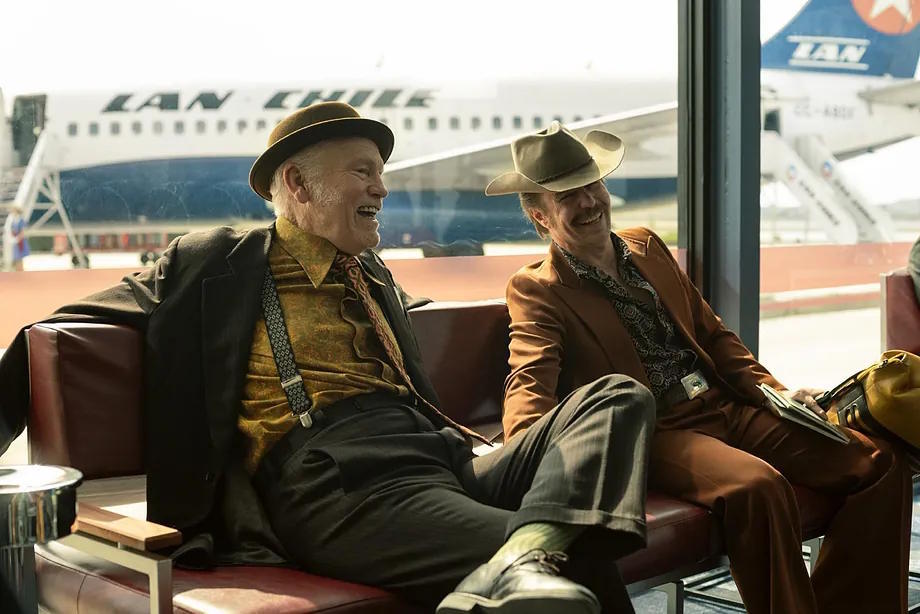
Martin McDonagh (London, 1970) has transitioned from a breakthrough playwright thanks to the play The Beauty Queen of Leenane (which he wrote at just 26) to an essential figure in contemporary cinema in just five films and 17 Oscar nominations (the short Six Shooter and its actors Frances McDormand and Sam Rockwell won it). Following Three Billboards Outside Ebbing, Missouri and The Banshees of Inisherin, the filmmaker returns with Wild Horse Nine, a story of lost men, ruthless men, and, most importantly, men in love with their own defeat. John Malkovich, showcasing like never before, and Sam Rockwell are two CIA agents who, days before the coup in Chile, reflect on Easter Island (Rapa Nui) about each of their sins, their wounds, and, once again, their defeats.
Your film is, in some way, a history lesson to demonstrate that we have learned nothing from history.
Yes, that could be true. Unfortunately, for example, the matters that the CIA or the U.S. government kept hidden - or tried to - in Chile in 1973, or in Cuba at the Bay of Pigs, in the Congo, or wherever, are no longer a secret, and yet no one seems to react. We live in a moment where neither governments hide their crimes against humanity nor do people care at all. In a sense, one could say we are going backward. But I trust that at some point we will realize how absurd the current situation is, and that will allow us to fight against it with more strength and many more reasons. At the film's presentation in Venice, you mentioned that we know almost everything about the atrocities committed by the KGB and almost nothing about the horrors committed by the CIA. Who is responsible? The media, ourselves for refusing to inform ourselves, the government...? It is not us, neither you nor I, who control the media. But the truth is that information about Pinochet's coup is available to anyone who wants to know. Yes, in a way, we are all somewhat responsible. As far as I'm concerned, my responsibility is to ensure that a film like this, which talks about all that, is as truthful as possible. And I believe it is. Personally, I prefer to be optimistic and focus on hope. I trust that those who watch the film will inform themselves afterward and not be deceived by far-right propaganda.
Again, as is common in much of your cinema, this is a story of friendship between two men. Is there a reason for this? What does your therapist think of this obsession?
I think it's time for me to go to therapy. For now, I don't have a therapist. In any case, I settle for the simplest explanation, which is usually the best. I find the relationships between men with some depth and love very interesting. Cinema is not very inclined to dwell on this aspect when portraying a man's life. There is a constant in Hollywood that consists of depicting brilliant men, unique beings who perform unique feats. And yet, I have never been attracted to these kinds of stories. They all look very similar and are quite boring. Most people are not brilliant. Why should anyone be interested in this kind of martians? I find sad, uncomfortable, or problematic stories to be more common and shared by everyone. That's where most of us are, and exploring that is much more entertaining. And more truthful.
There is a fairly common term to describe a type of masculinity: toxic. Would you say that it is those types of behaviors or relationships that you flee from or try to refute in your films?
Perhaps it is something that lies beneath the surface, but I couldn't say that my goal is to change people's ideas about what is called toxic masculinity. Although, of course, I detest it. I prefer to think that I want to show that we are not like that, that we don't have to be; that it is possible for subtlety and love to occupy a central place in our relationships, both among us men and with women. Furthermore, I don't like films that present role models, so to speak. And these characters are certainly not role models. But there is a love in the relationship between John and Sam that is not even expressed in words, but it is there. And it is something palpable.
How would you describe your position within the film industry in general and Hollywood, which rewards you so much, in particular?
I definitely do not consider myself part of the Hollywood system. I am clearly outside of it. On the other hand, I am also not interested in offering an external view - that of an outsider - on the United States just because I was born in London. I am not looking for an external or 'meta' perspective on Americans. However, I believe that being a bit on the sidelines is a privilege that allows you to seek a truth that you probably couldn't reach if you were part of the Hollywood commercial system. Moreover, I have complete freedom: no one interferes with my scripts with suggestions or changes. It is a pure vision, entirely mine.
Would you say, from your external point of view, that Hollywood is now more conservative than ever?
Not necessarily. The 80s, for example, were also a fairly conservative time, but the memory we have of them is thanks to their most interesting voices. In the end, it is the exceptions that define the eras. That always happens, and no matter how bad commercial films are, what remains is what is truly relevant. It is David Lynch who defines the 80s, not the garbage that grossed 300 million dollars.
Did it take McDonagh for us to realize that Malkovich has always been there?
It's strange. He has always been one of the brightest actors of his generation and, for whatever reason, he hasn't played a lead role in a long time. Something similar happened to me with Frances McDormand, who hadn't starred in major films for 30 years since Fargo. I don't feel like I'm doing anything revolutionary. I'm not one of those who want to discover anything or anyone. For me, it's simple: they are the best, I give them my best character. What others do or don't do is not my concern.
Once again, everything happens, as in In Bruges..., on an island. What would your nonexistent therapist say about this?
I'll save that question for the therapist. There is something beautiful about filming on an island. Not only the fact of living there or being there, but the sense of isolation that pervades everything. We stayed in Rapa Nui for the two and a half months that the shoot lasted. It was truly beautiful. At first, I thought we would want to move, to find a place with more nightlife or go out somewhere on the weekend; but in the end, I spent my time biking around the island, watching the wild horses, and discovering new places to shoot the following week. Being surrounded by the ocean gives the place an almost spiritual quality that is striking.