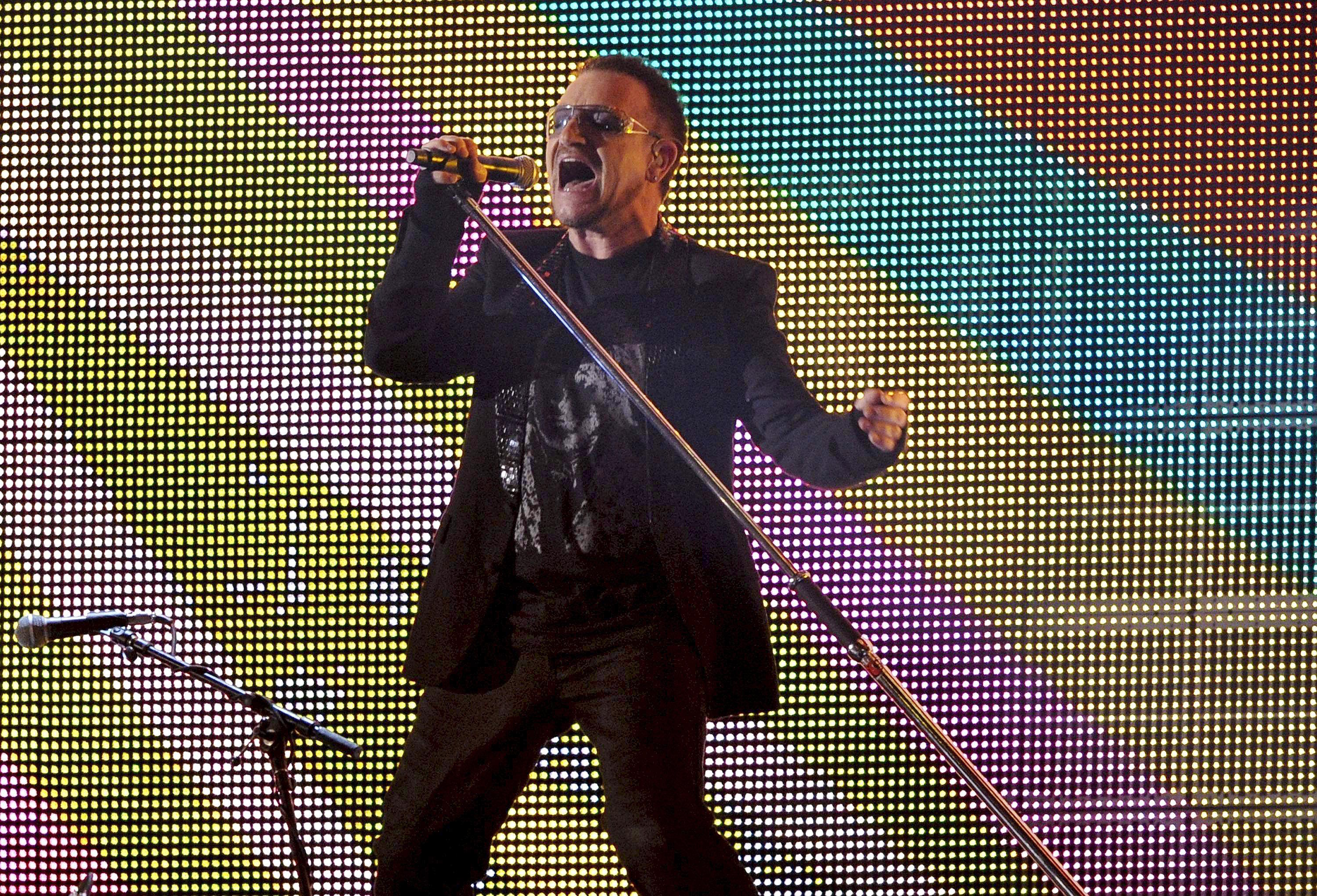
The interview begins and ends with Bono's Spanish teacher from school. "She had it in for me!" says the U2 frontman as if he were still 12 years old. "Spanish is very complicated," he laughs, "and that teacher didn't make it easy for me." The band releases their sixteenth studio album today, and our language stands out in several lyrics and in the album's title, Carnival of Light. "I didn't get along very well with that woman. She used to correct my homework and essays very harshly. She wouldn't even look at them!" Bono continues, cheekily. The Edge, sitting next to him on the couch, comments: "But she wasn't even Spanish." Bono exclaims: "She was Irish!"
"Spanish is a fantastic language," the singer asserts passionately, now serious. "Many of my favorite novelists, filmmakers, and poets are Spanish. Maybe one day I'll learn it well enough to read Lorca without translation, or to watch El ser querido without subtitles." References to Spain are continuous in the conversation; even before starting, Bono sends a message about the Urda accident: "We know what has happened in your country and we want to express our solidarity and condolences to the victims and those affected."
Both respond to the archetypes and roles that any inhabitant of the planet can identify in U2. They are so Bono and so The Edge: with messy hair and blue-tinted glasses, the singer is emotional, eccentric, and witty, while the guitarist wears his black wool hat and speaks amiably and rationally. They are the heart and brain of U2. Each could finish the other's sentences. They are in good spirits, at times even appearing like a comedic duo.
QUESTION. Let's start by talking about the carnival.
BONO. The carnival is very old in Spain. We discovered it in Brazil with Quincy Jones, in Bahia [in 2006]. Only after finishing the album, Edge, you were reading about Spain's relationship with the carnival and discovered that it originated there as we know it.
THE EDGE. Yes, and I think this says a lot: the carnival was suspended in Spain during Franco's time. Is that true?
THE EDGE. The government considered it too free. We, although we have fun and make records that we consider joyful and a celebration of positive things, are also aware that it is very important to defend freedom and democracy at this moment, because they are undoubtedly threatened (he says emphatically), and we want to be clear about that.
Q. In the title Carnival of Light, I would say that the most important word is light. Light symbolizes important concepts, all represented in your new songs: truth, knowledge, and reason, but also hope and joy. Are these the values that U2 wants to convey to today's world?
BONO. Lightness is also important in the physical sense [light means light and lightweight in English]. You know, having lightness of movement. It's not just brightness, but light as an antidote to heaviness, against the gravity of this time, of the gloomy. It simply seemed to us that even U2, who are not afraid to tackle big important themes, nor to create ambitious works, can feel overwhelmed by our own seriousness. Hence the importance of not being too serious.
THE EDGE. I would like to add that we are attracted to light as a way to move forward. It illuminates our path ahead. We always try to look toward something better; we try to use hope, not just as a passive feeling, but as a driving force to move toward something good.
BONO. Yes, every opportunity to have hope is a duty. Do you know Lea Ypi? I think she is an Albanian political scientist. I don't know much about her, but I was struck by that phrase.
U2's new album is 'Carnival of Light'.
Q. It is a joyful, energetic, and stimulating album in a time of confusion, anxiety, and pessimism. Are joy and optimism a form of resistance today?
THE EDGE. Yes, undoubtedly, because the great enemy of people is discouragement, feeling powerless and depressed, thinking that their efforts mean nothing and lead nowhere. That's why, to drive action, we want to inspire people to feel that they have power, that their voice matters, and that things can improve. We continue to hold on to those ideas, that things can get better. That's why it's important to tell the truth, especially to tell the truth to power. But it's also important, in doing so, to understand what you are trying to trigger, where you are headed, and to try to be helpful.
BONO. Well, you also try to inspire yourself. This is also music to get out of bed (laughs). No, no, it's music to get out from under the bed, too. These are such times, for sure. There are many spoiled children in power, and I don't just mean politics, but the power they exert over us. Ukraine is protected by a network of satellites, and it seems that if the spoiled child in question wakes up and throws a tantrum, with so many lives at stake, people get massacred because they lose that shield. We can't let those people control our mood. During the Vietnam War, you had the Supremes (sings the lyrics): "Stop in the name of love/ Before you break my heart/ Stop!". In the midst of the Vietnam War, they sang that, and it's as impactful as War by Edwin Starr (sings the chorus): "War/ What is it good for?/ Absolutely nothing/ Say it again/ War!". Or think of Sly & The Family Stone: (sings) "Dance to the music". This was resistance! And we also need Masters of War by Bob Dylan, and we also need...
BONO. Exactly. They can't control our mood.
THE EDGE. So it is an act of rebellion to face the darkness and choose joy.
Carnival of Light is U2's sixth studio album this century and the culmination of a year of extraordinary creativity, following the two EPs the quartet released a few months ago, each with six new songs. Days of Ash was released on Ash Wednesday with explicit messages of "rebellion and dismay" about the war in Ukraine and the killings of a protester in Minneapolis, a teenage Iranian girl, or a Palestinian activist. Easter Lily, released on Good Friday, was its intimate counterpart about friendship, loss, and faith. Carnival of Light is a complement to both and will have a long run with a world tour that next year will pass through Barcelona (May 13 and 15) and Seville (May 22).
It features impetuous downloads, confident quirky sounds, an uninhibited attitude, and layers of iconic guitar riffs, sometimes glam, sometimes punk-rock; but also ambiguous moments. In it, we find numerous invitations to dream (awake), not to succumb, to break free, and to find the solution in love. Probably the best way to explain the album is Can't Stop Us Now, a long mid-tempo with a chant-like quality that speaks about fighting, about what is revolutionary, and about not giving up. Additionally, the album ends with a nostalgic ballad recorded by Dolly Parton shortly before her death (Torn) and includes a song reminiscent of R.E.M. influenced by Rosalía (The Mirror Maker (Rosalía)): in fact, her name is repeated in the chorus itself.
U2's first concert (when they were still called Feedback), in October 1976, at Mount Temple Comprehensive School in Dublin.
P. What influence has Spanish culture had on your music, lyrics, and artistic vision?
THE EDGE. People always say that the Irish are like the Spanish of Northern Europe, and I think there's a lot of truth to that, especially in our spirit.
BONO. Well, Edge, we didn't win the World Cup.
THE EDGE. That's true (smiles).
BONO. In fact, we only made it to the quarter-finals...
THE EDGE. What I was going to say is that Spanish culture attracts us so much because of its freedom. You have Carnival; in Ireland, we have pancakes (laughs). Spanish culture is freer. The language itself conveys a sense of freedom.
BONO. I would say that Latin cultures express themselves better through the body. You know, dance... just being in your body. By the way, our first carnival was actually in 1991 in Tenerife. We took some photos with Anton Corbijn that we included in Achtung Baby, and that experience suggested some interesting concepts to us. Oscar Wilde's quote: "The mask reveals the man." That idea is part of that carnival, that people only become themselves when they wear a mask. There's also a very important democratic aspect to the carnival, the idea that people can choose a queen, the queen (says in Spanish), who comes from humble origins. It's a clever idea because it allows for satire of royalty, to mock them. As for the queen (in Spanish), we ask ourselves, "Who is the queen of our carnival?" and, of course, it's Dolly Parton. Because she was born in a one-room humble house at the most beautiful and poetic address [Locust Ridge, Acacia Crest], with more than 10 people living in the same room... She was the queen of our carnival.
THE EDGE. What also seems very interesting to us about the carnival is how it became a kind of symbol of emancipation for many enslaved people, especially in the Caribbean and Latin America. And that is largely part of a civil rights tradition.
BONO. And to answer your question, Lorca's Suite of Mirrors also had a lot of influence.
P. Tell me about the other queen of your carnival, Rosalía. How has she inspired you?
BONO. Well, we actually got a bit angry with her because she got there first (laughs). In her album [Lux], she found a way to rediscover Catholicism, Christianity, and sacred texts from different traditions while still being playful. I already knew her music from Motomami, although I couldn't see her live; my daughter did, she likes her a lot. When we were experimenting with the song The Mirror Maker, we thought the most striking thing about her as an artist is her ability to stand in front of a mirror and reflect the world behind her, what's on the other side of the mirror. So it's not just physical, but metaphysical. Every time white people sing about God, we always think: "Oh, how interesting!" Because we grew up in a time when you couldn't sing about God unless you were Black, because it was very uncool (laughs). That's what we saw in Rosalía. But we were so embarrassed to act like teenage fans that we had to warn her. I sent her a message through a friend, and she was very kind and generous about it. If it had been me, I would have had security make sure those Irish people stayed away from me. "Clearly, they're a bit crazy"... Well, the song is just a small snapshot, a Polaroid of someone approaching stardom with a unique perspective.
THE EDGE. We also fully share her healthy disrespect for artistic compartments. She incorporates opera, flamenco, fine arts, modern dance... she mixes it all beautifully. When we started working with Brian Eno [in 1984], he lamented that entering the world of fine arts was incredibly difficult. There were so many prejudices against someone like him, who hadn't received formal training. Like Rosalía, we love incorporating other disciplines and learning from other artistic forms, and we believe that makes modern music much more interesting. If it becomes too repetitive, it stops being cool. In the early days of rock and roll, you had jazz musicians borrowing rhythms from Africa and everywhere. It was a beautiful melting pot of ideas, and we think it's very important to maintain that spirit.
P. In 2026, it will be the 50th anniversary of the band. Are the things that matter to U2 the same as they were 50 or 30 years ago?
THE EDGE. These days, I care a lot more about having my guitar in tune (smiles).
BONO. I'm not sure your guitar tech is as impressed as you are... (The Edge laughs). I think we've changed a lot... on a superficial level. We've changed a lot, but on a superficial level, yes. In the end, you learn to navigate the world, and it's a bit sad that it is that way. The only thing that still terrifies me, I think more than you, Edge, or any other member of the band, is going on stage. It's not terror in the sense of feeling nervous about the stage, but about what you might encounter when you go out there, in a city that has gone through trauma or, you know, a very divided city. If you're a singer and have any talent, you pick up on all that. That hasn't changed. So maybe I've gotten better at shaking hands with people, which, although those manners and that etiquette are commendable, is also a bit concerning; it's concerning that a rock and roll star becomes too good at shaking hands. You learn to navigate the world a bit too well... There are things you shouldn't stand out too much in, and maybe one is becoming a worldly man, but not of this world. Well, that's a song that still needs to be written (The Edge smiles).
P. Thinking about these 50 years, what do you think has been your contribution to the culture of our time?
THE EDGE. Ha, ha. Wow, wow.
BONO. Well! (Gets up from the couch with his hands on his head, walks around the room, and sits back down).
THE EDGE. I would say that, strangely enough, we haven't stepped out of the mainstream culture and are still a strange case. In fact, some have said that we don't do rock and roll at all, that our music is actually religious art, meaning it looks elsewhere, not focused on the here and now. And there's some truth to that. "Here are those guys who look like a bunch of Amish, diving headfirst into the era of Material Girl and this totally materialistic moment."
BONO. The 80s.
THE EDGE. Yes, the 80s, when we really made the leap. And I still feel that we are outsiders in the mainstream and that we are outside; although we seem so integrated into the dominant current, I still see us outside the system, and I think it's a fantastic position to be in. I love not being too caught up in what's happening. We're always thinking about what's about to happen.
BONO. You see, that has been... With just one question, you've just healed a very deep psychic wound (The Edge laughs). You've given us the opportunity that my Spanish teacher took away from me when I was 12. You've given us the chance to write our own essay (laughs). Thank you.
THE EDGE. Well, what's your answer?
BONO. What's the answer? Well... Too awarded.
THE EDGE. Absolutely.
BONO. Too spoiled.
THE EDGE. Very possible.
BONO. Too criticized.
THE EDGE. From my point of view, definitely.
BONO. And yet, underestimated! Ha!
THE EDGE. Oooh, that sounds provocative. Sounds provocative (Bono laughs).
BONO. You see, it's... it's... When you asked me that question, you can't imagine everything that went through my mind. When we met in Larry [Mullen]'s kitchen, he was 14, Edge was 15, I was 16, and Adam [Clayton] was 16, or maybe 17, and only Edge and Larry knew how to play. Adam was pretending, and I was pretending too. And what happens to those who pretend? They become singers or salespeople. With this question, you've given me the chance to try to defend our band... Let's see, have you ever heard of the internet? (The Edge laughs). They sell computers there.
THE EDGE. Does that thing still work, that ancient thing?
BONO. It still works. Well, the thing is, there's a lot of bullying on the internet. I mean, my closest friends tell me: "Don't go there, Bono, there are people with very strong opinions about you." And I reply: "But don't people like someone who's shaken their hand for so many years?" Well, it flatters me a lot that people take our band seriously enough to have an opinion about us, even if it bothers them, you know. It's a huge, huge compliment for us. I think if I were outside of U2, I would also have some issues with the singer (The Edge smiles). I'm just being honest. I would have them. I think the guitarist is the most influential guitarist of the last I don't know how many years. I really believe that. I think Larry's drumming style is absolutely extraordinary and unique. I think Adam has an extraordinary mustache... (The Edge laughs) and a truly unforgettable sound and bass style, and that we make music that, no matter what you think about it, doesn't sound like anyone else's. In a country like Spain, which reveres painters and filmmakers, that has its own colors that people say: "Oh, that's Velázquez's red...", well, I'd better choose a less pretentious image than Velázquez or they'll throw a scaffold at my head... The thing is, after all this time, we have a part of the spectrum that at least we can say is ours, and we've played with some interesting ideas. So, if you can get past the singer who wants to bring chaos back to the messianic (laughs) [play on words: "to put the messy back in the messianic"], I think U2 really has extraordinary feelings wrapped up in its songs. I don't listen to much of their music, but when I sing their songs, I can feel it. I feel it very intensely, and I feel it in our audience too.