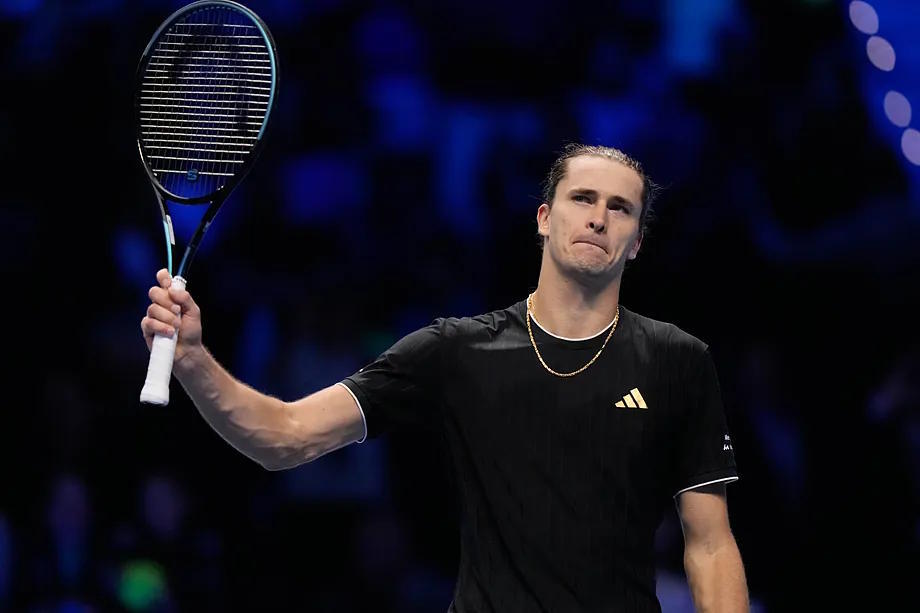
It wasn't the first time Alexander Zverev got upset in a press room. He had previously been asked about his off-court issues, such as the accusations from his ex-partner Brenda Patea, the mother of his daughter, which he has always denied. This has led to his tensions with the press. But this time the question was purely tennis-related. And the German ended up equally frustrated. At the recent Paris Masters 1000, after starting his reign as number one with a loss to Lorenzo Musetti, a journalist asked him about his new status, and Zverev exploded.
"I feel like I'm the only number one in tennis history who has to explain why it's okay for me to be the number one in the world. I think I deserve to be where I am, even though I lost today," he stated.
He was right. He deserves to be where he is. He has been the best of the season, with two Grand Slams won, Roland Garros and the US Open, a Wimbledon final, and extraordinary consistency. But it's impossible to close the debate. Is he really the best tennis player in the world today? These days, at the ATP Finals in Turin, a gathering of the number ones in history is taking place, and legends like Ilie Nastase, Mats Wilander, Stefan Edberg, Boris Becker, Thomas Muster, Gustavo Kuerten, Marat Safin, and Juan Carlos Ferrero stroll through the halls of the Inalpi Arena. What better setting to question whether Zverev is at their level.
The data fuels the doubts. The first is devastating. This year, before the ATP Finals, Zverev had won 62 of the 70 matches played against players outside the Top 10, an extraordinary 88.6% win rate. However, against the top ten players in the world, his record was just three wins and nine losses, a 25% success rate. This Sunday he added a fourth win.
After defeating Rafa Jódar 6-4 and 6-4 in the first group stage match, a journalist reminded him of that statistic, and Zverev defended himself again. "Six of those losses were against Jannik [actually five]. Can we take those away? He's a robot, not a human being," he joked, provoking laughter this time. "One was against Carlos, so that's seven. But the Top 10 has changed a lot this year. Against the players here, who are the eight best in the world, I have six wins and two losses," he argued. A peculiar way to defend his superiority: asking for the losses against someone he considers practically invincible to be disregarded.
Because there lies the second troubling statistic. Zverev has accumulated 11 consecutive losses against Carlos Alcaraz and Jannik Sinner. In the two Grand Slams he did not win, the Australian Open and Wimbledon, he fell precisely to them. In the other two, he did not have to face either. At Roland Garros, he only faced one player from the top 25, Flavio Cobolli, ranked 14, whom he defeated in the final. At the US Open, his path was also clear until the last match, when he overcame Ben Shelton, the ninth in the world.
The historical statistics also do not favor him. Before arriving in Turin, his win percentage during 2026 was 78.3%, even lower than the 79.1% with which Andy Roddick ended 2003 as number one. If he maintains that ratio, Zverev would finish the season with the worst win percentage of a ranking leader in the 21st century.
So how did he get there? The explanation lies, in part, in the misfortunes of his rivals. Alcaraz started the year winning the Australian Open but then suffered a wrist injury that forced him to miss Roland Garros and Wimbledon. Only in the last few weeks, with titles in Vienna and Paris, has he regained his best form. Sinner, for his part, won Wimbledon and then had to end his season due to a knee injury. Between them, they had monopolized the Grand Slams of 2024 and 2025. This year they left two vacancies, and Zverev took advantage of both.
The German himself acknowledged this after winning the US Open. "If we are all healthy, I think Jannik is still ahead. It's that simple," he admitted. This Sunday he was asked again if he considers himself the best in the world, and his response was more nuanced. "I think I've had the best season of all. Out of respect, we have to consider that Jannik has been injured since Wimbledon and that Carlos has also been injured for a while," he acknowledged. He then made a distinction: "In the Grand Slams, I was the best in the world, without a doubt. In the Masters 1000, Jannik was the best." And he concluded: "It's about who has had the best 12 months. And I think that has been me."
Now he has another opportunity to dispel the doubts. In the group stage of these ATP Finals in Turin, he faces Ben Shelton and Arthur Fils, and in a hypothetical final, he could meet Alcaraz. "Today I felt light. In Paris, I felt heavy. I enjoyed it a lot," he celebrated after defeating the Spaniard. Zverev is right when he claims that no one can dispute the points he has earned. What he still needs to prove is that he can prevail against the best when they are all on the court. That is the true challenge of his reign.