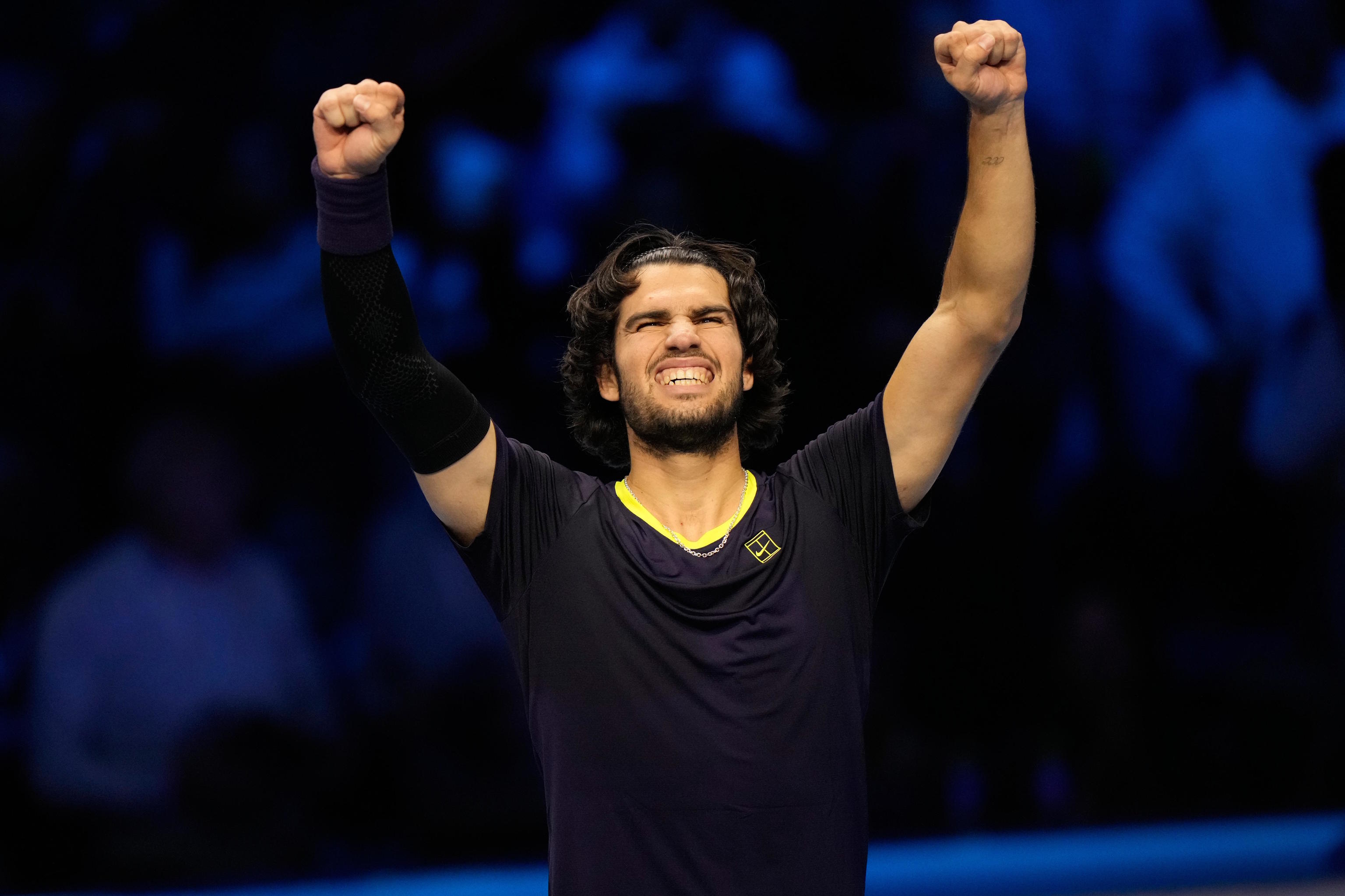
This summer, not long ago, Carlos Alcaraz was still training with rackets without strings and hitting easy balls with his left hand; his right wrist was still not ready to withstand the force of a forehand or a serve. This Monday, still in autumn, he debuted at the ATP Finals with wild strength, hitting shot after shot, even more aggressively than before the injury. His opponent, his friend Frances Tiafoe, suffered, losing 6-2, 6-2, but it's likely that Flavio Cobolli, Daniil Medvedev, and whoever comes next will also suffer. A recovery for the ages.
"I felt like I could do anything. That feeling is very nice to have," Alcaraz acknowledged yesterday at the Inalpi Arena in Turin. From uncertainty to absolute confidence. How is it possible to recover like this?
"After a long injury, fears always arise. It's not just about recovering physically; you also have to regain confidence. Sometimes you focus too much on the injured area, and doubts creep in when making movements that used to come automatically. Carlitos has shown that he is calm, that he has confidence, that he can withstand anything. The way he has come back is truly admirable," analyzes Carla Suárez, captain of Spain in the Billie Jean King Cup and commentator for Movistar, to EL MUNDO. "A wrist injury is much more troublesome than other injuries a tennis player can suffer. If your wrist isn't perfect, it's impossible to play tennis because it's involved in every shot, absolutely every one. That's why Carlos's recovery has been exemplary. He has had the patience that is needed," warns Feliciano López, director of the Mutua Madrid Open and analyst at COPE.
To understand what happened, we must go back to April. When Alcaraz suffered the injury at the Trofeo Conde de Godó, he could have rushed to reach Roland Garros or, at the very least, Wimbledon. But he did the opposite. He stopped training for weeks, immobilized his wrist, and returned gradually. He admitted he was climbing the walls with so many days of inactivity, but his team held him back time and again. It's a lesson in how sports rehabilitation has changed.
Both his physiotherapist, Juanjo Moreno, and his doctor, Juanjo López, deserve all the credit, both having a holistic view of preparation. For example, it was Moreno's idea to have him train with rackets without strings to replicate tennis movements without subjecting the wrist to impacts. There was also a progressive effort to recover the loads. First controlled movements, then strokes, and finally competition. Each phase had to provide something more than strength: the assurance that the wrist would respond.
"He has handled it very well, and that also speaks volumes about his team: his physiotherapists and his personal doctor. It wasn't an easy injury, yet they managed the timing very well, without rushing," highlights David Ferrer, Spanish captain of the Davis Cup, who is already waiting for him for next week's Finals. "It's a bit like Rafa [Nadal]. They are players who come back from an injury and have that ability to compete again and win again," recalls the former tennis player.
When he reappeared at the US Open, Alcaraz acknowledged that he still had to trust the advice of those who assured him he could push himself to the limit. It was the last step of his rehabilitation. Since then, his evolution has been extraordinary. Not only because of the titles at the ATP 500 in Vienna and the Masters 1000 in Paris but also due to the regained aggression.
According to data from Tennis Insights, in those two tournaments, his first serves averaged 195 kilometers per hour, above the speeds of previous years. He also gained precision: his serves landed an average of 57 centimeters from the lines, four less than his usual average. Particularly effective was the flat serve to the T from the advantage side, placed just 43.1 centimeters from the line.
The consequence is even more significant: 73% of his first shots after the serve were executed from inside the court, meaning in advantageous positions. The improvement in his serve after the injury is allowing him to attack and dominate from the start. An improvement that, in this case, is thanks to his coach, Samuel López. "Sometimes you have to be more aggressive. I'm understanding very well how I should play at each moment. The serve numbers? Samu is a genius," Alcaraz acknowledged after his exhibition against Tiafoe.
"In every tournament, I feel like I can win. In the end, what one thinks is the most important. With each match, the possibilities increase, confidence increases," Alcaraz added. Months after an injury that threatened to affect his career, his wrist is responding again, and his mind has forgotten the doubts. There lies the success of his recovery: not only having returned to hitting a ball but doing so with the conviction that nothing can stop him. As he said yesterday: "If you don't say nice things to yourself, who will?"