History books reflect one of the most expensive vices of the Romanov dynasty, which was to amass the most spectacular gems in the world. Regardless of being an aesthetic whim, these treasures were part of a deliberate strategy of political power and divine legitimization to project the endless wealth of the Russian Empire before European courts and other dignitaries from other continents.
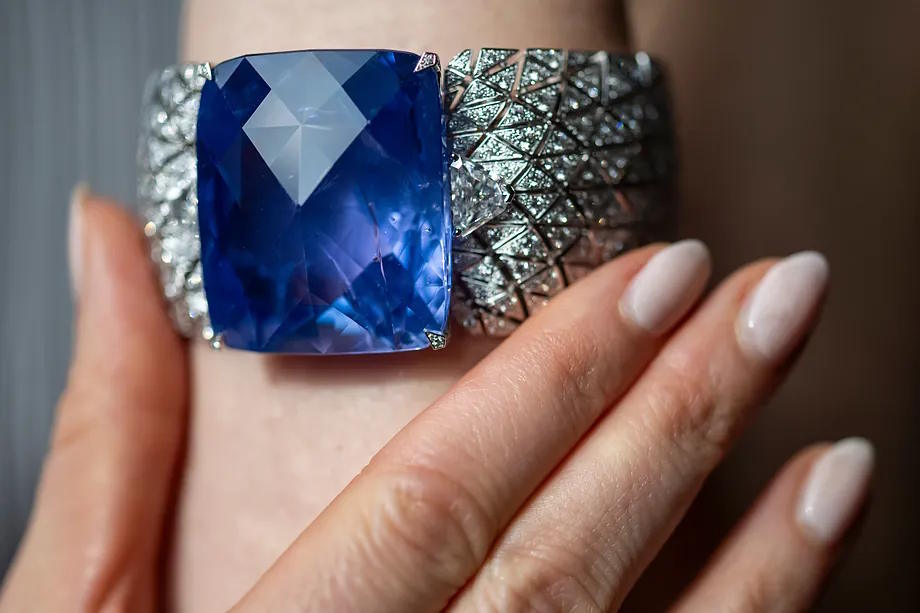
Of all the stones preserved after the Russian Revolution, one that has drawn the most attention is the legendary Romanov sapphire of 197.80 carats from the mines of Ceylon and without any thermal treatment. Its unusual faceting points to an origin in the ancient Mughal Empire of South Asia before becoming part of the Russian crown jewels in the 19th century. Ultimately, this jewel has come to public attention in a Sotheby's Geneva auction where an anonymous buyer paid $4.9 million (almost €5.4 million). A staggering figure considering the estimate was two million.
Currently, the gem is set in an articulated bracelet with a geometric design of platinum and diamonds designed by Cartier around 2015. One of its most curious features is that the bracelet has a mechanism that allows the sapphire to be removed and replaced with an interchangeable central piece of carved rock crystal adorned with triangular-cut diamonds. So, for the same price, you have two different jewels.
To demonstrate the authenticity of the stone, two reports prepared by Cartier are attached along with a copy of the original design, a brochure about the stone, and a French edition of the Fersman catalog, which was the official Soviet inventory of the Russian crown jewels compiled between 1924 and 1926.
Historians have confirmed that in the late 19th century the sapphire was already in the hands of the Romanovs. The most striking image of the jewel dates back to the legendary Winter Palace ball in 1903 when the widow Empress Maria Feodorovna -born Princess Dagmar of Denmark, the second daughter of King Christian IX of Denmark and mother of Tsar Nicholas II- wore it as a brooch on the front panel of her skirt alongside a second twin stone.
As was customary in the tsarist empire, Fabergé was responsible for setting the stone in a pierced mount with an old-cut diamond border. The Romanov sapphire was part of a pair of monumental sapphire and diamond brooches, but unfortunately, the second sapphire of 249.25 carats disappeared after the Revolution of 1917.
With the end of the Romanovs after three centuries on the throne, the Bolsheviks seized the sapphire which was later inventoried in the Fersman catalog of the Russian State Treasury. To finance their ideals and obtain foreign currency for Lenin's government, the stone was put up for sale. Cartier acquired it and soon after sold it in 1927 to the soprano and eccentric Polish socialite Ganna Walska, who wore it at countless social events for over four decades. The millionaire was one of the sources of inspiration for Orson Welles in filming Citizen Kane (1941).
In 1971, Ganna auctioned off much of her jewelry at Sotheby's in New York, and there was particular excitement over the sapphire that was set in a necklace of sapphire and emerald beads. After an anonymous buyer acquired it, it was auctioned again in 1992 at Sotheby's, where another anonymous person obtained this coveted treasure. It was precisely that same person who in 2015 went to Cartier to dismantle the stone from its previous necklace and create its current setting.
Since Catherine the Great, the Romanovs' obsession with owning the largest diamonds, emeralds, and sapphires on the planet was immeasurable. More than a century later, much of the preserved jewelry is in the Diamond Fund of the Kremlin. Among them stands out the Great Imperial Crown of Catherine the Great with almost 5,000 diamonds and a red spinel of 398.72 carats; the Imperial Scepter crowned by the legendary Orlov Diamond of 189.62 carats and the Imperial Orb, topped by another Ceylon sapphire of about 200 carats.
Other notable possessions ended up in the coffers of various European monarchies, especially in Britain, as Queen Mary of Teck rushed to buy the most lavish ones. The most famous is the Vladimir tiara which a British diplomat named Albert Stopford smuggled out of a palace in St. Petersburg hidden in pillowcases. The piece was worn on countless occasions by Queen Elizabeth II and Lady Di.
Other jewels that ended up in the possession of the Windsors included the pearl and sapphire choker and the sapphire and diamond brooch of Empress Maria Feodorovna, the tiara of Tsar Alexander II, and three Fabergé eggs: the Flower Basket egg, the Mosaic egg, and the Column egg.
Among the lost jewels or those of unknown whereabouts are six imperial eggs -the Alexander III Commemorative Egg, the Hen Egg with sapphire pendant-, the Wheat Spike tiara, and the aforementioned sapphire.