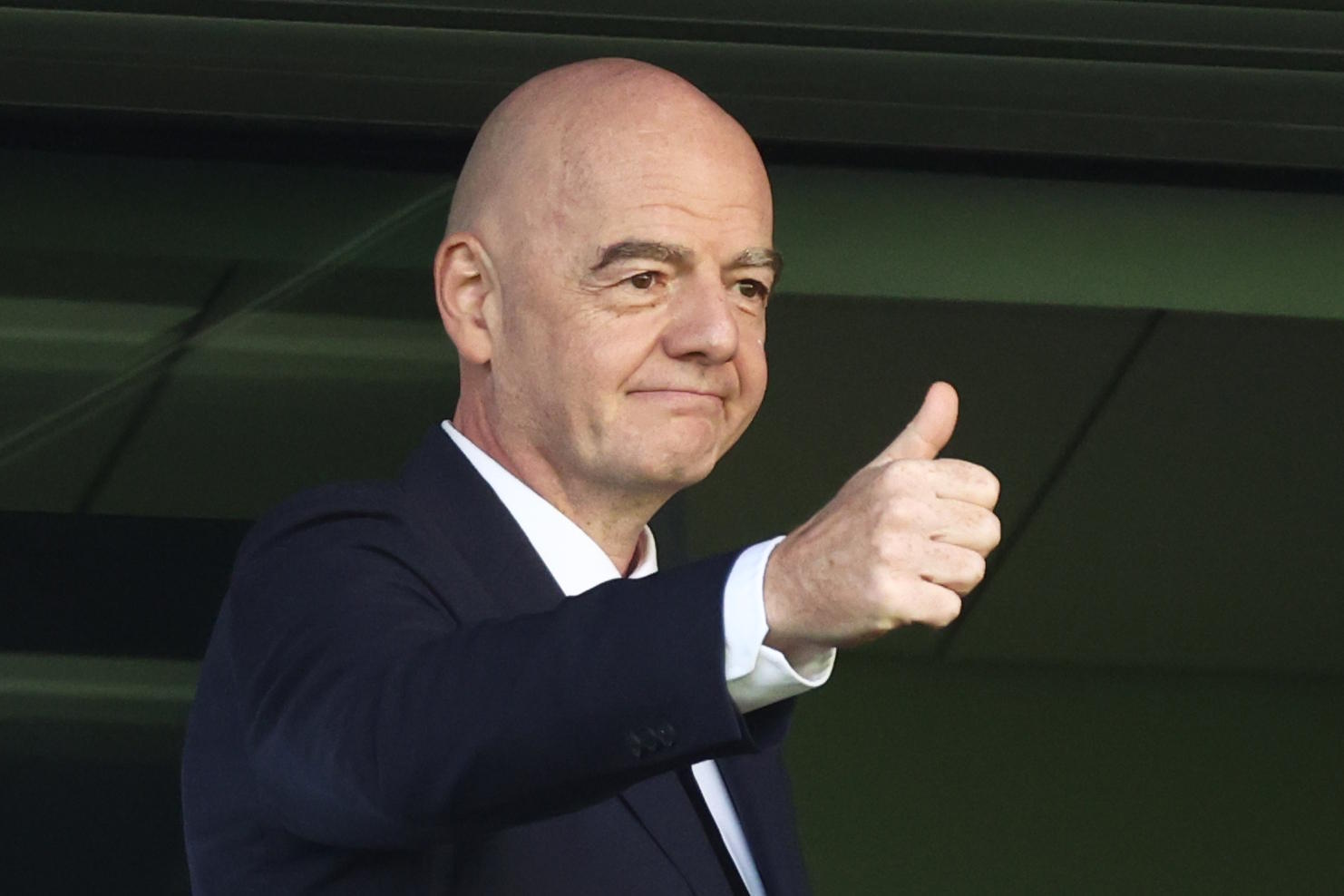
When Gianni Infantino accompanied Donald Trump to present Spain with the World Cup at MetLife on July 19, no one doubted he would comfortably face his fourth and final term as FIFA president. Four days later, the scandal over the maneuver to sell investment funds for part of the commercial rights of the World Cups complicated his plans. The Swiss took office in February 2016 after defeating three candidates and completing the work of Joseph Blatter. He was elected by acclamation in 2019 and 2023. Infantino will face a Congress on March 18 in Rabat, where three opponents will contest the presidency against him. These will be the most contested elections in a decade and, if he loses, the first in half a century where the sitting president is not reelected.
The deadline for presenting candidacies ends at midnight, and the Italian-Swiss already knows he will have three rivals: the French Philippe Diallo, the man backed by UEFA; the former president of the Japanese Federation, Kozo Tashima; and former Swiss player Ramón Vega. All of them meet at least two of the three requirements outlined in FIFA's Governance Regulations in Article 67: "having participated directly and actively in association football for at least two of the five previous years" and being proposed by a federation - UEFA cannot propose or has its own vote. The most difficult is the third: presenting "support statements from a minimum of five federations". Diallo will have them, Tashima will too, and the big question is whether Vega can secure them to enter this Game of Thrones for the presidency. The Cameroonian Jean Nyamsi has not succeeded, lacking support. The deadline to be proclaimed candidates is February 18, although sources consulted by EL MUNDO indicate it could be earlier. Although the electoral campaign began in April, right after the Vancouver congress, it is now that candidates will ask for votes.
Infantino enters the electoral race with support, some fueled by the distribution of 25 million to each federation from World Cup revenues, the largest ever distributed. In the Rabat congress, the vote will be secret, and it will be exercised by 211 federations, 210 if FIFA, in the extraordinary congress it will hold this Monday the 23rd, does not lift the sanction imposed in June on Nepal, which leaves it without a vote due to governmental interference.
Leading the opposition is UEFA. It has not been easy for Aleksander Ceferin to find a candidate. Arsène Wenger was the European favorite, but the FIFA Development Director did not step forward. Instead, one of the people who tried hardest to persuade him has done so: Philippe Diallo. This French lawyer, of Senegalese origin and 63 years old, has a long career in administration and has been president of the French Football Federation since June 2023, in addition to being a member of UEFA's Executive Committee.
Last June, before the World Cup, Diallo signed a letter of adherence to Infantino, from which he retracted in September. At that moment, he began searching for a candidate alongside Ceferin. Being backed by UEFA does not mean he will have the unanimous vote of the 55 European federations. Some, like the French, Italian, English, or German, have expressed strong opposition to the current president. What will the Spanish Federation do? Its position is delicate because it is the next organizer of the World Cup and it is yet to be decided where the final will be played. The official stance is to stand with the UEFA bloc, knowing that its partner in the organization, Morocco, is an ally of Infantino, as is the African Football Confederation (CAF). However, in the offices of Las Rozas, they are very aware that defeating the current president is a complex task. Louzán and his board will have to define their position before it is decided whether the World Cup final will be in Madrid or Casablanca, a decision that will come in 2028, as they have already acknowledged.
If the three rivals are validated, Infantino knows he will go to a vote where he will need two-thirds of the votes to avoid a second round against the rival who poses the greatest threat. In that second round, the winner will be the one with 106 supports. Federations vote individually, and that is why the transition at the head of FIFA is complicated. Although confederations position themselves in support of a candidate, there are always dissenters.
European football has 55 votes and seems to be backing Diallo. The African Confederation has 54 and is expected to support Infantino, but at least 15 federations, due to internal disagreements with their president, Patrice Motsepe, approached Secretary General Mattias Grafström to see if he would step forward.
Asia will have 47, but there are also differences: Qatar is with Infantino while Jordan or Japan lean against him for now. The situation is similar in Concacaf, with Canada as a critic, Mexico as a continuity supporter, and 35 votes in the air. There is also, for now, no block support from Oceania, as of its 11 federations, New Zealand has already distanced itself from the current president.
South American football has the fewest votes, only 10, but wants to gain leverage and may demand matches in the first phase of the 2030 World Cup, beyond the inaugural one in Uruguay, the first in Argentina as the host, and the one in Paraguay for being the Conmebol host. The dance of promises in exchange for support is about to begin.