Flying to Java is flying to one of the most accessible volcanic paradises on earth. Just 900 euros away and two flights —I chose to go via Doha— lies the island that is home to Jakarta, the capital of Indonesia, the gateway to sulfur tourism, the mountains of fire, ash, lava, steam, carbon dioxide, hydrogen sulfide, sulfur dioxide... To the beauty of fire. To the incandescent danger dressed in untamed nature. The stop in Jakarta is quick. The megalopolis of nearly 42 million inhabitants, including its metropolitan area, is a constant buzz of motorcycles and cars, skyscrapers, offices, shopping centers, and construction sites coexisting with informal commerce, low houses, and street food.
Indonesians are friendly. Safety for foreigners is absolute. One perceives a young nation —just 81 years since independence from the Netherlands— with a certain inflation of military barracks. A giant country: 17,380 islands, 287 million inhabitants, of which 87% practice Islam. A state thriving with a rain of investment capital and talent from Singapore, China, the U.S.... Also thanks to tourism revenue.
In Jakarta, I dedicated just enough time to shake off the jet lag and make the first social immersion. Visit the grand Istiqlal Mosque —impressive interior dome, free guided tour—; across the street, discover the Catholic cathedral and, if lucky, attend a wedding with a heavenly choir reminiscent of Disney. Nearby, Monas, the country's symbol, a 132-meter obelisk with a gold-covered flame reaching into the polluted sky; in the center, the Chinatown and the remnants of Dutch colonialism in Kota Tua, with Fatahillah Square and its Batavia café as the main attraction.
To reach the next destination, Yogyakarta, I recommend the night train, saving on hotel costs. First-class seat, maximum air conditioning, a thousand stops, and Dutch punctuality. Yogyakarta symbolizes Javanese tradition, the enclave of the sultanate and the royal palace, Kraton.
From this city, you will visit two archaeological sites filled with magic and spirituality: Borobudur and Prambanan. Ideal places for walking, meditating, and, if you are a believer, connecting with the beyond. Prambanan is a short train ride and a walk away. It is the Hindu jewel of the island of Java. Built in the 9th century, its grand temples are dedicated to Shiva, Vishnu, and Brahma. Despite eruptions, earthquakes, and looting, the 20th-century restoration recovered much of its splendor. Stupas, angular towers, vertical temples, sun entrances meticulously studied to adorn the sculptures, jewels with a somewhat funerary air where a multitude of tourists marvel at the peaks while practicing selfies. The park on which Prambanan sits also houses the Sewu temple, a Buddhist complex worthy of Indiana Jones.
You will go to the impressive monument of Borobudur by car. Along the way, you will be invited to stop and try civet coffee. Don't do it. It's a tourist trap that hides animal mistreatment and exorbitant prices. Borobudur (780-850 AD) is Buddhist and represents the path to enlightenment. Nine stacked platforms, a central stupa, and 72 perforated stupas with a Buddha inside. Walking through it, climbing its steps, is a spiritual journey that frees us from desire to achieve liberation.
Another train takes us to Malang, the city that opens the doors to great volcanic excursions. Along the way, clouds and distance make us overlook touching Mount Merapi (2,911 m.), the most active volcano in Indonesia. Our goal is threefold: to discover the Tumpak Sewu waterfalls, to witness the sunrise at Mount Bromo, to climb one of its craters, and the next day, to see the first sun again in a dreamlike place, the sulfur lake of Kawah Ijen. All for 100 euros. This includes transfers in old Toyota Land Cruisers, entrance fees to national parks, guides, and the boat crossing to neighboring Bali. A two-day plan that will leave you sleepless and breathless.
The descent to the waterfalls is a stream of people. Below, the best angles, closest to the waterfalls, are fiercely contested by content creators. Poses and more poses on the rocks to fill hours of reels. On the way back to the car, the highlight is diving into a small cave like a siphon. An adrenaline-filled plunge.
That same night, at 12:30 AM, the old Land Cruiser arrives to pick up the tourists. We leave Malang, another city clearly on the rise that during World War II was the main concentration camp for the Japanese in Java, an internment center for Europeans, especially Dutch, and prisoners of war.
The journey is long until we enter the lava field on which the Bromo volcano stands. Fields of black sand, total darkness, and a kind of 4x4 competition of Toyotas improvising paths at full speed and dodging each other. All with a single goal: to be the first to reach the top so that visitors can occupy a good spot on the mountain and see the sunrise over Bromo with the central crater adorned by threads of lava. A curious spectacle, but it feels lacking. Too many people, too cold —jackets were rented by the hour—. Too much waiting time, but what comes next is worth it.
With the rays of dawn at our backs, we stop for breakfast —included in the ticket— and make another stop in front of a walkable crater of Bromo. A stroll through the lava sand can be done on rented ponies, climbing stairs reminiscent of Chinese tourist attractions, and reaching the ring of the smoking crater. A sign warns that it is a "sacred place." A path allows you to circle the crater, peering into that hell. Some wooden planks warn walkers that they are entering the "Death Zone". Be careful!
The excursion continues. Another six or seven hours by van to reach Banyuwangi, the small city that is the base for Kawah Ijen volcano. The regime included in the excursion leaves us in a shared room with other backpackers. Sleep is scarce because at 12:00 AM we will be picked up for a medical check. Temperature, pulse, weight, breathing, and some questions. With the "fit" in hand, we are taken to the entrance of Kawah Ijen volcano. It is 2 AM and we have been equipped with headlamps and gas masks.
The ascent is quite demanding: 500 meters of elevation over three kilometers and little air to breathe. So much so that we cross paths with manual taxis: the lambos, some lamborghinis pulled by one or two humans, simple wooden boxes with wheels and rudimentary bike brakes. And the business, to my surprise, works. Chinese, Australian, Arab tourists... pay to avoid the extra effort, the panting, the discomfort. The suffering of the extremely thin porters who huff and puff while pulling them up the volcano is of no concern to them.
The ascent is quite demanding: a 500-meter elevation gain over three kilometers, with little air to breathe. So much so that we encountered "manual taxis"—known as *lambos*—which are essentially wooden boxes on wheels, equipped with rudimentary bicycle brakes and pulled by one or two people. To my surprise, it's a thriving business. Tourists from China, Australia, the Arab world, and beyond pay to avoid the physical strain, the heavy panting, and the discomfort. They seem indifferent to the suffering of the gaunt porters who huff and puff their way up the volcano, hauling these carts along.
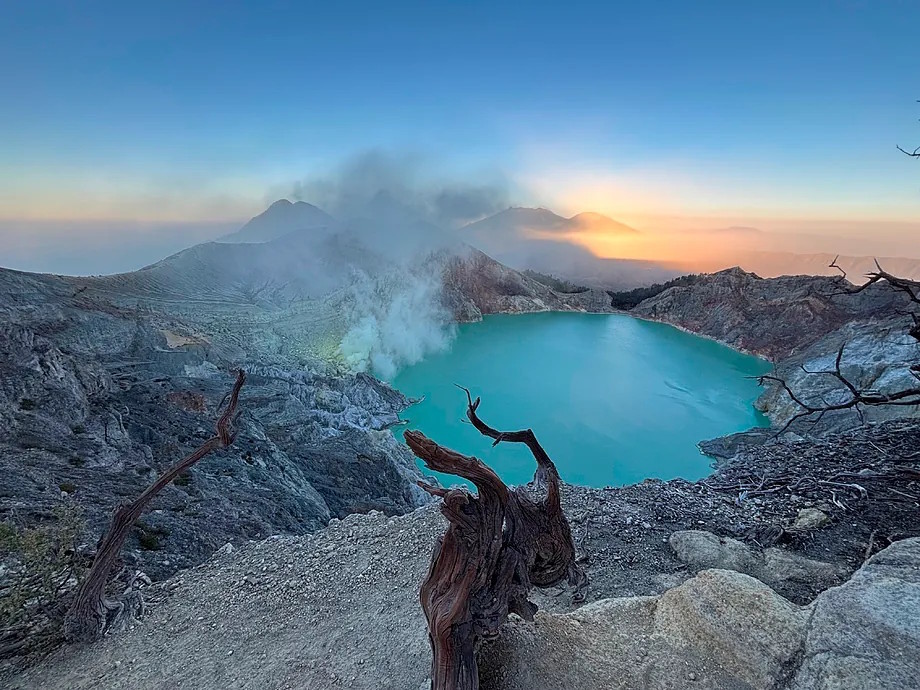
Sunrise at the sulfurous lake of Kawah Ijen looks like something out of a travel brochure: turquoise water, fire, toxic smoke, and a mountainside where chunks of sulfur are extracted by hand—destined, supposedly, for the chemical and cosmetic industries. Fortunately, tourists are not permitted to descend into the crater. It all boils down to taking photos—with or without a face mask—and collecting memories. The experience is so profound that it leaves travelers dreaming of other volcanic destinations. Yet, just as we reached the airport in Jakarta, mere hours before our departure, some unpleasant news arrived in the form of volcanic ash. Indonesia had closed the capital's airspace due to a violent eruption of Anak Krakatoa, located between Java and Sumatra. This setback left us stranded for five days. A vengeful, 15-kilometer-high column of ash served as a stark reminder of our own fragility—and a warning to those who seek out volcanoes: the Earth is not to be trifled with.
PRACTICAL GUIDE
HOW TO GET THERE: Madrid to Jakarta via Doha with Qatar Airways. Fares start at 900 euros.
WHERE TO EAT: Java may not be a gourmet destination, but it is easy and inexpensive to get by on *nasi goreng* (fried rice with soy sauce, egg, vegetables, etc.). WHERE TO STAY. Bed and breakfasts and hotels starting from 30 euros. For a splurge: the Grand Hotel De Djokja in Yogyakarta.