The United States is still recovering from the aftermath of the midterm elections and the scandal involving spies and horns at Nvidia, processing the implications, questioning whether we are facing an artificial intelligence bubble, analyzing the systemic risks following the collapse of Microsoft services, the nationwide airspace shutdown, and issues accessing banks and airlines this Monday... But none of that seems to matter in New York. The city with the most millionaires on the planet only has time this week for one thing: art auctions. Perhaps the largest in a long time. With works by Kandinsky, Monet, Van Gogh, Pisarro, Degas, or Cezanne that could raise up to 2.4 billion dollars (2.19 billion euros), an astronomical, record figure, which, of course, drags along scandals and stories of Nazis.
The major houses, coordinated, are going to make a true display of strength these days that confirms not only that the art market has regained all its appeal for the wealthy, but that, despite inflation, slow growth, and political doubts, the stock markets are still soaring, boosted by the AI fever, and are making many people rich. According to a very recent study by Bank of America, "a new generation of collectors is emerging. Wealthy millennials and Generation Z are more than three times as likely to own an art collection than baby boomers and the silent generation (42% vs. 13%)."
The art market has left behind years of uncertainty and correction. Global sales from Christie's, Sotheby's, and Phillips reached around 6.4 billion euros during the first half of 2026, a 70% increase compared to the same period the previous year. Sales rates have improved, with 91% of the works sold at each auction. Additionally, private sales organized by them are also skyrocketing. Christie's recorded over 910 million euros in closed-door events by mid-year, while Sotheby's generated 755 million euros, a 52% year-on-year increase and a new historical high.
According to The Global Art Market Report 2026, the comprehensive annual overview of the sector prepared by Clare McAndrew, the global market generated 53 billion euros in 2025, a success after two years of decline. The most striking figure is probably that sales of works over nine million euros grew by 30% last year, while in the primary market, galleries are navigating as best they can "the rising costs and increasingly selective demand." This summer, the mega-gallery Pace announced that approximately 50 artists would leave its roster, claiming that the business model is "irreparable." A few days later, former global director of Art Basel, Marc Spiegler, warned in an opinion piece in The New York Times: The Art Galleries Are Not Well.
In this context of geopolitical uncertainty, financial volatility, and inflation concerns, it seems clear that works by the great masters are an increasingly attractive option for the truly wealthy. Just a year ago, the Portrait of Elisabeth Lederer, a work by Gustav Klimt, the jewel of the private collection of Leonard A. Lauder, heir to Estée Lauder, was sold for 215 million euros. It is still far from the absolute record held for a decade by Salvator Mundi by Leonardo da Vinci, which exceeded 410 million euros, but it is a clear sign of how hot the sector is.
Masterpieces, in addition to boosting ego, offer asset diversification, the stamp of exclusivity, and that old premise of the sector of a capacity to create long-term value in a world where everything seems ephemeral. Added to this, of course, is the emergence of new treasures surfacing due to such favorable market conditions. It is not without irony that in that November 2026 auction, Sotheby's also sold a solid gold toilet for nine million, a creation that mocks the ultra-rich Americans. The work is signed by the provocative Italian artist Maurizio Cattelan, the same one who sold a banana on a wall for 4.7 million euros.
The auction of the 'Portrait of Elisabeth Lederer' at Sotheby's, which reached a record of 223 million euros.COVER
If the last two major events were extraordinary, expectations cannot be higher now. In 1964, the Solomon R. Guggenheim Foundation auctioned in London about fifty paintings and drawings by Wassily Kandinsky because they had so many that they couldn't even display them on the walls of their center. Among them, Betonte Ecken (Accentuated Angles), an abstract canvas that sold for 22,000 pounds. More than six decades later, the work could sell in New York for between 55 and 75 million euros. A record for the artist.
The main highlight of this week has been, in any case, the Blaquier-Arrieta collection, consisting of 12 Impressionist and Post-Impressionist works that Sotheby's expected to sell for 450 million euros, and ultimately sold for 412. Among them are notable works by Cézanne, Monet, and Van Gogh. Châtaigniers en fleurs, the chestnuts in bloom by the Dutch artist, is the great jewel and although its valuation was around 162 million euros, which is 57 million more than anyone has ever paid for a Van Gogh, it ended up selling for over 190 million. The sixth most expensive work in history, adjusted for inflation.
The Harlequin by Cézanne was estimated to fetch 110 million more, and so it did. Neither of the two works has been exhibited to the public in half a century. They were part of the private collection of the Blaquier-Arrieta family, who bought them in London galleries in the 1970s, never wanting to lend or show them, and did not even have the entire collection displayed in their residences.
Carlos Pedro Blaquier, one of the great Argentine businessmen of the last century, was accused of collaborating in illegal kidnappings during his country's military dictatorship (1976-1983). The businessman denied the accusations and died in 2023 without facing a criminal trial. The sale of the collection - the heirs have not wanted to donate any works or leave them in the country - reopens a recurring debate about the responsibility of great fortunes and the moral legitimacy of those artistic assets, especially considering that Nelly Arrieta de Blaquier, long divorced, was heavily involved in museum work. But there is another even more delicate controversy that has once again placed Sotheby's in the spotlight.
The heirs of the German Jewish publisher Samuel Fischer claim that Châtaigniers en fleurs, the Van Gogh painting in the lot, was sold in 1936 under duress, during the Nazi persecution, when his family was trying to escape Germany. Therefore, they requested its withdrawal from the auction and clarification of the circumstances of that sale. Or negotiate compensation following the principles established in Washington in 1999 for works affected by Nazi looting. Which is what ultimately happened. "The family hopes that the considerable public interest in this case, as well as its swift, fair, and equitable resolution, will encourage other families who suffered persecution during the Nazi era," stated Gunnar Schnabel, attorney for the Fischer heirs, after the sale to a well-known gallery.
This week of public auctions has generated special attention. Not only due to conflicts and lawsuits but also to see how tastes evolve. Sales at auction of Impressionist and modern art have increased by 133% year-on-year in the first half of the year, while young contemporary art has cooled by 88% from its peak in 2022, benefiting auction houses, whose business focuses on the secondary market of established artists.
Also to many of those who profit from the process. Lawyers, accountants, professors, specialists, and... "art advisors." According to a Bank of America survey, "even the most experienced collectors seek professional guidance to create and manage their collections. Among those who own at least one million dollars in art [€910,000], 64% currently use an art advisor, while an additional 13% say they would like to do so in the future."
The Artnet Intelligence Report. Year Ahead 2026 estimates that Impressionist and modern art "generated €4.35 billion in sales, a 29.5% increase compared to 2024. The growth was particularly notable in the segment over nine million euros, which saw a 68.6% increase compared to 2024. The number of lots sold in this category reached a decade-high of 122,213, and the average price per lot rose by 22.4% year-on-year."
Some examples. In May, at Christie's New York, Number 7A, 1948, by Jackson Pollock, reached one of the year's major milestones by selling for €163 million, an amount that nearly triples the artist's previous auction record set five years ago. In the same season, No. 15 (Two greens and red stripe), by Mark Rothko, fetched €89 million, while Joan Miró reached €48 million with Portrait de Madame K, despite organizers speculating hours earlier about a figure closer to €30 million. Also at Christie's, Anxious girl, by Roy Lichtenstein, raised €42 million, and La femme aux lilas (Portrait de Nini Lopez), by Pierre-Auguste Renoir, sold for €26 million.
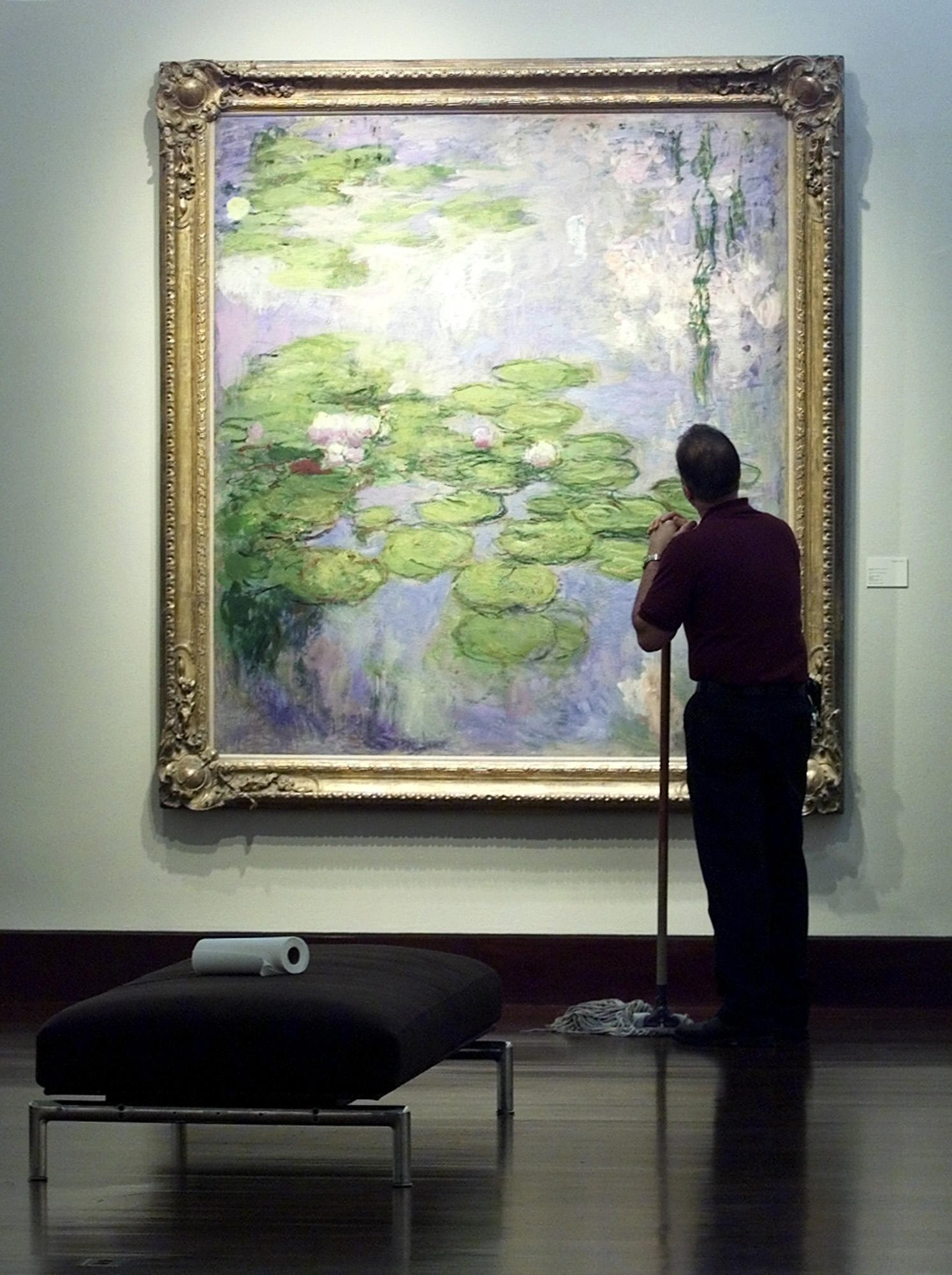
At Sotheby's, Brown and blacks in reds, also by Rothko, was sold for €76 million. A month later, Nu assis au collier by Amedeo Modigliani reached approximately €58 million. A Nymphéas by Claude Monet surpassed €47 million. Not to mention the €47 million paid for Museum Security (Broadway meltdown), by Jean-Michel Basquiat (which had sold in 2013 for €12 million) and the €38 million for Arlequín by Picasso.
If we look back at the great historical masters, a canaletto that had belonged to Horace Poole was sold for €27 million, and a drawing by Michelangelo, a preparatory study for the Sibila Libia of the Sistine Chapel, went for €25 million. Meanwhile, a self-portrait by Francis Bacon reached €19 million in London, and a Rembrandt sold for €16 million.