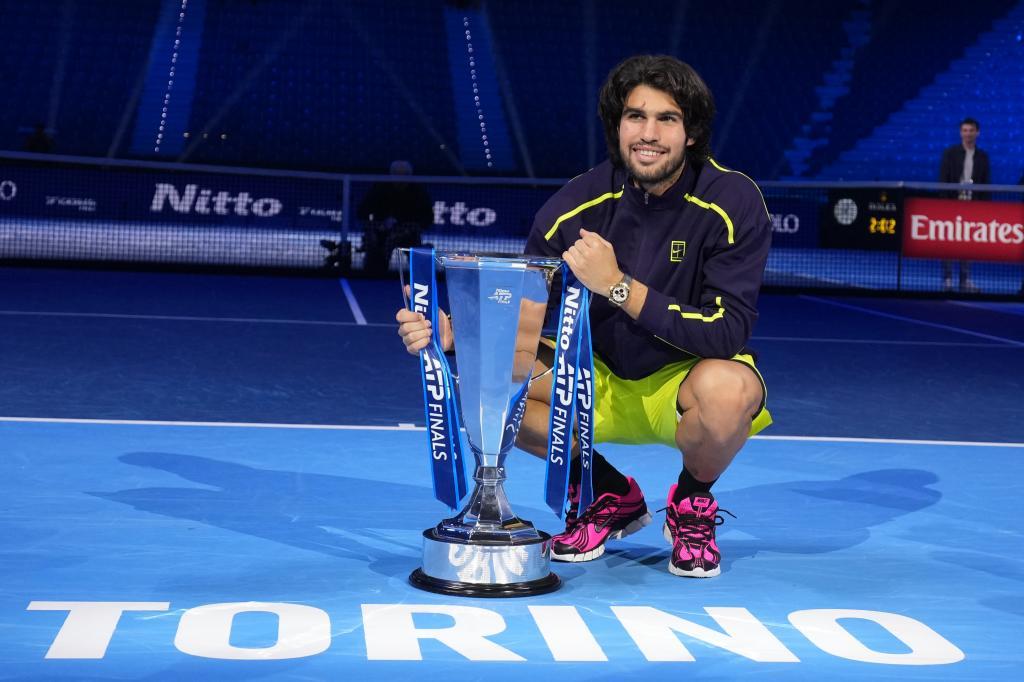
Rafa Nadal was once asked, after his retirement, which title he would have liked to win but never did. After 22 Grand Slams, 36 Masters 1000, and two Olympic golds, he barely needed to think. "Of course I would have liked to win the ATP Finals at least once. It's probably the only major tournament I never won," he replied. It was his great unfinished business, the last enigma of a career in which he had found answers to almost everything. And this Sunday, in Turin, Carlos Alcaraz finally solved that enigma: he conquered the old Masters Cup, achieved what his idol never could, and ended a 28-year curse for Spanish tennis.
There is something strange about Spain's relationship with the tournament that closes the season. Since its inception in 1970, the country of Nadal, Alcaraz, Juan Carlos Ferrero, Carlos Moyá, David Ferrer, or Sergi Bruguera had celebrated only two titles until this Sunday. The first was won by Manuel Orantes in 1976, defeating Polish player Wojtek Fibak in Houston. The second came in 1998, when Álex Corretja came back from two sets down against Moyá in Hannover. Since then, nothing. Ferrero lost the final in 2002, Ferrer in 2007, Nadal in 2010 and 2013, and Alcaraz himself lost last year's final to Jannik Sinner. Up to 17 Spaniards had participated in some edition of the ATP Finals, but none had managed to add their name to the very short list of champions.
Why? The answer lies, to a large extent, under the players' feet. The ATP Finals have always been a strange tournament for Spanish tennis, historically rooted in clay and accustomed to building points through long rallies. The Masters Cup, on the other hand, has almost always been played indoors, first on carpet and then on hard courts, in fast conditions that favor serves, winning shots, and short points. Of the 56 editions, only three were held outdoors. Not all courts were equally fast, nor did all Spaniards have the same style, but for decades the tournament seemed designed for players with characteristics very different from the Spanish school.
There are its great dominators. Novak Djokovic, with seven titles; Roger Federer, with six; Pete Sampras and Ivan Lendl, with five each. Extraordinary players, also particularly effective on fast courts. In the Masters Cup, moreover, there are no adaptation rounds or easy opponents. From day one, the best in the world are waiting, and there is little margin for error. Even Nadal, used to finding solutions in any circumstance, repeatedly encountered that obstacle.
Nadal's physical problems
Although in his case, the surface does not explain everything. The Spaniard won six Grand Slams on hard courts, two Australian Opens and four US Opens, and clearly demonstrated that he could defeat anyone away from clay. His real problem with the ATP Finals was the calendar. The tournament takes place in November, after an endless season, and Nadal often reached those dates with his body at its limit. He qualified for 16 consecutive seasons, from 2005 to 2020, but could only compete in 10 of those editions due to injuries. In 2017, he also withdrew after his first match. And when he managed to reach the final day, in 2010 and 2013, he first faced Federer and then Djokovic. "Many times I reached the end of the season not in the best physical condition," he would later acknowledge, not hiding that he had let some opportunities slip away.
Alcaraz seemed doomed to repeat that story. In 2024, he admitted to being mentally exhausted and competed while sick. In 2025, he reached the final but succumbed to a physical issue against Sinner. And this year, when it seemed he had finally found the formula to dominate indoor tennis as well, his body threatened him again. A strain in his left hamstring during his match against Daniil Medvedev jeopardized his participation. There were medical tests, canceled practices, and matches played with extreme caution. But Alcaraz had worked all season to change his relationship with this tournament. "It's a very important goal from the beginning of the year. For me, it would be a huge success to lift the trophy," he confessed upon arriving in Turin. And it wasn't just a commitment statement.
In the end, after so many years of frustrated Spanish attempts, the solution came from a player who seemed destined to inherit many of Nadal's virtues but has learned to carve his own path. Alcaraz had already shown he could win on clay, grass, and outdoor hard courts. Now he has also done it indoors, against the best in the world and after overcoming his own physical limitations. Nadal retired without conquering the Masters Cup. Alcaraz, at 23, already has his.