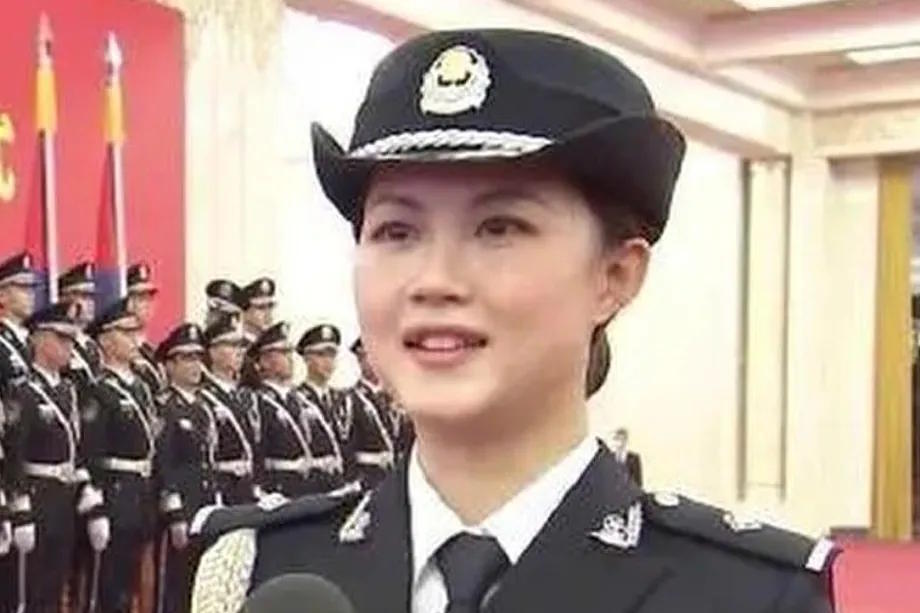
The red carpet was laid out at the foot of the presidential plane at Shenzhen airport. A cloud of cameras and a large entourage awaited the arrival of Claudia Sheinbaum, one of the first foreign leaders to land in the great Chinese tech metropolis to participate in the major Asia-Pacific economic summit. It was Monday, and the Mexican president walked smiling through protocol greetings to a black limousine. A few steps behind her walked another uniformed woman. She had her hair tied back, stood tall, and wore an impassive expression. When Sheinbaum reached the vehicle, she opened the back door and took the passenger seat.
The scene lasted a few seconds. But it was enough to unleash another viral phenomenon on Chinese social media. While the cameras followed the Mexican president, thousands of internet users had their eyes on the discreet woman walking behind her. Her name is Xu Jin, and she has one of those jobs where success consists precisely in not drawing attention. Her mission is to protect prime ministers, presidents, and first ladies arriving in China, anticipating any threats and becoming an almost invisible shadow. But with her, the exact opposite happens: every public appearance provokes a new wave of admiration. On Weibo and Douyin, the major Chinese platforms, she has been dubbed "the most beautiful bodyguard in China." Others prefer to call her the "iron warrior," fascinated by her martial discipline.
Xu's fame began to rise in 2023 when Bashar al Assad, then president of Syria, traveled to China accompanied by his wife, Asma. During a meeting of the Syrian first lady with students in Beijing, cameras captured a woman in a blue suit who always stayed by her side. While Asma greeted and conversed with the young people, her escort carefully monitored every hand that approached. That unknown woman began to attract attention on social media. Since then, Xu has become a recurring presence behind some of the most powerful women visiting the Asian giant. In 2025, she accompanied Paetongtarn Shinawatra, then Prime Minister of Thailand. This time, it was the leader herself who brought her out of anonymity: upon returning to Bangkok, she posted a video thanking her for the care received during the trip and expressing her desire to meet her again. The bodyguard reappeared alongside Brigitte Macron, wife of the French president, during her tour of Beijing. Last April, she accompanied Ngo Phuong Ly, wife of the Vietnamese leader To Lam, during a visit to a museum in the south of the country.
Behind her figure lies a story that blends martial arts tradition, patriotism, and the secrets of the elite bodies of the communist regime. According to profiles circulated by local media, she was born in 1985 in the central province of Henan, a land associated with some of China's most famous martial traditions. Her father was said to be a soldier, and from a young age, she grew up in an environment where physical discipline and combat were part of daily life. She began training at the legendary Shaolin temple, nestled in the Songshan mountains, before continuing her studies at the Beijing Sports University.
Shaolin occupies a mythical place in the Chinese imagination. Its warrior monks have long fueled all kinds of stories that were later turned into global spectacles by kung fu cinema. But behind the acrobatics and choreographed fights lies a tradition of extraordinarily tough training. Strength and flexibility exercises are combined with defense techniques, balance, and concentration.
For Xu's admirers, her past in Shaolin would explain the almost sculptural serenity with which she appears alongside her charges. But the story takes on even more cinematic tones when some media report one of her alleged feats: having single-handedly defeated five Japanese karate champions. That supposed victory has even earned her the nickname "the Mulan of Henan." Her story is irresistible to popular Chinese nationalism, where rivalries with Japan always resonate. Although it is common for the most patriotic voices of propaganda to embellish these biographies. In a country where the services responsible for protecting leaders operate under secrecy, the gaps in her biography have become fertile ground for imagination.
The legend continues with her enlistment in the Army upon reaching adulthood. There she would have trained in shooting, hand-to-hand combat, and counter-surveillance techniques. Later, she would have been assigned to protect high-ranking officials related to Zhongnanhai, the complex of walled buildings and gardens in Beijing where much of the power of the Communist Party is concentrated.
Xu is not the first woman from Chinese protection services to win public favor. In the 1990s, another bodyguard, Bian Mei, earned a formidable reputation after shoving aside an overly persistent photographer during the visit of an Italian prime minister's wife.
Bian also drew attention for her beauty and even placed third in a contest held in Beijing. Three decades later, Xu Jin has become her media heir. The cameras seek out the presidents and first ladies, but they end up finding that woman who always walks a step behind.