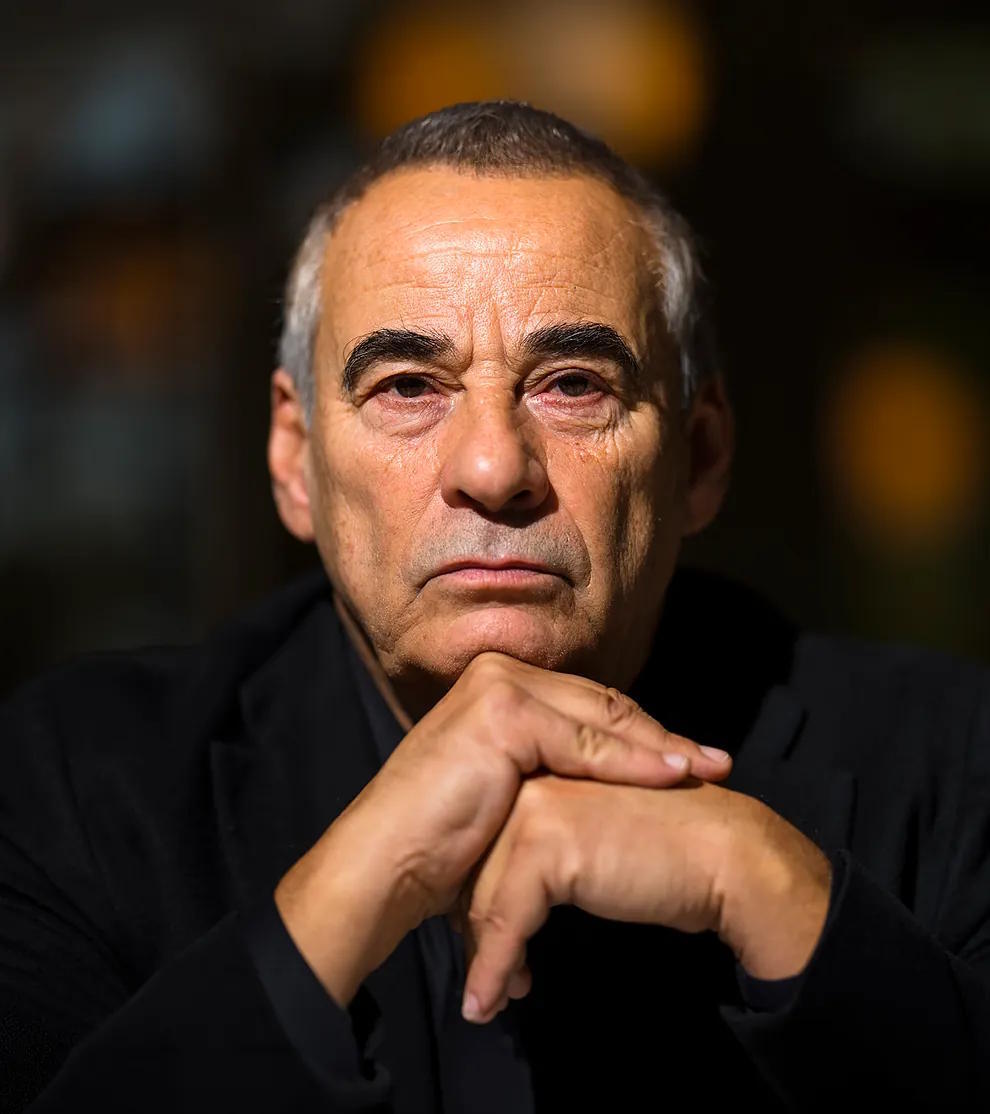
Mark Twain maintained that at 14, it is inevitable to see one's father as a complete fool. At 21, however, things change. It is surprising to see all that the good man has learned in just seven years. Eduard Fernández (Barcelona, 1964) knows something about all this. Not so much about the author of The Adventures of Tom Sawyer, though he knows a bit, but about fatherhood in general. He is the father of Greta, also an actress, he is the father (why not) of an entire generation of actors, and right now, he is a father in fiction three times over. In The Bad Father, by Roberto Bueso, he plays the role of a castrating and villainous parent like few others (or like many, depending on how you look at it), in In the Name of Another, by Oriol Paulo, he is vengeful, cruel, and a vigilante beyond justice itself, and in the series Killing a Bear, by the Sánchez-Cabezudo brothers, his sense of protection (not exactly for the environment) is frightening. Be that as it may, for one father or another, who knows if he will not give birth (now as a mother) to another Goya. That would be his record-breaking 15th nomination.
"Sometimes I think being right-wing or very right-wing would be much more comfortable. Everything would be much easier"
What kind of father is or has Eduard Fernández been?
He is. One is a father for life. The worry never ends, no matter how old the children are. I have always tried to be very close. But the profession doesn't always help. Greta, when she was older, told me she suffered a lot from my absences. I have also suffered for the same reason. I have had a hard time because, honestly, there is no one I love more than my daughter. Missing part of her childhood has caused me pain. But life is what it is; you have to accept that you need to bring money home.
Do you feel able to confess any fatherly flaws?
The most obvious one, I admit, is that I find it very difficult to set limits. I can't say no. Being a father is complicated because a woman takes on what's coming during the nine months of pregnancy. For a man, it's different. No matter how much you prepare yourself, there comes a moment when everything changes, and you ask yourself: "But what is this? What does this defenseless creature have to do with me?"
How do you remember that first moment of astonishment?
I held Greta in my arms and was left speechless. I couldn't say anything. My brain was blocked. Children are everything, the most exhausting, the most beautiful, everything.
The father in The Bad Father is egocentric, narcissistic, full of himself, but at the same time very needy of admiration and recognition. Do you think this is a thing of the past or is it intrinsic to fatherhood in a patriarchal society like this one?
In the film itself, the son assumes a different kind of fatherhood, more evolved, related to love, affection, and care. But I believe this type of father hasn't disappeared; it's not a thing of the past.
How was your relationship with your father?
My father was a bit like the one in the movie, somewhat despotic. He painted in his studio, and I basically saw him at mealtime. It was curious because his mood, whether he was in a good or bad mood, largely depended on how his painting had gone. I remember there was always a bottle of Vichy prepared for him that we couldn't drink from, under the pretext that he was sick. He was taken care of a lot and rarely set or cleared the table or cooked. He also gave you advice about sex that, instead of clarifying anything, confused you even more.
Do you identify with what has been called new masculinity?
I was taught to think for myself, which is no small thing. I don't know if I learned it in school or if it comes naturally to me. The fact is that, in this sense, I prefer to do my own thing and not rely on labels. What I can say is that I am fragile, sensitive, and emotional. Characteristics that may contradict my solid physique. And I have to admit that the term "new masculinity" is frankly ugly.
Does the fragility you speak of help you be a better actor?
I don't know. What I do know is that it sometimes leads to a lot of suffering. I've taken a lot of hits because, besides that, I'm naive. I find it hard to believe that there are bad people, and that makes it difficult for me to foresee certain behaviors. There are people who can cause a lot of harm, and I tend, I don't know how to say it, to make it very easy for them. Over time, though, you learn to protect yourself.
You talk about your fragility, and I recall your recent confession about your addictions on the show Lo de Évole. Do you regret taking that step? Did it serve any purpose?
I thought about it a lot. The first person I told was Greta, my daughter. If she had doubted, I wouldn't have done it. But, on the contrary, she encouraged me a lot, even though I was scared. What I didn't want was to hurt anyone, and it turned out to be just the opposite. Many people have thanked me for it. Just today, I received a call from a girl who has problems with alcohol and is asking for advice. That's really nice, honestly. What advice have you given?
The first thing I always say is that to stop being addicted to drugs or alcohol or any other substance, you have to overcome the shame. Only when you overcome the shame can you ask for help. And that's fundamental. When you find yourself where I found myself, the first thing you do is hide. And that can't be. You have to share with others what's happening to you to overcome it, and you have to be clear that there are many more people than you think in a similar situation.
Perhaps the problem is that we live in a society addicted to everything: to phones, to success, to youth...
The state of anxiety we are in permanently is part of the system. We have been taught that everything can grow indefinitely, and that's not the case. There comes a time when everything explodes. What we might need to do is try to look at the world from a different perspective.
What perspective is that?
There's an exercise I often propose. You look at a world map, and what do you see? Rivers, countries, and some creatures that are people. The question I invite you to ask is: "Are there resources in this world for everyone?" It seems the answer is yes. So let's share. Is it that complicated? Pere Casaldáliga said that everything that is not essential is stolen. He was that radical. And one more thing...
I'm listening.
The greatest revolution that can happen and that is yet to come is that of women. The day women take charge, everything will truly change, and it would be good for that to happen because there's no doubt that men need to change.
In these times of contrasts, it seems there's a movement that longs for a past, to use your own words, less evolved.
Yes, it seems we are in a time of missing things from the past...
Do you dare to give a diagnosis? Why is this happening?
Sometimes I think that being right-wing or very right-wing would be much more comfortable. Everything would be easier. What's clear is that evolving and questioning things always brings more fear. It hurts a bit. Some people directly say: "Leave me alone; I don't want to question or rethink anything." For those who are worse off, change is necessary; it's a demand, but there's always the risk of making mistakes, going too far, or going down the wrong path. It happened with the drafting of the Law of Only Yes is Yes. It was a necessary change, but perhaps it was done poorly, and we need to learn to do things right. One thing I've observed in certain leftist groups when they are in power is that they tend to speak very loudly and very quickly. I've seen it in some Podemos ministers, for example. And what I say is that if you're already a minister, there's no need to try so hard; everyone is already listening to you. I also believe that the right is more accustomed to leading, and the left has to learn.
I'm lost. The left (or at least its lighter version, the PSOE) has governed for longer since democracy...
What I mean is that there are many ways to lead. Politicians, for example, should have their names removed and simply be called "Public Servant 1," "Public Servant 2,"... What matters is not the politicians but the policies. I don't know if that's clear. It irritates me, for example, when there's a demonstration, and there's a debate about whether there were few or many people. It doesn't matter; it's people who are suffering and asking for something, and politicians are there to serve them.
To focus the topic, how do you see the possibility of political change with a right-wing government? Are you worried? I'm asking in general and very specifically about the law that bans ideology in cinema that has been approved in Castilla León.
Yes, I'm worried. That law makes no sense. The only thing that should matter, and what matters to me, is whether the movie is good, whether it turned out well or not. Nothing else. The PP usually adapts, but the combination of PP and Vox is very concerning. What they have done is a whole letter of intentions, and it sounds like total censorship.
By the way, is there any reason that explains so much activity? Are you taking advantage of the time before censorship arrives?
Two years ago, nothing was released with me, and no one came to say I should be very reserved or what was happening to me. What's important is to approach this work day by day. This system is what it is, and to sell more, it tends to exalt some and sell them as the best. The mistake is to believe it. The system simply wants to sell more and uses you. But I've been in this long enough not to fall into the temptation of believing the flattery more than is just and necessary. So, low profile, like Iniesta.