It was Frederick Wiseman, master of documentary filmmakers, who maintained that reality is created by telling it. For the director of seminal works in the genre like Titicut Follies, the fantasy of documentary cinema as a mirror of reality is exactly that: a fantasy. It is not so much, as the most famous yet celebrated principle of Heisenberg's indeterminacy held, that the very act of measuring or observing disturbs the system, but rather that, more radically, observation itself becomes the matrix, principle, and end of everything. Or almost.
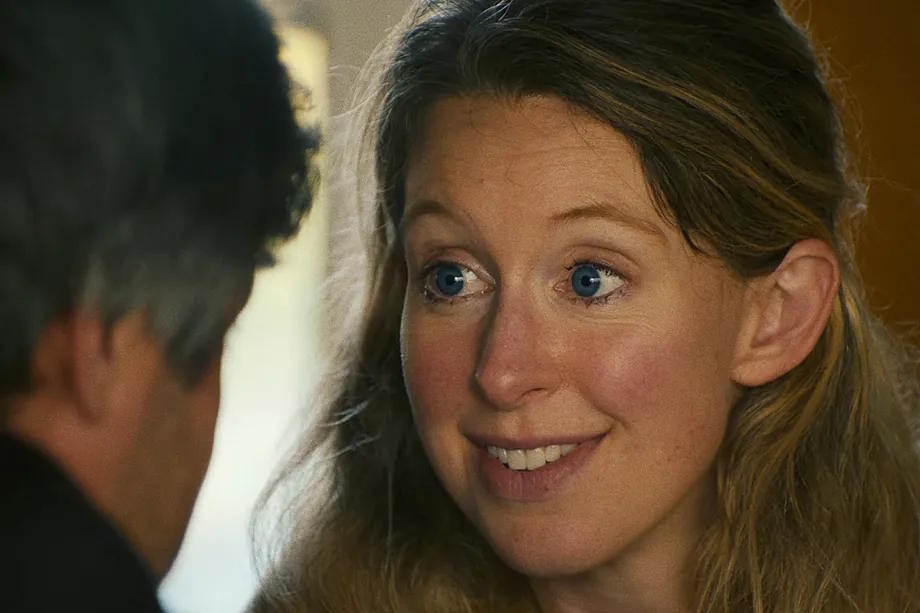
You Can See Everything, the documentary film by Nathan Fielder and Lance Oppenheim featuring the extravagant Elizabeth Holmes as the protagonist and master of ceremonies, aspires from its title to be a refutation of such enthusiastic relativism. But, of course, anyone who has approached Fielder's series (The Rehearsals and The Curse) or Oppenheim's documentaries (Spermworld) has more than enough reason to suspect such Cartesian innocence. As expected, everything is much more insidious, brilliant, twisted, intelligent, and probably cynical. Essentially, and hence the brilliance, what the film, now elevated to the status of phenomenon, demonstrates is that the project of seeing everything about something - phenomenon, person, or thing - can become the murkiest way to reveal what inevitably and self-interestedly always remains hidden from view. Returning to the beginning of the paragraph, it is not just that reality is created by telling it, but that what usually passes for reality, in its rawest version, is simply false. It sounds tremendous, perhaps somewhat cryptic, but it is merely a consequence of the spasm.
Indeed, if anything defines the film unexpectedly presented at the Telluride festival last summer, recently released near record levels in the United States and soon to be seen around the globe elevated to the status of hype of the season, it is its capacity and vocation for spasm. The budget is, to some extent, simple. 34 days before her imprisonment, the peculiar Fielder offered to fulfill Holmes's desire to be filmed before her incarceration, where she is currently located and where she will spend the next 11 years from 2023, the year of filming. It aims to replicate the mechanism of a conventional reality show, but, given the personalities of the actors, in that way, from the other side.
Remember, Holmes was at one point the greatest triumph of Silicon Valley ahead of all those currently in mind. Her revolutionary machine for conducting clinical analyses from a single drop of blood promised to forever solve the public health problem that has always been at the top of American concerns. Suddenly, the woman with the stiff smile and nun-like appearance became the first female billionaire entrepreneur on the planet. Not only did she convince the general public, but investors like Rupert Murdoch and Larry Ellison laid their hefty bank accounts at her feet. Alex Gibney recounts it all in the superb The Inventor: Out for Blood in Silicon Valley (2019).
Only one problem, everything was false. According to Holmes herself, there was a small "chemical problem" to solve. In other words, there was still the issue of whether anything she sold was true.
During the first part of the film, the viewer is invited to witness all kinds of circular or merely delirious conversations between Fielder and Holmes - with the collaboration of her husband, California hotel heir Billy Evans - about various topics. A notable discussion revolves around the meaning of the verb "can." For one, if the machine in question can do something, it means it will indeed do it. For her, however, it does not mean that it will do it, but that it could do it. And in that nuance, always a step away from spasm, the fine line that separates psychopathy from sanity, evil from correctness, lies from truth, reality from fiction, innocence from guilt remains somewhat undefined. The climax of this strange journey to nowhere will come with the explanation of the most famous gag from Abbott & Costello titled Who's on First?, which Holmes is unable to understand. But that is another story.
However, the real twist will come in the second half, when Holmes enters prison. The film pauses, jumps two years ahead, and, in a metafictional twist close to vertigo, introduces actress Amanda Seyfried as the protagonist of the series The Dropout: Rise and Fall of Elizabeth Holmes. As the surprise it is, any revelation beyond her appearance could be considered sacrilege. Until that moment, the viewer had witnessed a more or less extravagant, more or less quirky, more or less perplexing spectacle in which the naive cruelty of the most aggressive capitalism took shape in the angelic manners of its protagonist. The already old controversy over the inconsistency of truth in a world encapsulated in the firm convictions solidified by the echo chambers of social media is made explicit with a clarity that is frightening and, it must be admitted, entertaining. Oppenheim's direction, closer to thriller with its management of silences than to classic documentary, helps create an atmosphere always alien to any hint of agreed or sudden normality. But all that, we said, until that moment.
What emerges in this new start of the film is much more extreme, radical, and seemingly incomprehensible. Fielder and Oppenheim achieve without warning something akin to the strange chill proposed by the documentary The Act of Killing when it made the murderers of the Indonesian massacres become actors of their brutality. It is just one example alongside the most classic of all: F for Fake, where Orson Welles questioned the very status of the deceptive power of cinema. You Can See Everything embraces this tradition and raises the stakes.
Holmes is a person who acknowledges before the camera and without the slightest spasm (again) of doubt that she has never lied. Holmes demands that the New York Times correct the line in which she is supposedly referred to as "the character I created." She denies it and insists that the wording be replaced with "the character they created." Holmes, although later contradicted by her greedy and opportunistic husband, strives to make it clear that nothing she does before the camera is for money. And thus, Holmes, whether she intends to or not, ends up changing her role from freak to a symptom of a society entangled in the labyrinth of its emptiness, cruelty, cynicism, and its most evident lie.
What remains, amidst jokes and seriousness and disproportionate marketing campaigns promoted by producer A24 (which, not coincidentally, also appears for a moment as a character), is an unprecedented rejection of the very act of narrating, of representing the world, and, pushing it further, of cinema itself as an art committed to seeing everything. What matters, and the true mission of cinema, comes to tell us in its profound childishness You Can See Everything, is to portray what remains on the other side of the gaze, the invisible to the eyes. The truth is something else and smells strange. A spasm.
Direction: Nathan Fielder, Lance Oppenheim. Cast: Nathan Fielder, Elizabeth Holmes. Duration: 174 minutes. Nationality: United States.