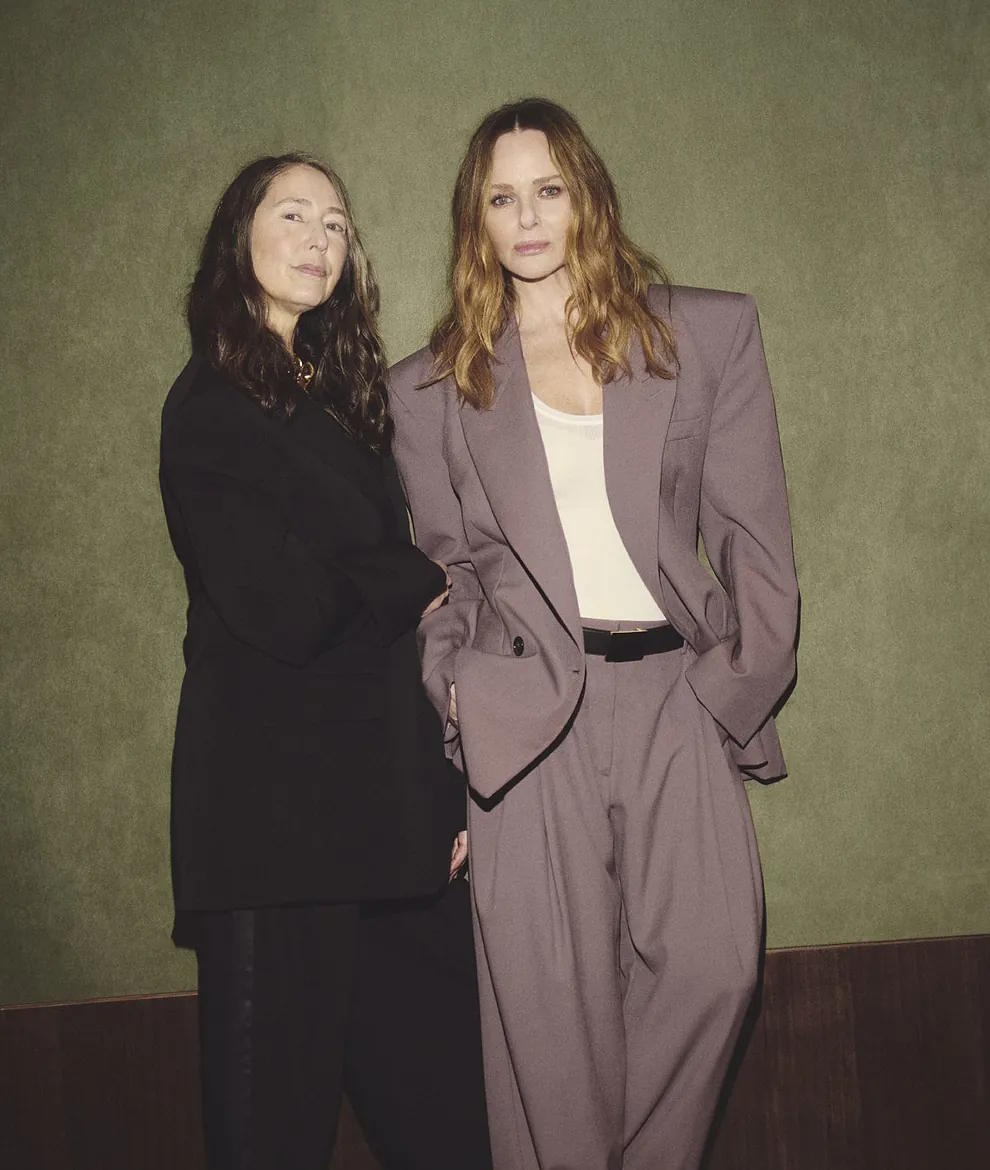
In 2005, the alliance between Stella McCartney and H&M marked the beginning of the democratization of designer fashion. Two decades later, the Swedish giant and the British designer reissue their collaboration with an objective that shifts the focus from mere aesthetic prestige: the integration of circular standards in mass production. The launch, scheduled for May 7th, is presented as a reflection on the 25 years of the creative director's career.
The collection serves as a technical and stylistic retrospective of McCartney's ingenuity. It includes key silhouettes of the British designer, such as men's tailoring, oversized shirts, and wide trench coats, interspersed with dresses with chain details inspired by the Falabella bag, mesh garments with cherry prints, and the 'Rock Royalty' t-shirt, a design celebrating the aesthetics of the 90s.
The relevance of this union, then, is relocated. Thanks to McCartney, it lies in the complexity of the materials. The collection uses recycled polyester from textile waste, organic silk produced without pesticides, and cellulose obtained from residual cotton fibers (ecojilin). The sequins, adorning two ivory pieces, are made from 80% recycled glass. Experimental solutions have also been introduced, such as coatings derived from industrial corn and reused vegetable oil. The use of these components aims to reduce the dependence on fossil fuels in an industry traditionally linked to the consumption of virgin materials.
Ann-Sofie Johansson, creative director of H&M, states that the company's approach is not to mimic luxury but to facilitate access to iconic design. "Things that seemed so radical in 2005, like organic cotton or material recycling, are now common practice in much of what we do at H&M".
Faced with the overproduction crisis in the sector, the director points out that the success of this project will not be measured solely by sales speed and queues outside the stores. The goal, this time, is projected towards the future: they aim to generate and enrich the debate through their new Insights Board. "We want to put sustainability on the agenda: encourage conversation and ensure it doesn't become something overwhelming for people or make them nervous to discuss".
McCartney's proposal, which will unfold over time with different formulas, avoids the discourse of ecological perfection. Instead, it is presented as a pragmatic solution: applying low environmental impact processes to a global distribution network.
Stella McCartney, the brand, is partly based on "less is more," cruelty-free materials, and circularity. How do you reconcile your personal ethics with H&M's business model, which still relies on large-scale production?
I don't reconcile it: I question it. Working with a company of this magnitude is an opportunity to show that things can be done differently within a system that reaches millions of people. If we can demonstrate that desirable fashion can be made with better materials, with less impact, and do it on a large scale, that's where real change happens. I have always believed in engaging with the industry as it is, not just with the version you wish it was, and trying to push it forward from within.
Fast fashion is often criticized for its short lifespan. What have you done in this collection to prevent these garments from ending up in a landfill within three seasons?
These are garments designed to last: in style, quality, and desirability. I have brought back iconic Stella pieces that people already love and have kept for years, and I have brought them into this collection with the same intention: for you to wear them over and over again. When something is well-made and you have an emotional connection to it, you don't throw it away: you keep it, resell it, pass it on. That's the change we need.
In 2005, we were in the midst of "masstige." Today the consumer is more skeptical. How has your approach to addressing the masses evolved to adapt to a more demanding mindset?
The consumer is much more informed now, and rightly so. For me, it's about being completely transparent and rigorous: not just saying something is better, but explaining how and why. At the same time, it has to be desirable. No one wants to compromise on how they feel in what they wear. So the approach is to bring together those two things—integrity and desire—and make it seem natural.
We live in a world of Shein and "dupes" (cheap imitations) on TikTok. Why is it important for you to offer an original collaboration in an era where luxury is copied in real time?
Because originality is not just about aesthetics, but about how something is made and what it represents. You can copy a silhouette, but not the materials, the production chain, or the intention behind it. That's where the real value lies. It's about showing that fashion can be done differently, not just creating something beautiful and fleeting.
Can sustainable fashion truly be democratic, or is "affordable sustainability" a myth that we keep trying to sell to the middle class?
It has to be democratic. If not, it doesn't work. Right now, the system makes doing the right thing more expensive. That's why projects like this aim to close that gap: making choosing better accessible to more people. It's not perfect, but it's a step forward. And I think the important thing is to keep moving in that direction, rather than deeming it impossible.
The industry is seeing a return of male creative directors at the helm of major fashion houses. As a woman who has always designed to encompass the female experience, how does this collection reclaim the wardrobe of the real woman?
I have always designed for women: for how they truly live, for how they want to feel. For me, it's about creating garments that bring strength, comfort, and confidence, rather than dressing for an external gaze. This collection revolves precisely around that: a wardrobe that works in real life, with a female perspective at its core, which I believe is still essential.
You often say you design "uniforms" for women. In these times, what is the "survival kit" you have created for the woman of 2026?
It's about garments that accompany you. Tailoring that gives you structure, pieces you can move in throughout the day, things that feel natural but are well thought out. In turbulent times, there is something very powerful about having a wardrobe that makes your life easier: one you can rely on and that makes you feel like yourself.
Why are you returning to H&M now? Is it a way to protect your legacy by bringing it closer to Generation Z, or were there "unfinished business" from two decades ago?
It's not about legacy, it's about impact. The first time we worked together, a real change happened. They took what we did and integrated it into their business. That stuck with me. Coming back now is an opportunity to go further. There is still much to be done, and working with a partner of this scale allows you to reach more people and have a greater impact.
What part of this collection is a "greatest hits" of your career and what part is a vision of how fashion should be in the next ten years?
It's a balance between both. I have revisited the pieces that have defined Stella, the brand, and brought them together in a way that feels current. But it's also about showing how those pieces can be done better today, with the knowledge and materials we have. It reflects the past but clearly looks towards where we need to go.
Would you rather be remembered as the designer who made luxury accessible or as the activist who contributed to changing the way giants of the retail industry act?
I have never separated the two. For me, being a designer and being an activist are part of the same thing. It's about creating fashion in a way that has a positive impact. If it helps transform the industry, even a little, that's what matters.