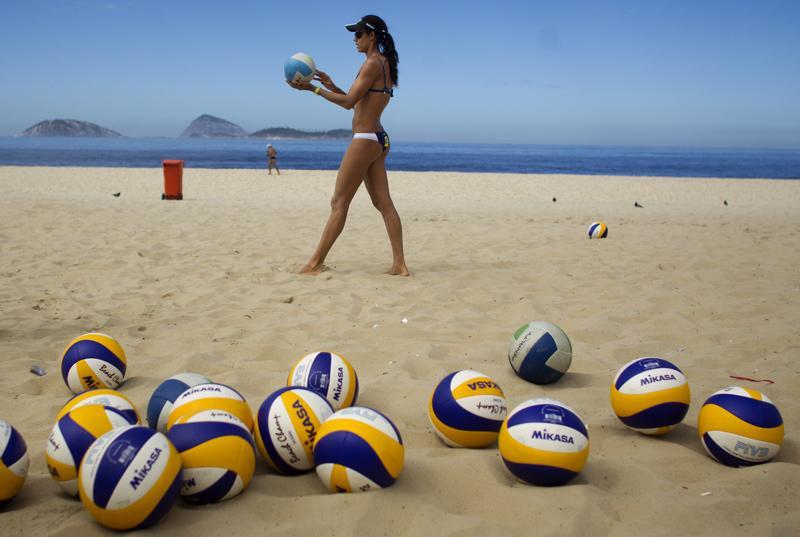
The visible (hyper-visible) return of the thong to beaches, pools, and cruises this summer has caught many by surprise, with joy, amazement, and disgust. Because here, the only universal truth is that the thong does not leave anyone indifferent.
To the point: it turns out that we had been talking for years about the return of conservatism to the beach scene in the form of swimsuits and the decline of topless, and this trend of once again revealing more of the lower body with absolute naturalness and boldness has shattered our expectations.
It's not that the thong is a great novelty. Although it was already being used on the beaches of Rio de Janeiro, it was Rudi Gernreich, in Los Angeles in 1974, who introduced it to Western fashion. That year, this designer and gay activist presented The Thong, a garment that revealed more of the lower body and was conceived for both women and men. Its design is often interpreted as a response to the prohibition of sunbathing nude in California: if the law required covering certain intimate areas, he reduced that coverage to the minimum possible. Surprise, surprise: the thong was born as a political tool. What happened next was that the industry and pop culture turned it into one of their most provocative fashion items.
After becoming popular on beaches in the 80s (although it would never become a massively used garment), the thong reached a unique golden age in the fashion context between 1999 and 2003. The sequence was as follows: in 1994, Alexander McQueen paved the way with his intentionally low-rise bumster pants to make the visibility of underwear inevitable (if you were wearing any); Tom Ford for Gucci and Jean Paul Gaultier brought visible thongs to the runway in 1997; and low-rise pants later made the famous whale tail inevitable. Britney Spears, Christina Aguilera, Jennifer Lopez, and Paris Hilton ended up turning it into an emblem of the early 2000s. There is even a figure that marks the peak of the phenomenon: in 2003, thongs already represented 31% of the British female underwear market; but by 2005, it had dropped to 23%. By 2015, the thong was almost anecdotal. Mark&Spencer said at that time that less than one in 10 pairs of women's underwear sold in their stores was a thong.
It makes sense if you look at it from a practical point of view. Because one of the advantages of wearing a thong is avoiding the -horrible- panty lines when wearing tight pants. You trade comfort for a good aesthetic. But suddenly, a new generation of panties appeared that served the same purpose without being quite so revealing. On the other hand, on the beach, topless had become ubiquitous throughout the 90s. In a way, thongs and topless contradicted each other. While the latter spoke of freeing the body, the former emphasized its submission to the male gaze. Or so the interpretation went.
But in the late 90s, a curious phenomenon occurred on our beaches. The Brazilian bikini bottom, halfway between the traditional bikini and the thong, began to gain popularity. More daring than the former and more modest than the latter, it quickly became omnipresent in the swimwear collections of major chains. In a 2021 article in this same publication, sociologist and former model Patrícia Soley-Beltrán commented: "There is no doubt that the Brazilian bottom has managed to give Spanish women greater freedom in how they present their bodies." And one of its users, Ruth G. Núñez, shared: "For me, a Brazilian bottom says that a woman is independent, loves her body, likes to show it off, and is proud to be able to do so without being judged for it. It speaks of female liberation and loving ourselves." Thus, the dissemination and normalization of the Brazilian bottom have been the perfect prelude to the return of the thong. It made it easier. Although it was not the only factor.
Covering the breasts, showing the lower body
Although the theory of displacement of erogenous zones by James Laver - according to which fashion periodically shifts its focus from one part of the body to another as the heterosexual male gaze tires of one or the other - is considered outdated today, if we strip it of its sexist connotations, it can help us explain, at least partially, the return of the thong. After decades of breast exposure, the new conservatism in swimwear fashion covers them again while focusing on the lower body, which has become the new center of the body ideal: the thong not only reveals it but also frames and highlights it.
Valerie Steele, director and chief curator of the Museum at the Fashion Institute of Technology in New York, explains to YO DONA that "as topless becomes normalized, exposed breasts - on the beach - lose some of their circumstantial erotic charge." And very low-cut bikini bottoms, she adds, "have long been more taboo in Europe than exposed breasts. In Brazil, however, the opposite is true: thong bottoms are acceptable, while showing breasts can get you arrested." In the end, what happens, this expert explains, is that "any part of the body can be an erogenous zone. But what is truly erotic or fetishistic is the play of hiding and revealing naked skin - the striptease - because we associate nudity with sex and pleasure, and that's why we like to show it; although nudity and sex also make us feel fear or vulnerability, so we continue to hide it."
It is also worth asking here what cultural taboo surrounds this part of the body. It combines several things that societies tend to keep out of sight: it is associated with bodily intimacy and physiological functions that societies have traditionally preferred to keep private. In other words, it is a particularly loadedboundary between the presentable body and the physiological body. It concentrates a great ambivalence: it can be beautiful and sensual, but also dirty, comical, animalistic, humiliating, or challenging. And here the thong is especially interesting from a symbolic point of view: it covers the area where this cultural taboo is most strongly concentrated but reveals and frames everything around it. It formally complies with the modesty rule while directing the gaze exactly to what is traditionally considered private.
And a word to the wise: if we were amazed by so many thongs this year, let's get ready for 2027. Because what's coming will have epidemic proportions. We just need men to also embrace the trend, and the fashion cycle may complete yet another unexpected turn.