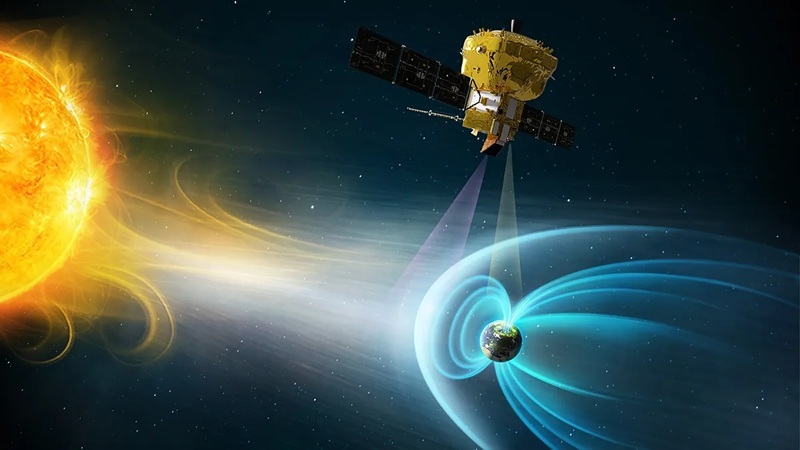
Life on Earth would not be possible without the Sun, but our star also poses a danger, especially now that our civilization is so dependent on technology. The solar storms that reach our planet have the ability to damage satellites and terrestrial infrastructures. These are inevitable but detectable phenomena, so scientists are working to be able to anticipate the arrival of these particles and protect us from them.
With this purpose in mind, SMILE, a spacecraft that was launched this Tuesday at 5:52 am from French Guiana, has been designed. The plan was for it to take off on April 9, but a technical issue with the Vega-C rocket that will put it into orbit forced a postponement until today.
The European Space Agency (ESA) and the Chinese Academy of Sciences (CAS) have joined forces to make this ambitious mission a reality, aiming to better understand the interaction between the Sun and Earth. SMILE (acronym for Solar wind Magnetosphere Ionosphere Link Explorer) will observe Earth's magnetic field in X-rays to discover where and how the solar wind interacts with this magnetic shield that protects us from the harmful activity of our star. "We are going to obtain a lot of information about how this interaction drives space weather phenomena - what is called Space Weather - which can affect modern technological systems," explains Rocío Guerra, head of the SMILE mission at ESA, in a phone interview.
Its focus of study, she explains, is what is called the solar wind: "From the Sun, we not only receive radiation, light, and heat; it also constantly emits solar wind into space, which is a continuous flow of charged particles. It interacts with Earth's magnetosphere, which is a magnetic bubble that protects us and acts as a shield against these particles. And although this interaction has been known for decades and there have been previous missions that have studied it, its global dynamics, variability, and effects are still not fully understood," she points out.
Therefore, SMILE will offer the first complete view of how Earth reacts to particle flows and radiation bursts from the Sun, as one of the main novelties it will bring, according to Guerra, is that it will allow scientists to "study that interaction in a global way and for a very long time," to understand geomagnetic storms: "This information will allow us to make much more accurate forecasting models, predictions of space weather with much more precision, which will be useful to determine the risks and mitigate them."
Solar storms are not something new; logically, they have always existed, but as Rocío Guerra emphasizes, "what has radically changed in recent decades is their impact on our lives, as today we live in a society deeply dependent on technology, satellites, power grids, navigation systems, aviation, and global communications. And all of this can be greatly affected by these events."
What could happen in the worst-case scenario? "An intense solar storm could cause large-scale disruptions in energy supply, navigation instruments, and critical infrastructures, so it would have very direct consequences on our daily lives. This mission aims to better understand these phenomena to anticipate them," explains this expert.
The most concerning precedent, which is often used as an example of the potential damages of solar activity, is the so-called Carrington event. It took place in 1859 and is considered the most powerful solar storm recorded: "It marked the beginning of understanding to what extent a solar storm can influence our lives. It was a powerful solar ejection that caused failures in the existing systems at that time, the telegraphs. There were auroras visible at unusual latitudes, like Cuba. It already had a great impact back then, so imagine if a similar phenomenon were to occur today," she points out. Another less severe but very relevant example took place on March 13, 1989, when a geomagnetic storm left millions of people in the Canadian city of Quebec without electricity for nine hours.
In addition to economic losses, these solar events could cause loss of lives: "If navigation systems stop working at some point, it can put at risk people traveling on an airplane to high latitudes, or astronauts in space," she warns.
Solar activity is measured in solar cycles, which last approximately 11 years. During this time, it fluctuates between a minimum and a maximum. "That solar cycle has periods of maximum activity when solar flares increase, and what we call coronal mass ejections, where the Sun expels tons of matter at high speed with a lot of energy. And it is during these peaks precisely when the risk of geomagnetic storms is higher. We are currently at the peak of activity, and it could start decreasing. That is why SMILE, which will operate for three years, has been planned to operate during the phase of the solar cycle where the most violent phenomena are expected. We are going to see many energetic events because it will be launched at a time when the solar cycle is still at its peak, and we will be able to study all that solar wind in all its splendor," she points out.
To make these observations, the spacecraft is equipped with four instruments, including a soft X-ray imager (SXI) provided by ESA, led by the University of Leicester in the UK. The images it provides will reveal how Earth defends itself from the solar wind and solar storms. "When those charged particles arrive and interact with the atmosphere, an emission of X-rays occurs, which is what this European instrument observes, one of the most complex carried by the spacecraft and the first capable of taking images of the magnetosphere in X-rays. Achieving such a wide field of view and with such precision has truly been a challenge," points out the ESA head.
This European X-ray instrument is complemented by the UVI instrument, which will observe auroras in the North Pole in ultraviolet: "Although there have been other missions that have studied auroras in ultraviolet before, they did not have that temporal continuity."
The spacecraft will work in a highly elongated polar orbit, allowing it to be positioned at a distance of 121,000 kilometers above the North Pole and observe the magnetosphere and all these phenomena globally for about 40-45 hours. "During that time, we will be able to follow those geomagnetic storms from their beginning to their end." Geomagnetic storms usually last between two and three days. With 45 hours of Smile observations, the aim is to better understand how auroras occur.
SMILE also carries a Light Ion Analyzer (LIA), which will collect solar wind particles with two sensors to measure "the Sun's attack against Earth's defenses," and a magnetometer (MAG) that will measure the magnetic field carried by the solar wind to compare the Sun's attack against Earth's defense.
The data collected by the probe will mainly be downloaded through the O'Higgins antenna, which is European and located in Antarctica, but will also reach other antennas in China.
This is not the first time that China and ESA have collaborated on a mission - they have done so previously in two missions that studied Earth's magnetosphere (Double Star, launched in 2003) and Cluster (launched in 2000, in a second attempt, as the original probes of the mission were lost in 1996 due to a rocket failure). However, SMILE does mark a milestone in the space cooperation between both agencies as it is the first mission they carry out jointly at 50%.
"The scientific collaboration has been magnificent. Both the Chinese Academy of Sciences and the European Space Agency have provided all their vast experience and technology, and there has been a perfect relationship. It is a very productive mission both scientifically and technically and in terms of engineering," says Guerra.
Its development has also been rapid for a space mission, as they began working on it in 2019. The total cost of the mission is estimated at approximately 250 million euros, of which the European Space Agency contributes 130 million euros.
Several companies and research centers in Spain contribute to the mission. Airbus has provided the module carrying the payload; the National Institute of Aerospace Technology (INTA) has been in charge of the SXI detector plane assembly; Airbus Crisa has developed the extended control unit of the payload module, and Sener, the X-band antenna of the payload module.