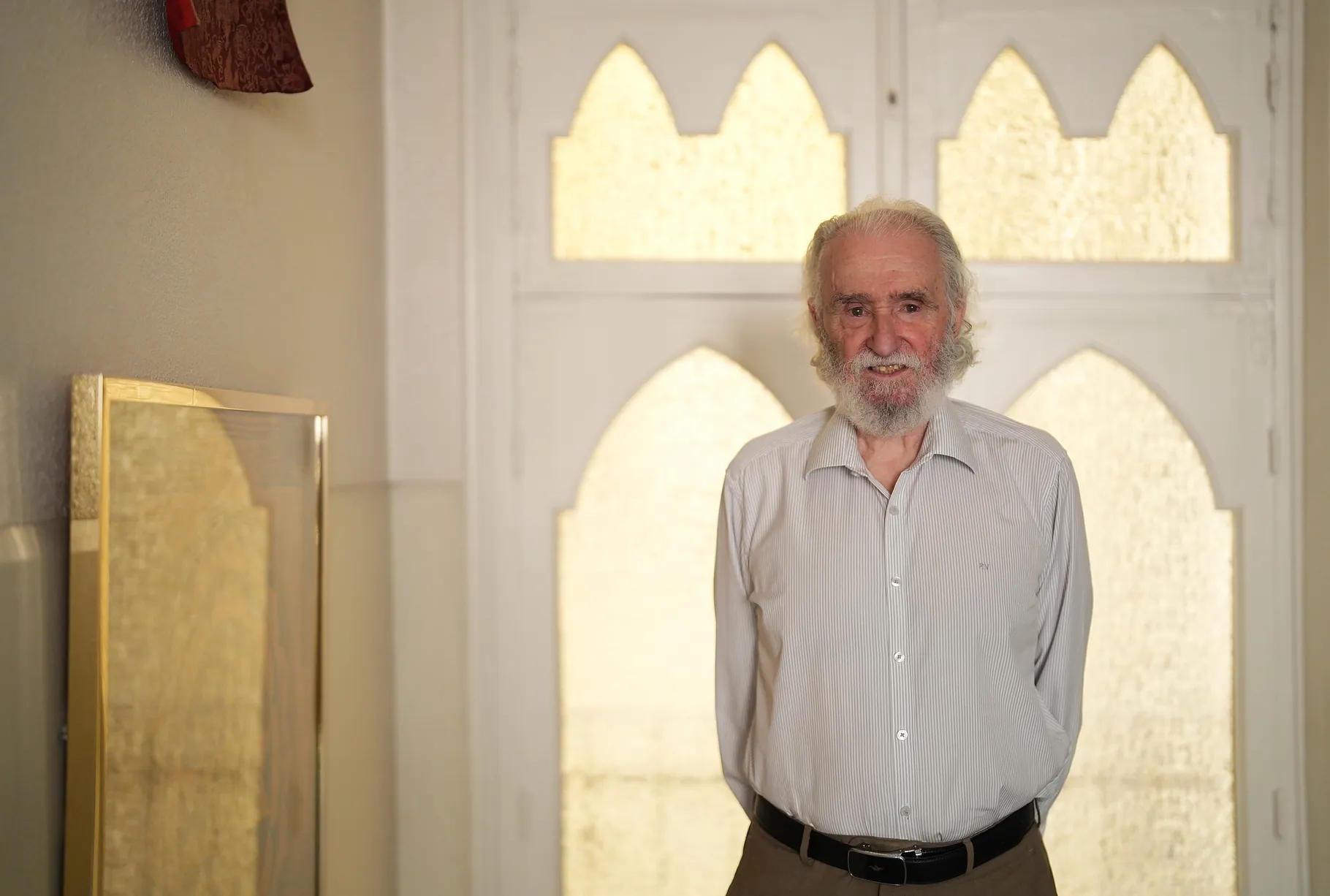
Today, practicing a yoga class is like ordering food delivery: just a click away, brand clothing, and showing off impossible poses on social media. But back in the 70s, long before this ancient discipline was adopted in Western wellness culture, studying and teaching yoga was an act of counterculture, a true leap into the unknown. Ramiro Calle (Madrid, September 4, 1943) shares that he became interested at just 16 years old thanks to a friend who traveled to Mexico and told him about a method to control the mind. "I always say, even if it's exaggerated, that if I hadn't found yoga, I would have ended up in a psychiatric hospital because I was a perpetually dissatisfied and bored boy."
His beginnings and the Shadak center
He was fortunate that his parents and siblings supported him unconditionally. In order to travel to India up to 99 times to learn from the best teachers and because it was impossible to make a living solely by teaching, "I founded a home yoga institute called Asana and later this place," he recalls at Shadak, his academy since January 1971 on the first floor right at number 10 Calle Ayala, where he still teaches on Fridays at 82 years old.
He admits that for the past five years, he has stayed away from public life, despite recurring requests. "I thought that what is good for the ego is bad for the being, and I had been too dedicated to congresses, daily sessions, even on Saturdays, book presentations, trips...".
Now his days are simple: "A walk in El Retiro Park where many people join, personal yoga and meditation practice, reading and studying, making some podcasts with the aim of spreading genuine teachings, and a lot of activism to defend animals. I feed the cats that come to me," he describes.
Challenges of yoga in Spain and censorship
Building a reputable career where he has taught over 600,000 students, including well-known figures and doctors, was not easy. He feels proud of the doctors he has taught because in a strongly traditional and Catholic Spain, any discipline coming from the East was viewed with great suspicion. "During the dictatorship, many books were banned, except for physical yoga books on poses. I started ordering them from abroad to inform myself and research."
He has also written many books, he is a truly prolific author. In his latest work, A Good Mind (Ed. Integral), he shares all the knowledge he has acquired throughout his life. "I am not interested in leaving a legacy, even though I have been offered foundations, academies, and large yoga centers." In fact, without any attachment, he has recently gotten rid of dozens of his articles written in newspapers and magazines.
Life philosophy of an eternal learner
"In my novel The Fakir, which has had 25 editions, the protagonist says that the duty of every apprentice is to keep learning. And I am not a guru or master, but an eternal learner. I have tried to give back to others everything that life has given me," he reflects.
Without seeking recognition or influence, in the era of artificial intelligence, they have even created a channel impersonating him. "It's me on screen, with exactly my voice. And everything he says is supposed to be based, at least, on my books. But instead of doing it to teach, they do it for their own purposes. A case of identity theft that people believe," he protests. For Calle, the only hope in this era is to become more aware and compassionate. "We are like vacuum cleaners. The only difference from machines is that we can realize and change. Either we remove greed and confusion to bring forth clarity and generosity, or there is nothing to be done with this egocentric society," he says.
Mental change versus current business
We often think we are living in the worst moment in history, but there is always a way forward. He continues: "At a high cost: wars, many deaths... Regardless of politics, religious or philosophical systems, what needs to change is mental behavior." He gives an example: depending on how you place the hinges on a door, it opens inwards or outwards. "Today, changing the exterior, understood as collective, is impossible. But each person can develop their own inner clarity."
Yoga is one of the paths to find it, but according to Ramiro Calle, "what we do today is not yoga, but exotic calisthenics and, above all, a business." Previously, people were more informed, with a more spiritual motivation than physical, he comments. "The worst part is the companies that have emerged around yoga: all those offering 50-hour courses and giving certificates." This originated in America and has spread worldwide, he asserts, even in India, because there is no standardized training that is universal. "It all has to be through the disciple themselves: a living laboratory of oneself and, through their own learning, then transmitting it to others. It's like a lineage, a big tree with many branches."
He sees a positive side: the spread, where even in the most remote places in the world, the word yoga is heard. On the flip side, people believe they are doing yoga when it's just exercise, he summarizes. In his view, both mental control and breathing are lacking. "Without meditation, there is no yoga: achieving the greatest stillness of the body to calm the mind, serenading the spirit, and going beyond ordinary consciousness. That has always been the case until a fusion of bodybuilding with yoga emerged." Why? "Because people don't want to meditate, they want strength, muscles, and flexibility." That's why he encourages exploring and eliminating the superfluous. "Rishikesh, a city I visited in the seventies, is now a circus. People go there with their degree-itis to get their diploma."
A reflection for the new generations
If he had to give advice to a young person, what would he say? "That they learn to accept the inevitable, but not with fatalistic resignation: if you can improve something, improve it; but if you can't, accept it, and don't add suffering to suffering. And, on the other hand, value the essential: nothing is worth more than a moment of peace." Calle believes that the more things we have and the more comfortably we live, the worse off we are. "The problem is not having or enjoying; the problem is becoming addicted to all of that."
Even longevity is an attachment: "We want to live longer without paying attention to the five sources of energy: nutrition, breathing, sleep, exercise, and well-being, which is mental and emotional serenity. If you understand that, you fulfill your process and just as you come, you go," he states.
Otherwise, anxiety will be eternal: "Spain is the country where the most sedatives and anxiolytics are consumed because people only seek the sensory: eating abundantly, having many sexual relationships; having the best things to wear, and so on. All energy is put into fun. But we don't realize that this is not inner peace." He summarizes in very few words what balance means to him: "Clear mind, compassionate heart."