The mere mention of the Amalfi Coast transports us to one of the most evocative and beautiful corners of Italy (and the world). For a reason, the famous 50-kilometer coastline in the Campania region is a UNESCO World Heritage Site. Just like Amalfi, the village that gives its name to this route an hour away from Naples and the epicenter of the 13 that make it up. From Sorrento to Salerno. From Positano to Ravello. All dotted with winding alleys, eternal viewpoints, vertical gardens full of lemons, and turquoise coves that rival those in the Caribbean Sea. This Tyrrhenian coast has nothing to envy to the paradisiacal spots across the pond. But this time we are not going to travel it as a road trip, as is usually done, but we focus on Amalfi itself, as its history, landscapes, and gastronomy deserve a chapter of their own within the desired coast.
To begin with, it was one of the four powerful Italian maritime republics —alongside Venice, Genoa, and Pisa— that stood out, since the Middle Ages, for their autonomy, their economic prosperity as a port power, and their struggle to control the Mediterranean and beyond. Not in vain, Amalfi, the only one in the south, became the most important of the quartet and also the first to be founded in 839, after gaining independence from the duchy of Naples. During the Roman Empire, its privileged position led to the settlement, in the 1st century, of a group of wealthy patrician families who built their elegant villas here, being the origin of this city that once had 70,000 inhabitants. Nothing like the current 5,000.
Everything is told in the Compass and Maritime Duchy Museum, located in the old arsenal where warships were built and repaired, which brought so much power to the population. The name is explained, as the Amalfitans were the first to use the compass in Europe, perfecting the Chinese invention discovered during their voyages. How? By applying a paper disk with the representation of the compass rose on the magnetic needle. The feat is attributed to a local, Flavio Gioia, whose statue welcomes visitors in the charming port among luxurious yachts, the promenade leading to the idyllic beaches, and the map showing how the city-state used to be, displayed on a large scale next to one of the ancient gates, the Marina gate.
Thanks to Gioia, navigation techniques evolved, opening the oceanic route that allowed them to set sail to the New World. "They were true pioneers, as in 1132 they created the so-called Tables of Amalfi, the first compilation of maritime laws that regulated movements in the Mediterranean until the 16th century. They included the rights and duties of the crew, what to do if pirates attacked, or compensations in case of loss of goods," explains Alesia Amodea, a guide at the museum, housed in a spectacular building of Islamic inspiration topped with pillars, pointed arches, and ribbed vaults.
The 16th-century manuscript of the Foscarini Code —a valuable series of medieval volumes— is one of the treasures, but also six parchments dated between the 11th and 13th centuries detailing a dowry of 225 dinars for the wedding of a young noblewoman or the sale of a field of beans in Messigne, near Pompeii.
The arsenal also houses a collection of gold tarìs, the official currency for centuries, amphorae and sarcophagi found on the seabed, sundials, models of the metropolis, and several compasses and sextants (used to measure latitude) from the 19th century. But what stands out is the replica of the 11-meter-long, 800-kilo galleon topped by a winged horse (symbol of Amalfi) used in the first regatta held between the four former maritime republics in 1956 and which have been held every year since then.
This is how we remember that golden age that allowed to strengthen ties between the West and the East. From Italy to North Africa and from there to the Byzantine Empire. It was the route followed by the Amalfitans, exchanging honey, wheat, salt, wood, and lemons —perfect for combating scurvy during voyages— and even slaves for gold dinars in Egypt and Syria, which in turn were used to buy spices, tapestries, silks, luxury furniture, and jewelry that they resold upon their return. A total business. "They were not only good sailors but also great merchants and diplomats. They used their people skills to generate profits, enriching the city," recalls Giulia Raineri, the villa's official guide.
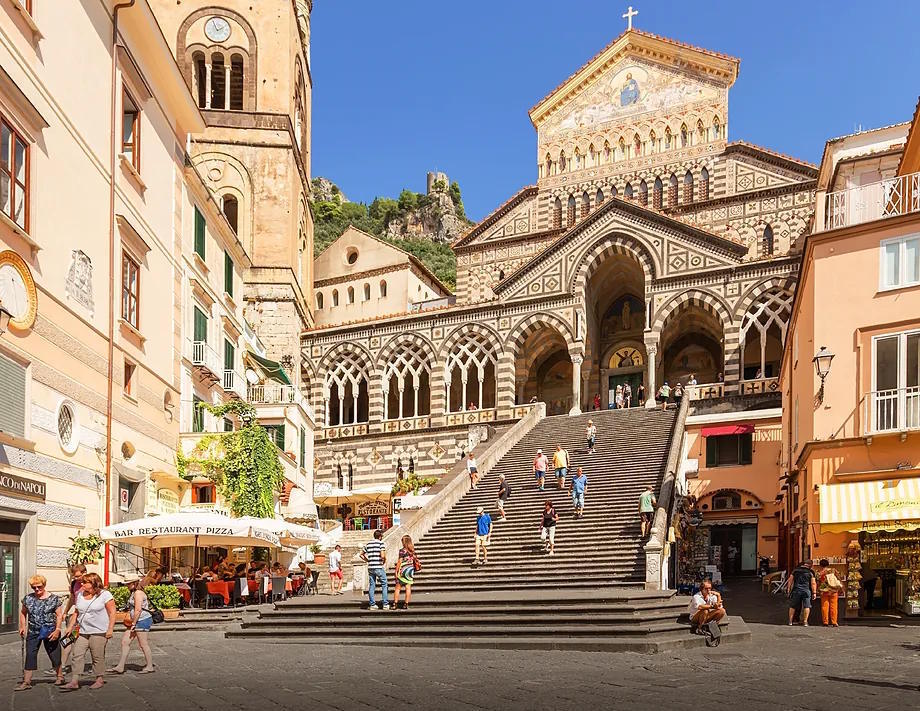
These pilgrimages across the Mare Nostrum shaped the municipality's appearance, with the Cathedral of St. Andrew as the ultimate example of mestizaje, presenting a Norman-Arabic Romanesque style with Byzantine, Gothic, and Baroque elements. Comprising two basilicas, it houses the Cloister of Paradise and the crypt with the relics of Jesus' first apostle, brought from Constantinople during one of the crusades.
"From them emanates a liquid (manna) on certain dates of the year to which miracles are attributed," adds Raineri. The devotion goes way back, as it managed to drive away the Saracen pirates from Amalfi with a great storm in 1544. The complex is complemented by the Museum of Sacred Arts, with unique pieces such as a 14th-century enameled chalice and an episcopal mitre with 20,000 gemstones.
The staircase leading to the cathedral, in the Piazza del Duomo, is one of the busiest spots in Amalfi. Locals and visitors sit there to watch people go by, either with a slice of pizza or a gelato (ice cream). Those who prefer have the terraces in front, as in every square (from Santo Spirito to the Dogi), where it's nice to spend hours. It is the starting point of the alleys winding through the old town, dotted with beautiful pastel-colored facades, fountains decorated with nativity scene figures (Cape'e Ciucci), endless stationery shops (you'll know why later), scandalous trattorias, and historic pastry shops like Pansa, open since 1830, where they serve their famous lemon cake and the Amalfi bread, the local panettone of the same flavor.
Next would be the boutiques selling ceramic items, handmade jewelry, souvenirs, or any product derived from the famous lemon: jam, soap, chocolates, slushies... Not forgetting the famous limoncello, a liquor native to the area thanks to its microclimate. At Antichi Sapori d'Amalfi, half factory half store in the heart of the town, the Cobalto family has been making it manually since the times of nonno (grandfather) Vittorio, three generations ago.
Standing for seven more years is the Monumental Garden, a lemon tree cultivated on terraces once used by the Romans high up on the slopes that shelter the municipality. Gianmarco Aceto is the latest link in the family responsible for the business, under the watchful eye, of another nonno, Luigi, who at 91 years old, goes up there every day. "He doesn't trust us," jokes his grandson while showing some of the gigantic specimens they use for their delicacies.
Before descending, it's worth visiting the San Lorenzo viewpoint. Better at sunset. And once back down, a visit to the Valley of the Mills is a must, where another treasure is hidden, the Paper Museum, paying tribute to another of the inventions discovered by the people of Amalfi on their travels. "Or bambagina paper, as they used to call it, made from linen, cotton, and hemp brought from China," recalls one of the managers, Chiara di Lieto, inside the oldest paper factory in Europe, built in the 13th century. Here, you can see how they used to work with tools that are centuries old, hydraulic wheels, stone presses, and outdoor drying rooms.
Now, let's talk about food. Following the valley path to Fore Porta, an agritourism spot with mountain views where the Amatruda family serves what they grow around (those tomatoes, eggplants, zucchinis...) along with local meat, cold cuts, and cheeses. All thanks to a third grandfather, another Luigi, who in the 70s fell in love with this rural paradise among (once again) lemon trees.