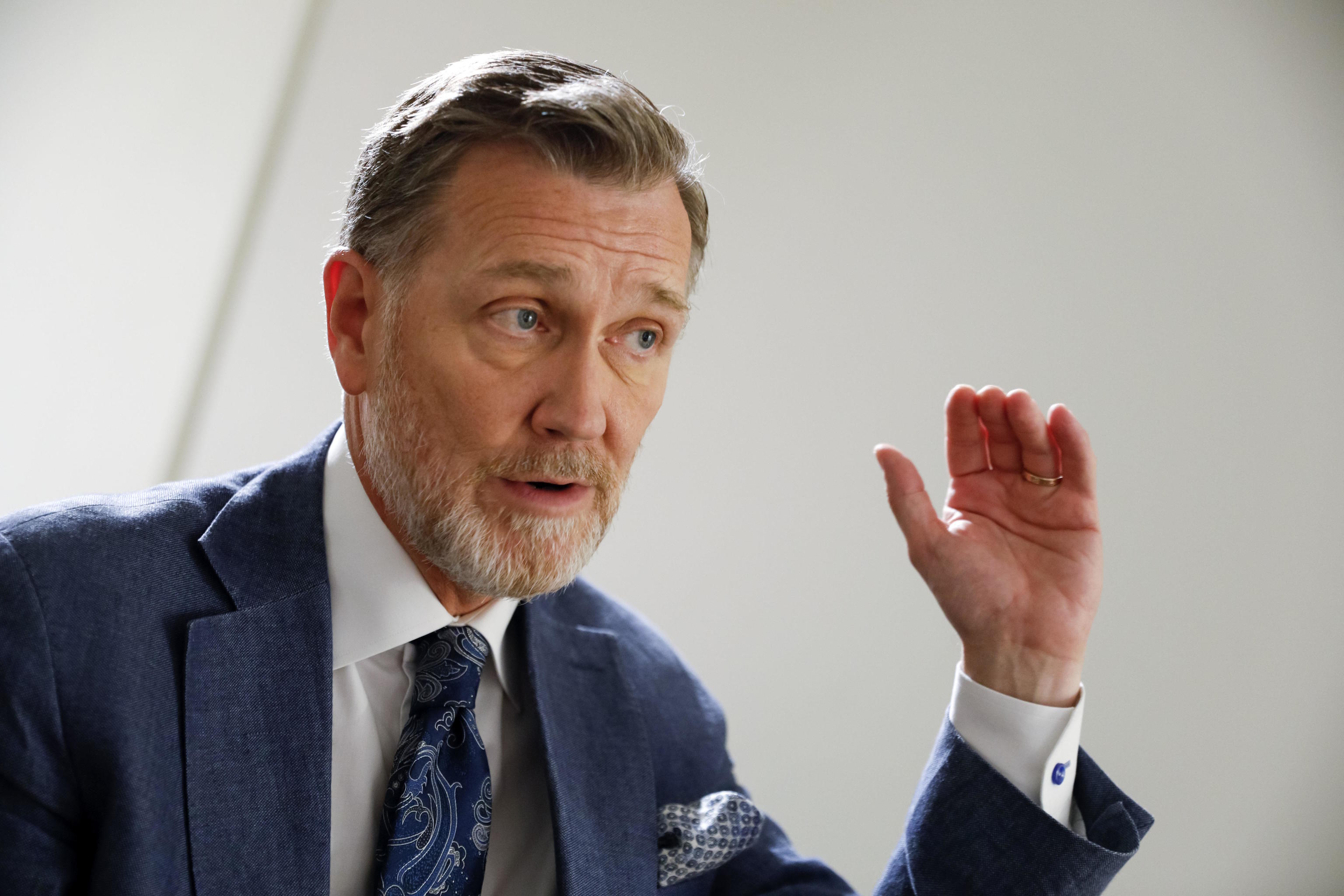
His "behavioral" human behavior is already famous worldwide. Thomas Erikson (Sweden, Örnsköldsvik, September 19, 1965) classifies people into four colors: reds (controllers, competitive, and energetic), yellows (sociable, sensitive, and empathetic), greens (reserved, cautious, and friendly), and blues (analysts, methodical, and perfectionists). His system for understanding our behaviors has sold over 10 million copies, with titles as well-known as Surrounded by Idiots, Surrounded by Narcissists, or the latest, Surrounded by Psychopaths (Ed. Planeta), where he explains how to free oneself from manipulations.
Erikson has been conducting seminars on interpreting behavior patterns and body language for over 20 years. He is also the creator of the DISC method (dominance, influence, steadiness, and compliance), which underpins all his work. In this interview, he explains why psychopaths are so difficult to identify and what to do when it is already too late to avoid them.
Where is the line between a real psychopath and the tendency to label anyone in a generalized way?
It is true that we use the psychopath label lightly, and that is incorrect: not everyone is one. Studies estimate that between 2 and 4% of the world's population would be diagnosed as clinical psychopaths, which equates to about 250 million people worldwide. They are many, yes, but they are scattered around the planet, not concentrated in one place.
What are the suspicious behaviors, specific signs, that would make us raise the alarm?
The psychopath talks like us, looks like us, but has nothing to do with the average person: they have a hidden agenda and a clear and constant intention to manipulate others and get as much as possible from them. They are difficult to detect because their behavior flies under the radar. That's why I wrote this book: to facilitate their detection.
But could we observe some common signs?
The first sign is quite subtle. When you meet someone, ask yourself: how do you feel? If they make you feel bad, uncomfortable, out of place, I would advise you to trust that feeling, call it a sixth sense or intuition. It is a signal that must be followed, at least as a first indication that something has sparked there. Intelligent people often believe they cannot be manipulated, and men even more so, because they enter their own flow of rational explanation of what they feel and have more difficulty recognizing that reality.And if we feel bad when meeting someone, what would be the next step?
The next step is to ask yourself why you feel bad: what does your intuition tell you? Perhaps you discover that this person is lying, trying to manipulate you, or turn you against others. A characteristic of psychopaths is that they never say what they do, so a good method is to compare their words with their actions. But that requires time and perspective because in general, we trust others and do not go through life thinking that those around us are dangerous until there is evidence to the contrary. With certain types of people, I even recommend taking notes, to be able to compare what they say with what they do and not be deceived.
Why do you think it is more common in men than in women?
Nature is strange, why does this happen? Why are there more color-blind men than women? Who knows, really. I have a personal, unproven theory: in romantic relationships, if the man is the psychopath, the woman tends to talk about it with her friends and family, to talk about feeling deceived. For women, it is more natural to talk about it, and that brings the psychopathic behavior of men more to light. However, even though it is not very popular to talk about differences between men and women today, there are neurobiological differences. And it is much rarer for a man who experiences psychopathic behavior from his partner to talk about it with his friends or family: he usually feels bad and remains silent.
Statistics speak of 75% of male psychopaths versus 25% of females. Do you agree with that ratio?Personally, I believe it is closer to 50-50. It's like the underground economy: very difficult to estimate precisely because it is hidden. There is an immeasurable number of female psychopaths that we normally do not know, just because men feel unable to talk about it and say they feel deceived, manipulated, or abused.
Why do you think these types of profiles tend to reach leadership positions?
Psychopaths thrive in power: the higher we climb in the hierarchy, whether in a legal or illegal organization, the more psychopaths we find. It makes sense because the psychopath easily gets bored, and despite having all the money, all the cars, and all the possible status, they always seek more motivation and stronger emotions. The higher up in leadership positions, the more power there is available to manipulate, control, and exploit others.
Does that include world leaders?
I am 100% convinced that the world is run by psychopaths. It sounds dramatic, but it is: just look at how the world has gone, the terrible things that humans have done throughout history. These people have a hidden agenda to dominate the world, and this is not just Hitler, Stalin, or Mao: it is in all organizations because that is where the power lies.
It is common to identify public figures with one of their traits. Can we do the same with the psychopathic profile? Can specific public figures who are psychopaths be pointed out?
Of course, it could be done, although it is a delicate matter. There is an American psychologist, Kevin Dutton, who conducted a detailed study of all the presidents of the United States, from George Washington to the present day, and assigned them a score based on their psychopathic traits. The number one? Against all odds, and by far: JFK. The number two, Bill Clinton, who, by the way, was also called "the modern Kennedy." Hillary Clinton was also high on the list, and Trump had a good score, although he was not president at that time. When he published the research, Barack Obama was in power, and the only thing this psychologist said, and I quote verbatim, was: "I do not want to give data on a president who is currently in office."
Could you give us at least one name of a textbook psychopath?
It is not just ultra-famous figures like Hitler, Stalin, Mao, or Pol Pot, who did horrendous things. I would say the most famous psychopath is not even a real person: it is James Bond. He is charming, witty, handsome... those are all the traits of a psychopath. The difference is that he is on our side, of the industrialized world, and that is why we like him, but he is a textbook psychopath.
How do you think social media influences these psychopathic profiles? Just by opening Instagram, one might think that ego there is bigger than the world.
Social media, truthfully, is not good for most of us. Jonathan Haidt has a very interesting study on this, as does Jean Twenge, showing how narcissists multiply and thrive there because they find their breeding ground. It's the "me, look at the hat I bought, look where I am and all that I have."
What is the difference between a psychopath and a narcissist?
All psychopaths are narcissists. What is not true in reverse, not all narcissists are psychopaths, and these behaviors are celebrated on social media. Just look at Instagram: whether the topic is cats, politics, or cars, at the top of the comments, we always find the most negative. Further down, there may be more positive comments, with more likes, but at the top is always the negative. That's what the algorithm does: let the negative rise like cream.
And is there something that characterizes them?
Psychopaths do not feel empathy or remorse and constantly need to be cheered on and celebrate their behaviors. They are in their element on social media. Sadly, social media does them a disservice in all of this.
What are the consequences for victims in these types of relationships, especially if they are, for example, in romantic or work environments, and cannot escape from them?
The most common consequence of this external stimulus is post-traumatic stress disorder, PTSD. Normally, when one becomes depressed, it is usually due to more internal causes, but when the cause is living with a psychopath, it often ends in PTSD. I have seen this up close with many women who have lived for decades with psychopaths and who, after that, do not trust anyone, have withdrawn from the world, and are unable to trust again. It is like when you break a leg: even though the bone heals, you are left with that feeling that it broke. And in that sense, therapy usually does not help much because it often focuses on digging deep, when what is needed here is for that person to regain strength and self-esteem to act as they deserve.
So, what is the best advice in those cases?
The best advice I can give to deal with a psychopath is to flee. Is it easy? No. But it must be understood that the psychopath will not change, it is impossible: it is not a mental illness, it is a personality disorder. It is like insisting that a color-blind person sees all colors: no matter how hard you try, it will not happen, it is physically impossible.
And if fleeing means giving up your own life as you knew it, even your dream job?
In the face of toxic behaviors, one must act quickly, there is no need to wait. I know people who, to escape from a psychopath, have changed countries, jobs, even the job that seemed like their dream job. Many times they say to me, "How can I leave this job if it is my dream job?" And I tell them, "Is it your dream job to live every day with a psychopathic boss? Flee." Life is too short to deal with these kinds of people. And, furthermore, post-traumatic stress disorder is a hole you enter, but you don't know when or how you'll get out. It sounds dramatic, but I think there is no other way.