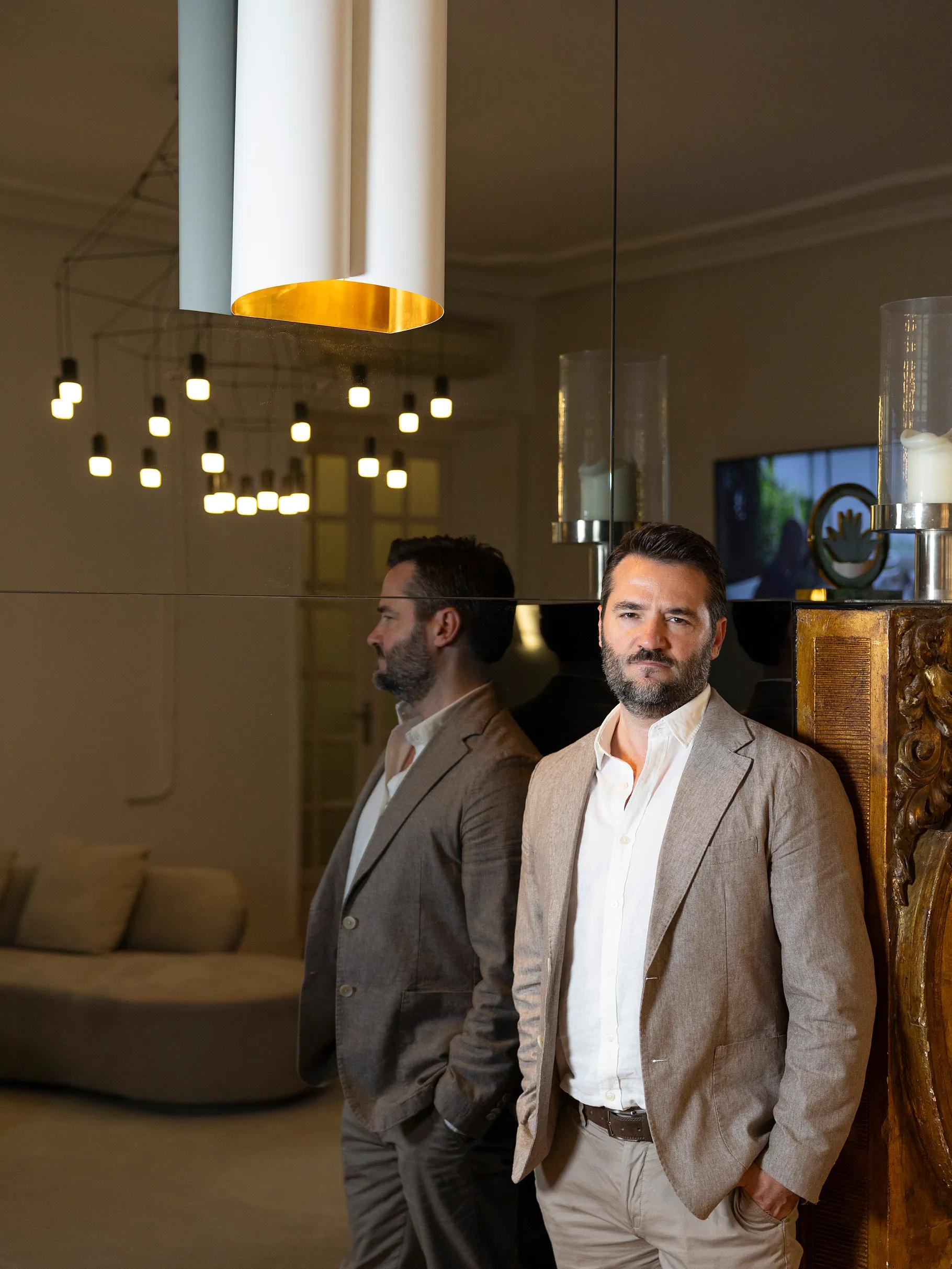
His professional career is exceptional. Emiliano Santarnecchi, director of the Brain Modulation Laboratory at Harvard Medical School and Massachusetts General Hospital, and an international reference in non-invasive brain stimulation, has just joined the new Scientific Advisory Board of SHA. There, he will lead the Cognitive Stimulation Unit, from which he will promote advanced protocols aimed at optimizing brain health, resilience, emotional regulation, and cognitive performance, basic pillars of 'healthspan' or healthy longevity.
What would you say is people's biggest concern regarding brain health today?
I believe that people are mainly concerned about stress and its long-term impact on brain health and cognition. There is now more awareness about the fact that even mild aging can progress towards a dementia-related path or any other type of neurodegenerative disorder. We know that we can detect these conditions many years before symptoms appear. Therefore, early prevention, diagnosis, and intervention are becoming essential both for well-being and clinical care. People tend to know more, and when you know more, you worry more, but that is also positive. It makes you think about how you want to take care of yourself in 30 years. So, I would say that the major concerns are stress and aging. I would also add sleep, which is probably the most underdiagnosed issue. It's interesting because people who have more sleep problems tend to underestimate its importance. They often say, "I don't think that sleeping little is affecting my performance," until they measure it and are surprised by how much it really matters.
There is a paradox: the brain is the most important, but it also seems the most uncontrollable. We measure heart rate, blood glucose, oxygen consumption, but what about our cognitive function? Why don't we pay attention to it? Indeed. The paradox is not only that we cannot control it. It is that, even though it is the most important and everyone agrees when you talk about it, if you then look at who is doing something for their brain, you realize that there lies the problem. One in three Americans monitors functions of their body, but almost no one measures anything about their brain. And yet, if you ask, "Would you rather have good knees or not start forgetting things?" the answer is clear. For many years, we thought we couldn't do anything for the brain, that we couldn't control or change it. So, why worry? If you can't improve something, you just live with it. But that has completely changed. In the last 20 years, neuroscience has advanced a lot. Before, we believed we couldn't modify the brain; now we know we can. We have behavioral, cognitive interventions, and also brain stimulation that can really help you take care of your brain. We just need to do it in time. And I think it all starts with education: if people don't know they can change it, they don't care.
If you had to recommend only three daily habits with solid scientific evidence to keep the brain healthy as you age, what would they be?
First, exercise. When we think of indicators like lipids, cholesterol, or hypertension, we often associate them solely with cardiovascular health. However, they all have a direct impact on brain function. So, you can do something for your heart and body by exercising and, indirectly, you get many benefits for the brain. In fact, studies show that simply walking at least three kilometers a day has a protective effect, especially in older people. It's not just general advice: it really changes the brain. The second is sleep. Sleeping well is not optional because it has implications at all levels. In the last ten years, we have been able to measure the brain's lymphatic system. We always thought it was there, but we didn't have the tools to see it. Now we do. That system cleans the brain during the night, removing proteins that accumulate with age, such as beta-amyloid or tau, related to dementia and Alzheimer's. So, it is essential to complete several sleep cycles each night. The third habit is to think about oneself. It may seem simple, but it has a huge effect. It is related to the 'default mode network,' an ancient network from an evolutionary point of view that is activated when you are not focused on a specific task. It is the wandering mind, but directed towards oneself, connected to memory of the past and projection towards the future. The back part of the brain, which is responsible for the past, is the first to deteriorate in dementia. That's why you have to keep this network active, just as you train the body. The simplest way is to be present, not to be distracted. That is mindfulness or meditation. And we know from neuroimaging studies that it improves connectivity in this network.
There is a lot of talk about physical exercise, but besides meditation, in what other ways can we train the brain?
There are two interesting strategies. One is cognitive training, although it is not yet sufficiently consolidated for there to be fully validated solutions. Many apps promise improvements that are not real. But when done correctly, as in the laboratory, basic cognitive functions can indeed be improved. And this is key: when we want to improve the brain, we think of complex functions, such as abstract thinking. But what can really be trained are the basic building blocks.
What do you mean by those basic building blocks?
Things like reaction time, the speed at which you respond to a stimulus. This is highly correlated with longevity because it reflects the integrity of neuronal connections, the speed of information transmission in the brain. Training that reaction speed frequently can have very relevant effects.
And the second tool?
Neurofeedback. It allows you to modulate brain activity in real time and gives the patient a very uncommon sensation: that of being able to control their brain. Until you experience it, you don't understand it. It's feeling like you can change your mental state in seconds.
When we feel mentally exhausted after a stressful week, what is happening in the brain?
The brain has multiple networks that normally do different things. But during periods of stress, those networks tend to activate at the same time for too long. And then they need time to readjust.
How can this readjustment be achieved?
There are two main ways. One is to disconnect and relax completely. The other, perhaps less intuitive, is to perform meaningful tasks, but one at a time. For example, reading activates the language network; writing activates another. By focusing on a specific activity, we allow some networks to work while others rest. In this way, the brain gradually regains its balance.
This is a somewhat uncomfortable but inevitable question. All this — neurotechnology, brain data — could also open the door to mental control. Right? It's a bit scary...
It's a very good question. And, in fact, it is a real concern. Especially now, with the rise of artificial intelligence, we don't always know where our data ends up. We are starting to share extremely sensitive information, such as genetics — just look at what happened with companies like 23andMe. But brain data goes even further: it is essentially what defines you as an individual. When you share that information, you are giving it all. That's why we need a true cultural revolution around the importance of brain data. We shouldn't just put on a device, send that information to the cloud, and let a company analyze it without further thought. It is a critical issue. In our case, we try to build systems and protection frameworks to ensure that this data is treated correctly.
Are there differences between regions in that regard?
Yes, clearly. Europe, for example, with regulations like the GDPR, protects privacy much better. In the United States, on the other hand, the system is more permissive, almost like the 'wild west.'Let's get back to the practical side. If someone only has a few minutes a day to take care of their brain, what should they do?
If I had to choose one thing, I would say meditation. In a very short time, it can have very powerful effects. Plus, it is accessible: you don't need technology or external tools. It is true that there are other options, such as cognitive training, but they require more structure or validation. Meditation, on the other hand, you can practice on your own.
Many people say they don't know how to meditate...
And that's okay. In that case, you have to find an equivalent activity. Some people achieve it by swimming, others by painting, as is my case, writing, or doing repetitive tasks that allow them to disconnect from mental noise. The important thing is not so much the technique as finding that space where the mind calms down.
How much of brain aging depends on genetics and how much on lifestyle?
There are no definitive figures, but there is a fundamental idea: we can influence much more than we think. Often, when we talk about genetics, we adopt a very deterministic view, as if there is nothing to be done. And that's not the case. Even what has a genetic basis can be largely modulated through lifestyle.
When does cognitive decline begin?
Earlier than we think. Some functions, like processing speed or reasoning, peak around 20-25 years and start to decline. However, others, like knowledge or experience-based memory, remain stable.
What factors influence brain health the most?
Dream, stress, exercise, nutrition, social connection, and mental stimulation. Stress, for example, has a profound impact: it affects the hippocampus (memory), the prefrontal cortex (complex thinking), and the amygdala, which becomes more reactive.
Lately, there is a lot of talk about the power of the mind to attract positive things. From a scientific point of view, does this have any real basis?
There are two ways to approach it. The clearest from science is the placebo effect. We know that when a person has positive expectations, specific brain networks are activated that, in many cases, coincide with those activated by real treatments. In fact, sometimes the placebo effect can generate even more intense responses than some treatments. This demonstrates that the brain has the ability to modulate symptoms and perceptions through expectation.
What is the future of brain health?
Towards personalization. Every brain is unique. We are moving towards models that allow simulating treatments - like 'digital twins' - to choose the best intervention in each case.
What do you hope to contribute to your joining the scientific council of SHA?
My goal is for it to become a global reference in personalized brain health and cognitive optimization. I believe that someone has to lead this change, and SHA has already come a long way.