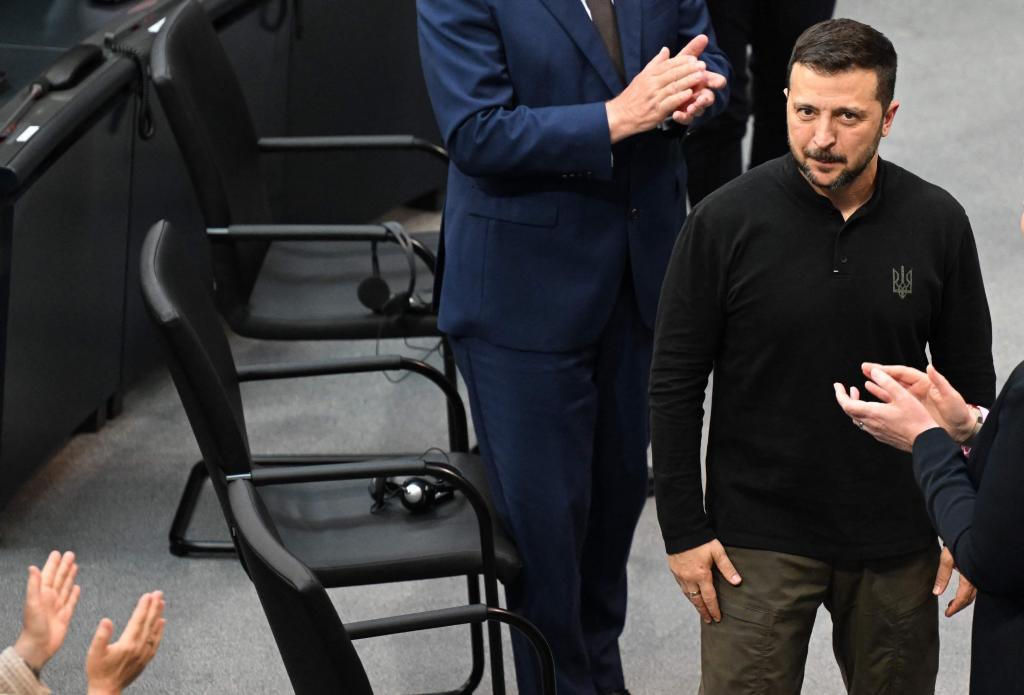
The recent actions of Ukrainian President Volodymyr Zelensky in the past few weeks reveal that we are facing a decisive moment in the war. The outcomes achieved this autumn could lead toa stronger negotiating position in the winter, provided that Trump wins the elections, Russia agrees to sit down, and China exerts pressure for this to happen. Zelensky wants to be prepared for this scenario. Therefore, he has decided to make all the significant moves himself.
This mindset led him to Ramstein on Friday, the German airbase where Ukraine's allies gather, establish a common aid strategy, and set the red lines for their intervention against Russia to prevent escalatory actions. It is precisely these red lines that Zelensky aims to blur on this trip, his first participation in this format.
In Kyiv, they believe that if they manage to break the US ban, mainly advocated by Jake Sullivan, National Security Advisor, they could deal several blows to the logistics, aviation, and missile launchers of the Russian military, forcing Putin's regime to reconsider its stance of not negotiating with Ukraine under these conditions. And what are the current conditions? For the past month, Russia's invasion of Ukraine has been met with Ukraine's invasion of Russia, at least in the Kursk region, an action that greatly upset the Russian autocrat, who treated it as a terrorist incursion rather than a reciprocal move.
"We want to end this war," Zelensky said upon arriving at the base. " Vladimir Putin is the one who does not want peace and is obsessed with conquering our territory. He wants our cities or what's left of them. Together, we must compel Russia to seek peace."
Since the invasion began, Ukraine has faced the immense challenge of confronting a nuclear power with the vast military resources of the former USSR, and they have done so with one hand tied behind their back. The aid provided by their allies has been very limited, often outdated, and almost always arrived months late. Each step up in assistance, whether sending tanks, missiles, or now fighter jets, has been delayed, giving Russia time to prepare against each new weapon or ammunition sent. Furthermore, when Washington has decided to send any equipment, such as the medium-range ATACSM missiles or the Patriot anti-aircraft missiles, it has come with restrictions: prohibited from using them on Russian soil or airspace. The goal now is for that ban to be lifted.
Russia is well aware that if Ukraine manages to convince the US, the threat to its bases, launchers, depots, and communication hubs would be significant. That's why Russian Foreign Minister Sergei Lavrov hurried to explain last Thursday that Washington " knows perfectly well, as they have been informed, that this would be a red line for Russia." But the red lines have been falling during the war at the same pace that Russia has been disregarding them: at this moment, Moscow is using ballistic missiles from North Korea to attack Ukrainian cities, another practice that seemed unthinkable three years ago. Zelensky asserts that if Russia can use weaponry from Pyongyang, he can use that of his allies.
So far, the US has presented an aid package worth $250 million, Germany has announced its own, and Spain, through Defense Minister Margarita Robles, will send a Hawk anti-aircraft battery "immediately." Romania has joined with another Patriot battery, the most effective against Russian missiles.