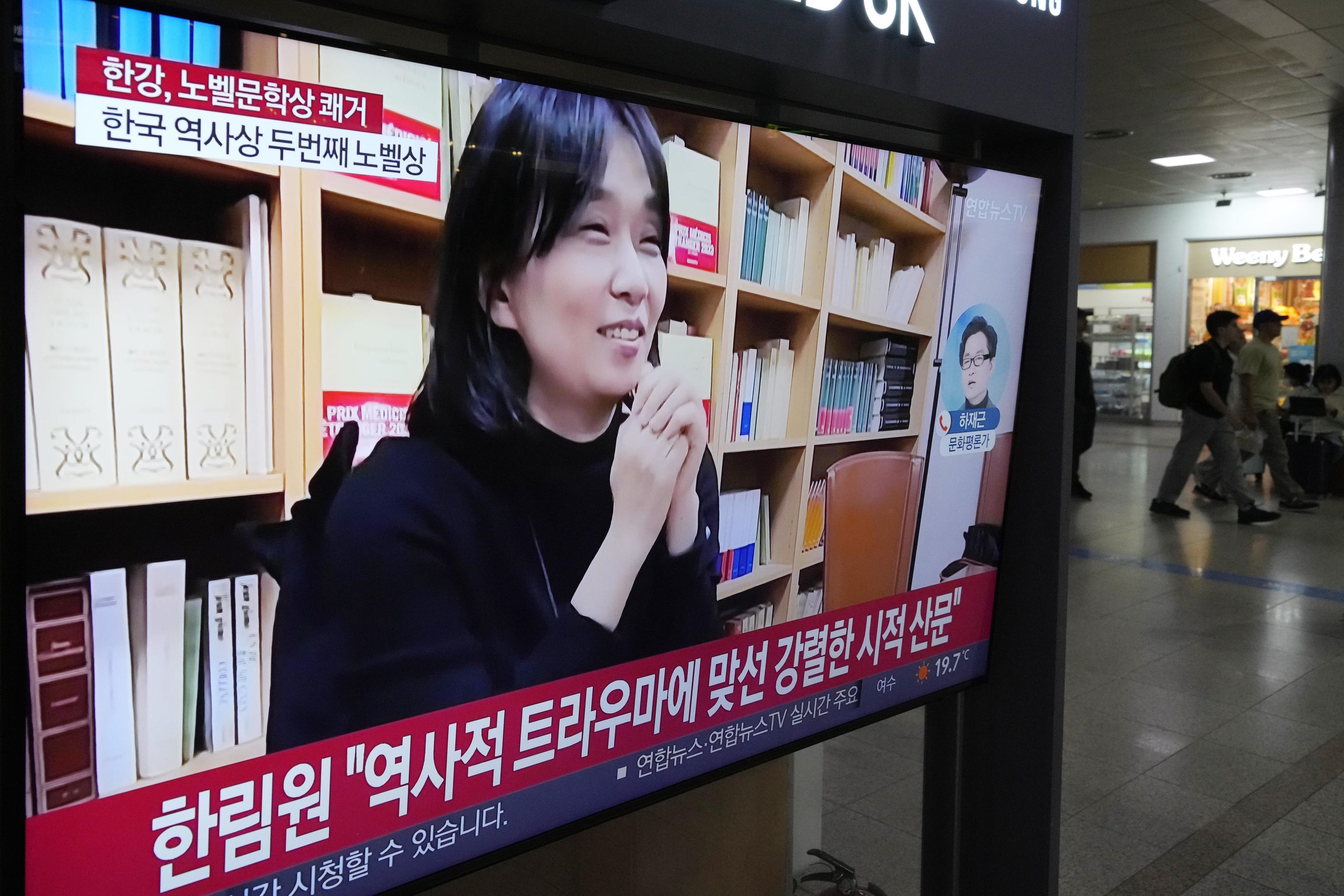
Han Kang (Gwangju, 1970) has been awarded the Nobel Prize in Literature by the Swedish Academy in recognition of "her intense poetic prose that addresses historical traumas and exposes the fragility of human life," according to the jury's decision.
The South Korean poet and storyteller, who has gained worldwide recognition through her novels but has been a minority author until today, has two narrative books published in Spanish, Galician, and Catalan, The Vegetarian and The Greek Lesson (Penguin Random House), and another essay/chronicle available in Spanish, titled Human Acts (Rata Books). Han Kang had previously won the Man Booker International Prize for fiction in 2016 for The Vegetarian.
The critiques of Han Kang often focus on the poetic root of her literature. Human Acts is the best proof, especially considering that its initial material seems more journalistic or historiographical than lyrical. In its pages, the narrator investigated the Gwangju Uprising in May 1980. That month, after a military coup that had imposed martial law in South Korea, 220,000 university students protested in the streets of the city of Gwangju. 165 protesters and 21 police officers died in the repression of the protests. Human Acts narrated that trauma from the morgue where the victims' bodies ended up, using a collage of voices that linked the survivors' intimate pain with the minimalist language of the essay. The Gwangju Uprising became a sociological study object in her pages.
Human Acts was a success in South Korea and a painful book in public discourse. The Greek Lesson, on the other hand, was a more intimate, more philosophical than political text, written after a personal convalescence of the author. The novel's starting point was the discovery that classical Greek had an intermediate form between the passive and active voice. During the 2008 crisis, Greek protesters against cuts and corruption got used to using that voice to not present themselves as victims or victimizers. From there, Han invented the story of a Greek teacher and one of his students, two lonely individuals in Seoul. The teacher was losing his sight. The student had lost custody of her son. The teacher narrated his memories in the first person. The student wrote in the third person and tried to evade her story.
The Vegetarian (published in Korean in 2007) is, of the three titles by Han published in Spain, the one that most directly speaks to the contemporary world. Yeong-hye, the woman at the center of the story, was a conventional wife who awoke from a violent nightmare with the need to rid herself of all the meat that fed her family. Around her, the world reacted with resigned irony, but Yeong-hye persisted and turned what seemed like a quirk, an irrational gesture, into a form of cultural insubordination. Not eating meat became a way to unveil everything that oppressed Yeong-hye: sexual repression, middle-class conformity, mental illness, social pressure, the objectification of women...
How to place Han Kang on the map of contemporary literature? By age, Han Kang is the daughter of a country that, like Spain, had gone through a civil war and a long period of political repression. The daughter of an unlucky poet, educated in the United States and exposed to the boom of the South Korean economy and the opening to the world of its culture, Han Kang is not a picturesque writer. Some critiques of The Vegetarian identify in Yeong-hye a character reminiscent of Kafka, someone who has an epiphany of the networks that oppress them but feels that vision as a condemnation rather than a liberation. The text, however, adds much more contemporary layers of interpretation: the bodies of her characters are the battleground. Sexuality appears as a promise of freedom, more dreamlike and poetic than realistic. Dreams are artistic images, rather than surrealistic games, and this detail is relevant because Han Kang has written extensively about contemporary art.
Violence is another relevant theme in Han Kang's work. Now, the announcement of the Nobel Prize will accelerate the publication in Spain of Saying Goodbye is Impossible (Penguin Random House), a new story of brutality built on historical facts. Like in Human Acts, the author delves into a historical trauma in her pages, the Jeju Massacre. On that South Korean island, there was an anti-authoritarian rebellion in April 1948 that was suppressed by the Army. At least 30,000 people died until May 1949, in a small civil war that foreshadowed the 1950 conflict. W.G. Sebald, not Kafka, is the reference in this case.
Han Kang succeeds the Norwegian playwright Jon Fosse, awarded last year for "giving voice to the unspeakable," according to the decision. The previous winners were Annie Ernaux (2022), Abdulrazak Gurnah (2021), and Louise Glück (2020).
The Nobel Prize in Literature has been dominated by male writers, with only 17 women among its 119 awardees. The last female winner was the French Annie Ernaux in 2022.
Precisely French writers have been the most awarded in this prize, with 16 winners in history. The literature of the USA and the UK has had 13 winners each, followed by Germany (9), Sweden (8), Spain (6), Poland (6), and Italy (6).
In 2018, the prize was suspended after three members of the academy board resigned in response to an investigation for sexual assault and harassment involving the author Jean-Claude Arnault, married to board member Katarina Frostenson. He and his wife were also accused of leaking the names of the awardees on at least seven occasions so their friends could benefit from betting.
The predominance of European and North American literature has been subject to criticism in the past. A minority of the awarded authors have come from Asia, Africa, or the Middle East.
The Nobel Peace Prize will be announced on Friday, and the Economics Prize on Monday, October 14.
The prize is endowed with 11 million Swedish crowns (almost one million euros) from a legacy left by the creator of the award, the Swedish inventor Alfred Nobel.
The award ceremony will take place on December 10, the anniversary of Nobel's death.