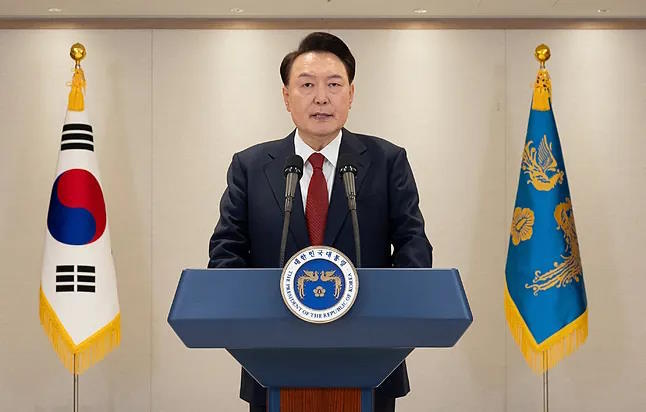
South Korean President, Yoon Suk-yeol, unexpectedly appeared on Thursday morning in a televised speech to defend his martial law decree and ensure that he will not resign despite pressure from the opposition and his own party.
"I will fight to the end to prevent the forces and criminal groups that have been responsible for paralyzing the government and disrupting the nation's constitutional order from threatening the future of the Republic of Korea," said Yoon, who is currently under investigation by the police and prosecution for alleged crimes of rebellion and treason.
"The National Assembly (Parliament) is dominated by a major opposition party that has become a monster destroying the constitutional order," continued the conservative leader, who maintained that last week's martial law was intended to "defend the democracy and constitutional order of the country."
On Wednesday, after the police raided the presidential office, the chief prosecutor leading a criminal investigation against the president stated that he would not hesitate to arrest Yoon on charges of insurrection.
The political crisis continues in Asia's fourth-largest economy. Thousands of people took to the streets of Seoul again last night to demand the removal and arrest of President Yoon, who clings to power despite popular acclaim for his resignation.
On Saturday, Yoon will face another impeachment process filed by the opposition, which controls the Parliament, but still needs the support of at least eight lawmakers from the ruling People Power Party (PPP) to suspend the president. Subsequently, the formal impeachment must be confirmed by at least six of the nine judges of the Constitutional Court.
PPP leader, Han Dong-hoon, expressed his support on Thursday for the second impeachment against President Yoon Suk Yeol. According to Han, the president's removal is the only viable option left to restore political stability in the face of the defiant president.
"We thought that voluntary resignation (by Yoon) would be a quicker and more predictable route than impeachment. But it has been confirmed that the option is no longer viable. The president must be immediately suspended from all his functions, including legal authority over the military," Han stated.
As the legal noose tightens around Yoon, several officials involved in the short-lived martial law have already been arrested. Among them is Yoon's former Defense Minister, Kim Yong-hyun, who resigned days later after apologizing for the failed decree and attempted suicide on Tuesday night in the prison bathrooms where he was held.
This week, Cho Ji-ho, Commissioner General of the Korean National Police Agency, and Kim Bong-sik, Chief of the Seoul Metropolitan Police Agency, have also been arrested on insurrection charges. Both were accused of deploying the police to prevent lawmakers from entering the Parliament after Yoon declared martial law on December 3. Cho was disqualified on Thursday by a motion passed by Parliament, as was the Justice Minister, Park Sung-jae.
Another key figure in the failed coup in South Korea, General Park An-su, the Chief of the Army Staff who proclaimed himself "commander of martial law," has been suspended from his duties. Several other senior military officials have also faced the same fate, leaving a power vacuum in the top ranks of the South Korean Army.
Prosecutors investigating the martial law have questioned another key figure, Yeo In-hyung, a Defense Counterintelligence Command official, who revealed that the plan was not spontaneous but had been prepared since the conservative party's electoral defeat in the legislative elections earlier this year. Yeo stated that on the night of December 3, the president gave orders to deploy troops to the National Assembly to prevent lawmakers from voting to overturn martial law, as they did.