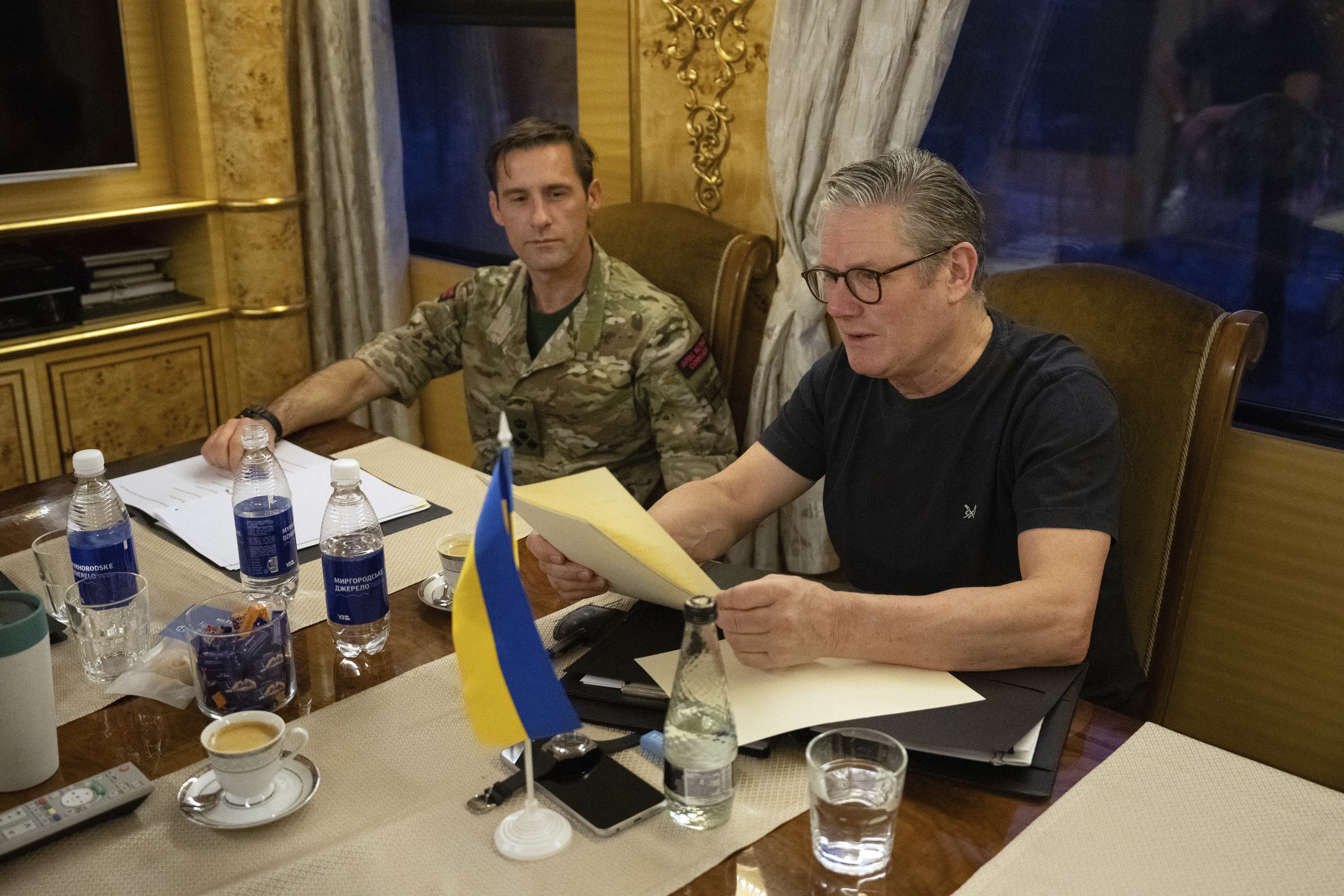
The prime minister Keir Starmer has traveled to Kiev to meet with President Zelenski to sign a "100-year agreement" of collaboration in defense and reconstruction, in what is seen as a challenge to Donald Trump, four days before his inauguration and amid fears of a withdrawal of support to Ukraine.
The meeting between Starmer and Zelenski was disrupted by alarms and shots to try to shoot down a drone near the presidential palace, just before the scheduled press conference.
"Putin's ambition to distance Ukraine from its closest allies has been a monumental strategic failure," stated Starmer. The prime minister assured that the relationship between the two countries is "closer than ever" and that he will use his visit "to take it to the next level."
His visit to Ukraine, postponed several times since arriving at Downing Street, comes three months after criticism from the Ukrainian government, claiming that the relationship had "gone backwards" compared to his predecessor Rishi Sunak, with delays in the delivery of weaponry and a halt in the shipment of long-range Storm Shadow missiles.
Volodimir Zelenski has used his meeting with Starmer to urge European allies to "not drop the ball" with the change of guard in Washington and to continue facilitating military support to his country, arguing that otherwise it would mean "more aggression, more chaos, and more war."
"It is very important to ensure that Ukraine is in the strongest possible position", highlighted Starmer during his tour of the Ukrainian capital. "I am here, visiting the burn unit at one of the hospitals in Kiev, a tragic reminder of the price Ukraine is paying. We have set the course and we cannot slacken."
Starmer could use his trip to Kiev to announce the possible deployment of British soldiers as part of a peacekeeping force in a hypothetical post-war scenario. Since the start of the war, the British army has trained over 45,000 Ukrainian soldiers on its soil.
"The power of our long-term friendship cannot be underestimated," added Starmer, who pledged to "continue supporting Ukraine against Putin's barbaric invasion" and to help the country "rebuild a prosperous and sovereign future" once hostilities cease.
During their stay in Kiev, the two leaders will sign a symbolic "100-year agreement" between the two countries. Starmer will announce the initial allocation of 47 million euros for economic recovery, as part of the 15 billion euro package in military, economic, and infrastructure support since the start of the war.
"The agreement goes beyond the here and now," emphasized Starmer. "The goal is to promote investment, technological development, scientific advancements, and cultural exchanges between the two countries, leveraging Ukraine's demonstrated innovation capacity in recent years for the benefit of future generations."