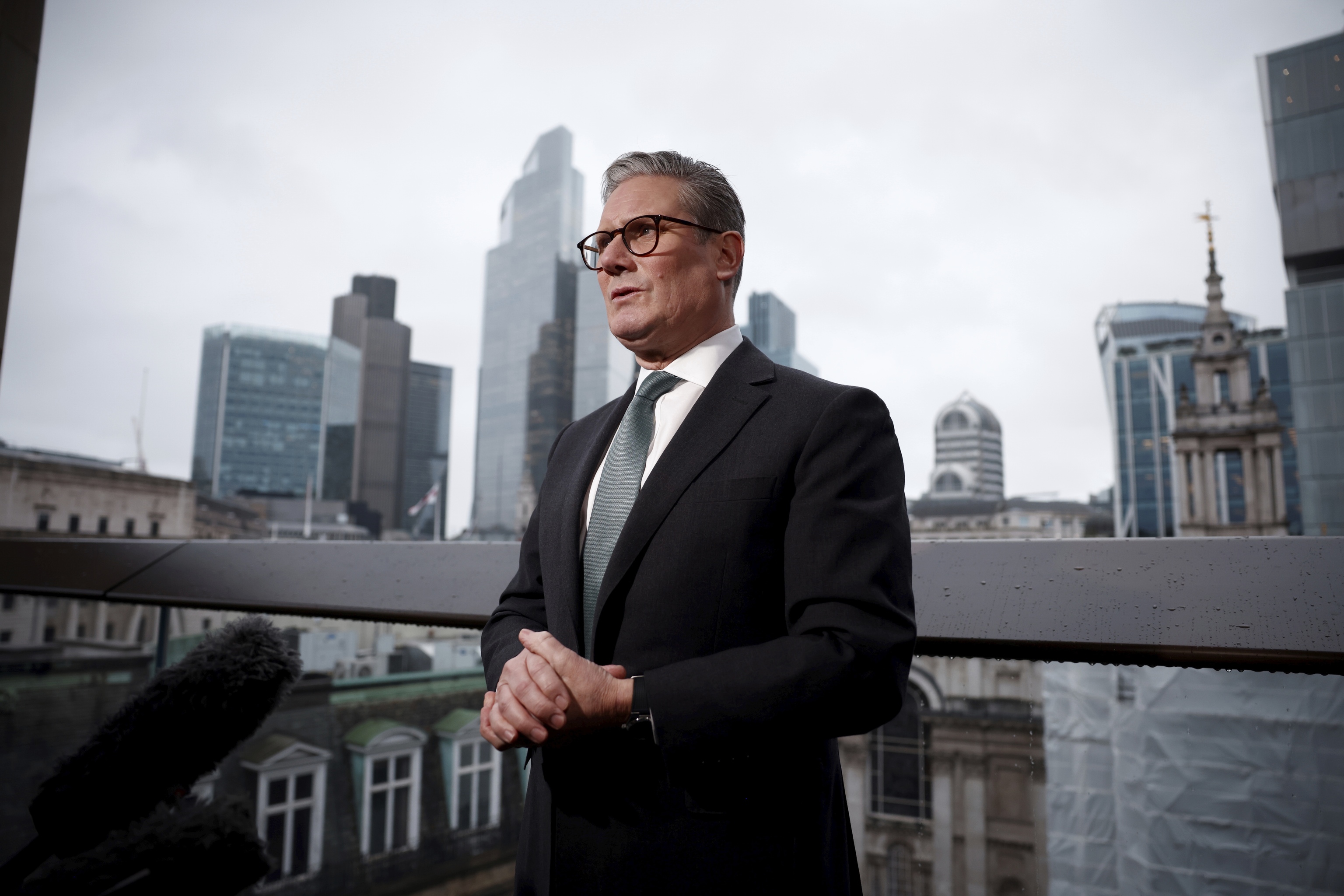
There are no photos of Keir Starmer with Donald Trump. They really know very little about each other and they met for the first time in September 2024, at a very private dinner at the Trump Tower in New York. That three-way meeting (also attended by the Foreign Secretary, David Lammy, swallowing the "neonazi" label he once gave to the host) served to break the ice and prepare for the litmus test of the special relationship.
Donald Trump denounced "blatant foreign interference" a few days later with the arrival of 100 Labour activists in the American campaign. Elon Musk had been undermining Starmer for months. The British premier had even displaced Justin Trudeau as the black beast among the MAGA tribe, denouncing the fall of the United Kingdom into Marxism and wokeism.
The special relationship seemed broken before it even began, until Donald Trump's call this week (after speaking, among others, with the leaders of El Salvador and Jordan). It was a 45-minute phone call, apparently warm and friendly, at the end of which the American president speculated that the first country he will visit this year may be the United Kingdom.
Downing Street is already working on preparations for a State visit. Trump's enthusiasm for the British royal family may weigh in, as well as the proximity of his golf course in Scotland. The setting will be in any case very different from his 2019 debut, with Queen Elizabeth II still alive and Boris Johnson boasting of populism due to Brexit.
"Starmer can use Brexit as cover this time and achieve preferential treatment with respect to the EU," warns political scientist John Curtice. "The Labour premier will face a dilemma if Trump offers him a deal on tariffs," clarifies Anand Menon, head of UK in a Changing Europe. "Trump may force him to choose between the US and the EU, precisely seeking to reset his relationship with the 27."
Ambivalence and caution have been the hallmarks of Starmer so far, who believes in "the value of personal relationships on the international stage" and warns that "the special relationship has been maintained in really difficult circumstances and is above who holds office in the UK and the United States."
"We get along well," emphasized Donald Trump after the conversation with the premier. "He is a liberal, a bit different from me, but a good person and I think he has done well so far. He represents his country with a philosophy I may not agree with, but I have a very good relationship with him."
The mutual flatteries remained hanging in the air, but there are still bitter pills on the table such as the refusal to cede sovereignty to the Chagos Islands to Mauritius (where the US base of Diego Garcia is located) or the veto as ambassador to Labour's Peter Mandelson (the same one who said a few years ago that Trump was "a danger to the world").
Starmer recently traveled to Ukraine to sign a "100-year agreement" of cooperation with President Zelenski, which was also interpreted as a challenge to Trump due to his approach to Putin. The premier praised Trump's role in the ceasefire in Gaza during their first conversation, but the humanitarian disaster could create a point of friction, as well as the UK's relations with China.
After threatening tariffs on half the world, it remains to be seen if Trump would appeal to the special relationship with the UK to revive negotiations for the trade deal offered to the British as the main reward of Brexit. And it will be necessary to consider how far Trump's disdain for the EU goes and if he will diminish the anti-Starmer animosity that has taken hold in his immediate circle.
Of the 616 messages posted by Elon Musk in the first week of the year, a total of 225 were related to politics in the UK, according to an analysis by the Financial Times. Direct interference through his own social network occurred a few weeks after Keir Starmer's election, when he wrote "civil war is inevitable" during anti-immigration protests in the summer of 2024.
Musk's incendiary rhetoric escalated at the beginning of 2025, accusing the Labour premier of being complicit in "mass rapes" due to the scandal of child sexual exploitation gangs. He then moved on to condemn "the dystopian police state," call for the "end of the tyrannical government," and ask King Charles to dissolve Parliament.
Since Trump's inauguration, and in his new role as advisor to the Director of the Department of Government Efficiency, the world's richest man has fueled anti-Starmer sentiments, amid signs of the president's possible discomfort with his quest for the spotlight.
Much has been written about Musk's fixation on the UK, born in South Africa but doubly linked to the British Isles through his grandmother, Cora Amelia Robinson, and his second wife, Talulah Riley (some of his 11 children are Anglo-American).
"Musk sees the UK as a kind of distant homeland," acknowledged Gawain Towler, former communications chief of Reform UK, witness and part of the rapprochement between Nigel Farage and the world's richest man. "For him, the UK is like Athens, if we compare America to Rome. He is quite concerned about what happens here."
Perhaps the key to Musk's excessive interest in British politics was given during the presentation of Vice President JD Vance, when he warned during the campaign that the US commitment to NATO will depend on the efforts of European allies to regulate X.
"The uproar over the child exploitation gangs is a distraction from Musk's true goal: rejecting regulation", warns former Labour advisor Imran Ahmed in The Guardian. "The media and politicians have generally fallen for his sleight of hand. It has been an exercise in charlatanism to disguise what he really intends: his agenda is purely economic."
In the spring, the Online Safety Act (OSA) will indeed come into effect in the UK. The text was promoted - and weakened in the process - by the last government of Rishi Sunak, a very close friend of Elon Musk, whom he rolled out the red carpet for at the first global conference on AI security.
Musk perceives the OSA, which introduces measures and fines against illegal content on social media, as a threat to his "absolute creed of freedom of expression," just like the EU Digital Services Act. The European Commission has been investigating X for "potential violations" since 2023, but how zealously both London and Brussels act against American tech giants will likely shape the future relationship with Donald Trump.