In Australia, they learned that the Chinese army was conducting live-fire naval exercises near their coasts last week because a commercial pilot alerted the authorities using a radio transmission on an emergency frequency. Never before had the navy of the Asian superpower conducted maneuvers in waters so far from the Pacific.
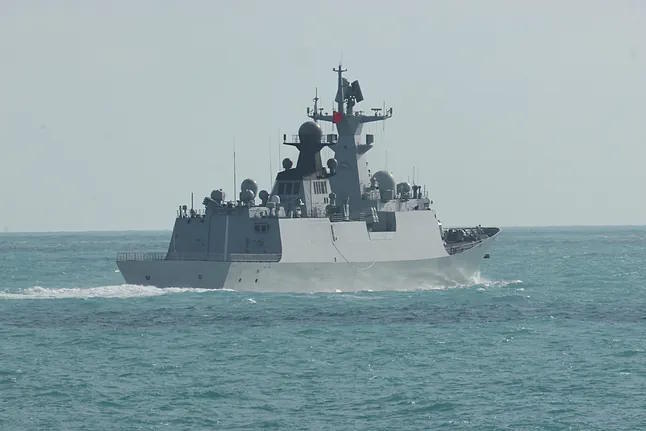
Three warships from China (a frigate, a Type 055 destroyer, and a replenishment ship) have been navigating international waters in the Tasman Sea since mid-February, spanning 2,000 kilometers between Australia and New Zealand. After the Virgin Australia airline pilot reported the combat drills, Australian authorities diverted over fifty aircraft from their flight paths to avoid flying over the area where the Chinese fleet was located, led by a destroyer equipped with the most firepower in its class: it is equipped with a massive naval gun, two anti-submarine helicopters, torpedo systems, and the ability to fire various types of missiles.
The Australian government, led by the Labor Party's Anthony Albanese, lodged a diplomatic complaint with Beijing, which responded by accusing Australia of "exaggerating" Chinese military exercises. "They comply with international law and do not affect air safety," a statement from the Chinese Ministry of Defense declared.
There is no legal obligation for foreign warships, if they are more than 300 nautical miles away from coastal nations, to notify their activities. Beijing used this as a shield to state that its maneuvers complied with the 1982 UN Convention on the Law of the Sea, which does not impose restrictions on military operations on the high seas, as long as they are conducted in international waters. Additionally, Chinese authorities claim that their navy announced last week their intention to conduct a possible live-fire exercise on the high seas.
However, what concerns Australia and New Zealand is that this unprecedented move by the Chinese military seeks to showcase the capability of the Asian giant's military force to extend far beyond its own shores. Specifically, in a Pacific region full of small island nations where the government of Xi Jinping has been trying for many years to expand its influence through checkbook diplomacy: building infrastructure such as airports, roads, and bridges in exchange for loyalty, as seen when the states of Kiribati and Solomon Islands severed ties with Taiwan in 2019 and recognized China's sovereignty.
Following these recent maneuvers, many analysts suggest that this is a new show of force by the Chinese navy in a region where Beijing aims for a greater presence. "China has diligently sought security agreements with small island nations throughout the South Pacific, causing anxiety in Australia and New Zealand over the prospect of a fierce territorial dispute in their backyards," says Donald Rothwell, a professor of International Law at the Australian National University. "These activities are also important information-gathering exercises. Each visit by the Chinese navy allows them to gain more experience in waters they do not frequently navigate."
Chinese diplomatic sources, in conversations with this newspaper, claim not to understand the complaints from Australian and New Zealand authorities, as the armies of these countries frequently conduct military maneuvers - including live-fire exercises - in the South Pacific, often joined by warships from the United States, Britain, France, and Japan.
"Two weeks ago, Australian, American, and French warships conducted joint maneuvers in the South China Sea, which is very close to our shores, and we did not act in any way or lodge diplomatic complaints about it," a Chinese official points out. Just 15 days ago, the Australian Ministry of Defense reported that, precisely over the South China Sea, a J-16 fighter from the Chinese People's Liberation Army (PLA) had approached an Australian P-8 reconnaissance aircraft to within just 30 meters, launching flares during the dangerous approach.
Those disputed waters, near the southern coast of China, have also been stirred in recent days by new live-fire combat exercises by the Chinese army. These exercises were aimed directly at Taiwan, where they denounce that Beijing is increasing its military pressure by deploying an increasing number of fighter jets and warships around the island.
In Taipei, facing the constant threat from China, they have been seeking a gesture from US President Donald Trump. The United States has been Taiwan's main ally in recent years and its major arms supplier. However, unlike the previous Biden Administration, the White House is maintaining a much more distant stance. A few days ago, Trump himself refused to answer questions about whether his military would defend Taiwan from a Chinese invasion.
Comentarios