On Friday night, after the infamous showdown between Donald Trump and J.D. Vance in the White House, many Ukrainians measured Volodymyr Zelensky's level of self-control by reading his lips at the tensest moment of the clash. Trump tells him that without the US, Ukraine wouldn't have lasted "not even two weeks," to which the Ukrainian responds: "Three days, as Putin said." With Vance joining in, Zelensky turns to his right and mutters an inaudible "sukablyat" traced in the air, the Swiss army knife of insults in both Ukrainian and Russian.
That "sukablyat," the word shouted by soldiers on the front line when they feel in danger, marks the level of diplomatic disaster experienced in the Oval Office. The argument may have immediate consequences on the battlefield and the resolution of the conflict that, despite peace negotiations, is going through one of its bloodiest moments.
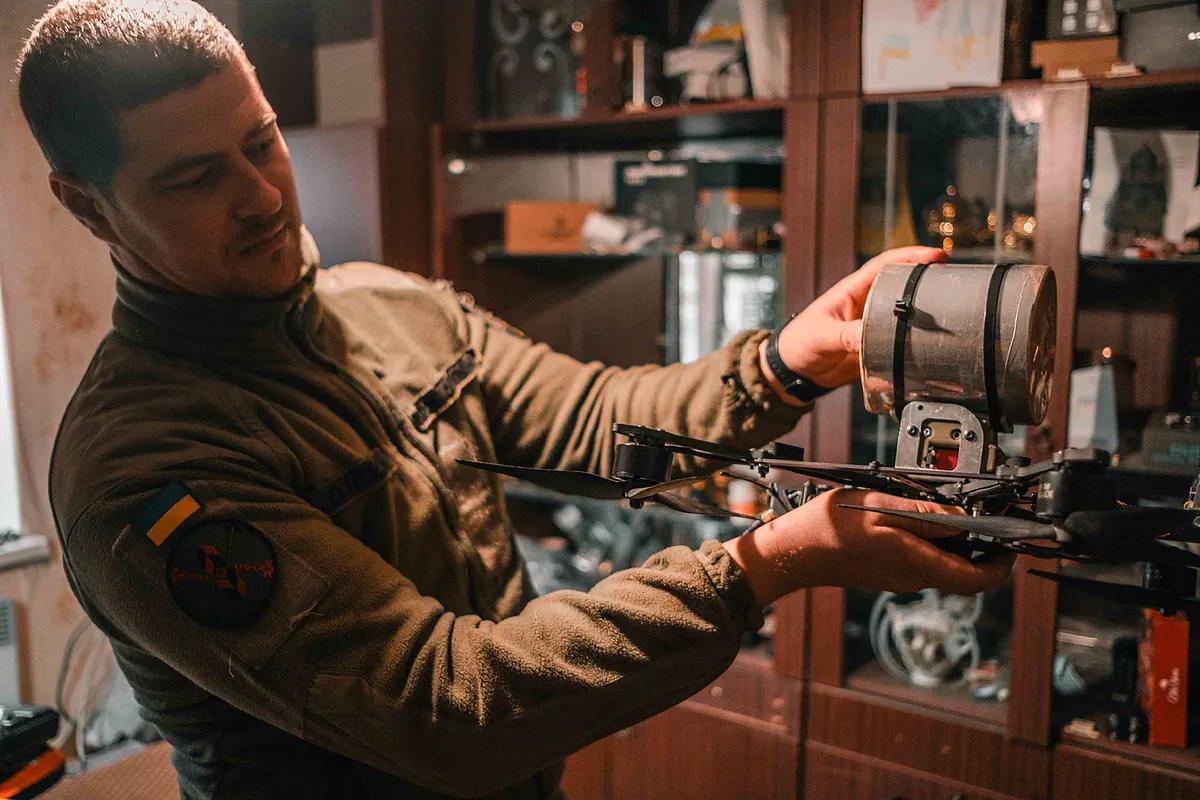
Can Ukraine withstand Russia's offensives without military support from the United States? In reality, it is a scenario that Kiev has already partially experienced. From the fall of 2023 to the spring of 2024, Washington went six months without sending a single bullet while the US Congress dragged its feet. During those critical months for Ukraine, the city of Avdiivka was lost, and its soldiers suffered greatly due to the lack of ammunition, but the country shifted its entire defensive strategy from artillery (scarce and very expensive) to drones (cheap and lethal). A 155-millimeter artillery shell costs around 3,600 euros. An FPV drone, about 500 euros.
Analyzing the delivery of US military equipment to Ukraine with perspective, it is evident that it did not have a significant impact on resisting Russia in the initial and decisive stages of the conflict, and that the main shipments were not aimed at a victory for Ukraine, but at wearing down Russia. The first US cannon (M777) arrived four months after the invasion began. The first Himars launchers, six months later. It took a year and a half to send the first M1 Abrams tank and two years for the long-range ATACSM missiles. Donald Trump talks about Ukraine lasting two weeks against Vladimir Putin without US assistance, but reality once again contradicts the magnate. It was the determination of the Ukrainians that thwarted Moscow's plans for a lightning invasion. Then the weapons began to arrive.
Has US assistance been key in keeping the Russians at bay on the front lines during these three years? It has been. The US has donated some of the most efficient vehicles on the front lines of the entire war, such as the Bradley combat vehicles, the M113 troop transports, or the M109 Paladin cannons. At another level, their assistance in military intelligence has been a significant advantage in anticipating Kremlin's plans and attacking its logistics.
If Trump finally cuts off US military aid to Ukraine, can Kiev sustain the fight with only the United Kingdom and European Union partners as the main donors? There is no simple answer to this question. The Institute for the Study of War believes that this US cut to the current flow of aid "would directly undermine President Trump's stated goal of achieving a just and sustainable peace in Ukraine," as it would "encourage Putin to continue increasing his demands and feed his conviction that he can achieve a total victory in the war." But the scenario is already a tangible possibility.
According to the latest data from the Kiel Institute for the World Economy, Ukraine's allies have allocated around 267 billion euros to support Ukraine. Of these, 49% has gone to armaments, 44% is financial support, and the remaining 7% is humanitarian aid. The US has contributed 114 billion, 43% of the total, despite Trump's claims that Washington provided more than Europe.
Without that 43% that the US contributes, can Ukraine survive? It could be done with political will, as we are talking about only 0.96% of the GDP of European partners, but it would also require doing something that has not yet been done: tripling shifts in ammunition factories, putting all machinery into operation, and still, we would be late. In other words, Europe could support Ukraine alone but only for a limited time, perhaps months, as the US has surpluses in arsenals that we do not have of essential items such as ammunition, spare parts, and armored vehicles, and at best, it will take us years to have them again.
Brussels has lost three decisive years to get its arms industry running at 100% to have autonomous defense in the face of the void left by the US and tangible threats from Putin. Nothing has been done. There is no common plan for ammunition purchases, no defense architecture, no coordinated command structure. Not even to think about Ukraine.
In the current scenario, there are only two pieces of good news for Kiev. The first is that drones are now the main military instrument, a low-cost technology for both spy and short or long-range attack drones. Additionally, the situation has changed in a year because Ukraine has done its industrial homework. Now, the vast majority of drones (four million per year) are already produced on its own territory, which also has its own line of projectile factories. In other words, in the fourth year of the war, Ukraine is less dependent on its allies than in 2022. The second piece of good news is that the Russian economy is depleting at the same pace as its old Cold War arsenals. The Russian National Welfare Fund, the fund from which Putin draws money to finance the war, has lost a significant portion of its total liquid amount since the invasion began. From about 8.8 trillion rubles in February 2022, that fund has dropped to 3.8 trillion in 2024. In other words, it has lost 60% and continues to decline.
Russia has never had so little money in the fund since its creation. For many analysts, that is the reason why this was not a good time to negotiate, but rather in a few months when Putin's money runs out.
Comentarios