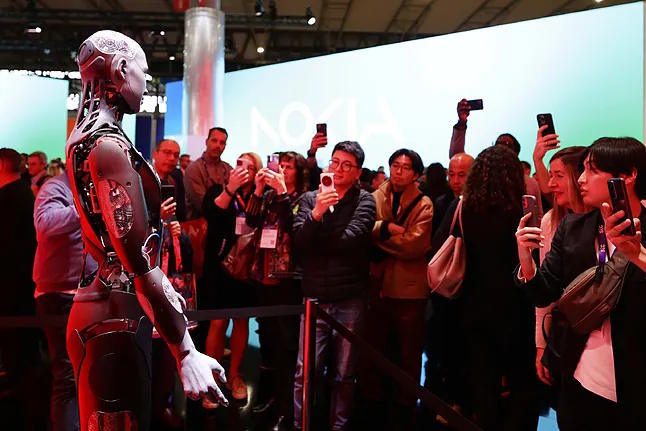
Barcelona faces an atypical Mobile World Congress in everything except for the continued growth that the fair continues to show, reclaiming space at Fira Montjuic to expand even further. It will be a Mobile of many firsts. It is the first congress under the Trump 2.0 Administration and amidst the dawn of a trade war. The first event of the new European Commission that criticizes policies from across the Atlantic and has promised to address many of the obstacles complained about by the European telecommunications sector.
Simultaneously, on a national level, it is also the first time since 2010 that the event is held with a President of the Generalitat from a non-sovereignist party. Salvador Illa will debut as president at the event after promising an ambitious investment plan and anticipates a reception with the King for the traditional pre-Congress dinner marked by institutional normality and the absence of snubs, something that has occurred with the presidents of ERC and Junts. Also making his first appearance as Minister of Digital Transformation, Óscar López, faces the challenging task of matching the impact that José Luis Escrivá had with the presentation of Sepi Digital and his statements about potentially participating in the 'Telefónica Operation'. As a result of this operation, Marc Murtra will also attend the event as the President of Telefónica.
The executive will participate in the forum, playing the traditional role of host in the opening discussion and in a panel where he will meet with the CEOs of the other three major European operators: Christel Heydemann of Orange, Margherita Della Valle of Vodafone, and Tim Hötges of Deutsche Telekom, the only thriving European 'teleco' due to its exposure to the United States.
Before that, there will be another clash, if not prevented. The U.S. Federal Communications Commissioner, Brendan Carr, will engage in dialogue with the European Commissioner for Technological Sovereignty, Security, and Democracy, Henna Virkkunen, and the Indian Minister of Communications, Jyotiraditya Scindia, on regulation and innovation.
Anything short of a head-on confrontation will be a surprise. At the event, although currently only with a closed-door agenda, Teresa Ribera, the Competition Commissioner, will also be present.
"The European Commission has shown full awareness of Europe's risks in the technological field vis-à-vis the U.S. and China, as reflected in the Draghi Report. Following this diagnosis, it is showing a strong willingness to regain our comparative lag in innovation and competitiveness, as evidenced by the Competitiveness Compass," points out the Public Sector Partner at EY Spain, Chus Escobar.
However, this European awakening is not as concerning to the United States as the regulatory model that, according to the Donald Trump administration, hinders the tech giants of their country and could be subject to retaliation in case of sanctions.
Sanctions that could begin on the brink of a March where the department now led by Ribera, who has already announced that they will not yield to U.S. threats, is expected to announce significant sanctions against some of these giants and conclude investigations of crucial cases such as the "pay or receive ads" model that Meta originally implemented on its social networks and has been accused of violating the Digital Markets Act.
Space, another area where Europe is also seeking to regain ground, will be another highlight of the three-day event, which seems to be trying to avoid the trending term: tariffs, a threat that, in the case of the European tech sector, does not seem so severe, opines José María Remacha, partner at EY Lawyers.
"All sectors are exposed to tariff threats. However, without disregarding the impact of tariffs, we must focus much attention on Europe's real structural challenge, the technological challenge (some call it a 'war'), as this has longer-term and structural economic and geopolitical consequences," points out the professional services firm partner.
In this sense, the congress will be a good showcase in Spain for Mistral, the great hope for artificial intelligence in Europe, whose CEO will also be another major point of interest for attendees, expected to exceed 101,000, with over 2,700 companies exhibiting.
Amidst the rise of this global tension, a fight that is not expected to take center stage is the traditional demand from telecommunications operators for tech giants to pay for the extra consumption they inject into their networks.
In this aspect, with tech giants committing to annual investments of over $300 billion this year for digital infrastructures related to artificial intelligence, operators seem focused on using this technology to improve their operations and generate annual savings and services.
Two years after the major technological announcement in the sector in the last two decades, telcos are under pressure to demonstrate that Open Gateway, the initiative to monetize their networks, is becoming a reality. Telefónica, Vodafone, and Masorange will present a joint case offering more security to victims with restraining orders.
In the case of the company led by Murtra, they will also showcase an alliance with Microsoft to give new life in the cloud to Kernel, the fourth platform and one of the major projects in the digital area.